Upgrade with Ima
Move an older RPG world onto per-character sheets with the Upgrade with Ima button or the /rpg-upgrade command, with what Ima asks, what it changes and what to check afterwards.
Beta
The RPG system is in beta and only accounts with the RPG beta can set it up. It may still change.
An RPG world created before November 18, 2026 keeps the player's stats as world trackers, and nothing tells the game which row is health, level or money. Upgrade with Ima is a guided Ask Ima job that moves such a world onto per-character sheets with roles, then offers the newer RPG pieces that fit.
It is a conversation, not a conversion switch. Ima proposes, asks before each group of changes, and builds only what you accept.
Where to find it
The button
Open RPG game system → Character sheet. In the box with the switch Per-character sheets, on a world that qualifies, an Upgrade with Ima button appears below the switch, beside the line This world was made before characters had their own sheets.
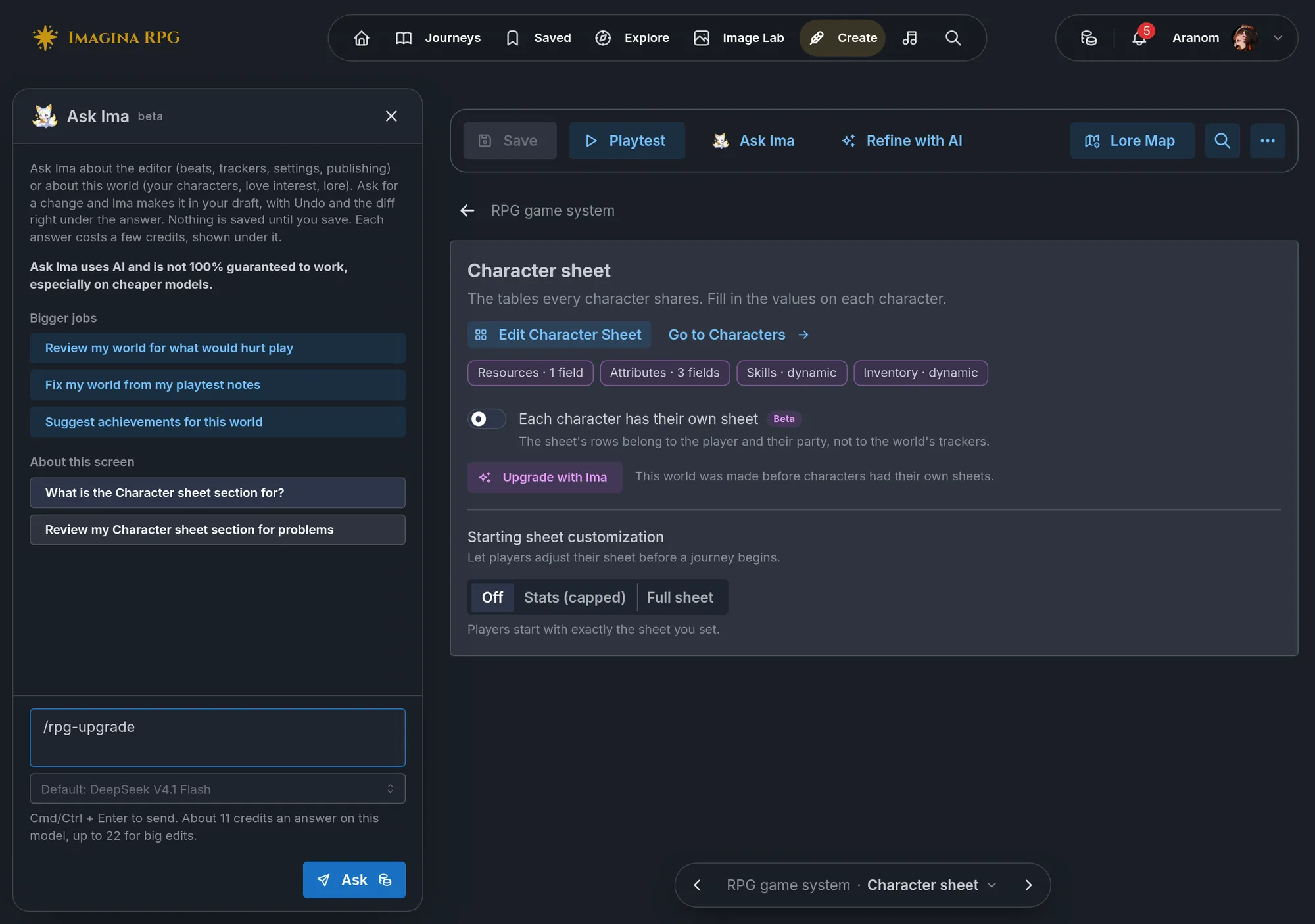
Pressing the button sends nothing and costs nothing. It opens Ask Ima with /rpg-upgrade already in the composer. Read it, add any direction after it, then send.
The button is offered when all of these are true:
- Your account has the RPG beta. Without it, the section shows neither the switch nor the button.
- The world's game system is on.
- Per-character sheets is off.
- The world was created before November 18, 2026. The date that counts is the world's own, not the date of the version you have open, and the cutoff is midnight UTC.
A world whose game system is first turned on by an author with the beta starts on its own sheets, so it never needs the upgrade. A world created on or after that date is never offered the button. A read-only shared view of a version never shows it either.
Once the switch is on, whether Ima turned it on or you did, the button and its line are gone and Alternate sheets shows instead.
The command
You can also type the command yourself, at any time and in any world. Type / in the Ask Ima composer to open the command menu. /rpg-upgrade is the last entry. Its hint is optional: pieces to add or leave alone and its summary reads Give each character their own sheet, set roles and add the new RPG pieces. Arrow keys move through the menu, and Enter or Tab puts the command in the composer without sending it.
The menu lists the command only for accounts with the RPG beta. Without the beta, typing it sends plain text. Ask Ima's empty chat has no starter for this job: the only button is the one on the Character sheet page.
What Ima does depends on the world:
- Game system off. Ima says the upgrade needs it on first, and stops.
- Already on its own sheets. Ima says so and goes straight to the newer pieces.
Giving direction
Whatever you write after the command is your direction, and it wins over Ima's usual plan. Use it to name pieces to add or leave alone, for example /rpg-upgrade sheets and roles only, no shops.
How the upgrade goes
The job runs over up to three answers, and fewer when there is nothing to build. Between them, Ima's questions arrive as a card under its answer: up to three questions, each with two to four options plus room for an answer of your own. Next moves to the following question, and Send answers (Send answer when there is only one) sends them. A typed reply in the composer works as the answer too. A card that has been sent can no longer be changed.
First answer: the core, proposed
Ima reads the world: the game system settings, your notes, the trackers, player characters, NPCs, items, shops, abilities, locations and the rules in your text. It then proposes four things, and a fifth when the world builds its levels by hand, and writes nothing yet.
- Roles. One line for each role the world uses (health, energy, level, experience, stat points, skill points, and money when the world has a currency, a money tracker or shops), saying which of your rows fills it, Built-in or None, and why. Ima binds a row only when it already means that thing. It adds a pool or a currency only when your rules already use that number, since a new one would be a new mechanic. Otherwise the role stays None. With Level set to Built-in, a player character who has no level starts at level 1. A stat you keep as a world tracker gets a sheet row of the same name. Ima's line says so in both cases.
- Per-character sheets. One or two sentences on what changes for journeys in progress. See Journeys in progress.
- Alternate sheets. Only when your characters clearly split by resources: one casts from Mana, another fights on Stamina, a beast has no Mana. Ima names each variant, what it adds or changes, and which characters use it. Most worlds need none, and Ima says that in one line.
- Party. Whether your player recruits and travels with companions, which puts the party system on, and the NPCs who travel and fight beside the player from the opening, or nobody when the player starts alone. Never an enemy template or a locked NPC. See Party.
- Tracks. Only when beats of your own raise a level by hand (a repeatable beat that adds 1 to a Level tracker and takes an amount off an Experience tracker). Ima proposes progression tracks instead, one for each such ladder, with the amount each level costs, what it adds and what earns it. It says the game then levels each character by itself, guests and companions included, and that it will remove those beats' level, Experience and grant effects so nothing is paid twice.
Then comes one question card, with Ima's proposal first in each list:
- Roles: as proposed, Standard RPG (Built-in for every role that has one), or leave the roles alone.
- Per-character sheets: on, with the variants if any, or not now.
- Party: the party system with the starting party, the party system with nobody at the start, or no party system.
- Tracks: the tracks as proposed, or keep the hand-built levels.
A question with nothing to decide is left out.
Take an older fantasy world in the shape of The Tollroad Wardens: Health, Mana and Gold kept as world trackers, Mara Vey as the player, and Brannoc beside her from the opening. The proposal could read like this (the wording is Ima's own each time, and a line for a stat kept as a tracker also says it gets a sheet row of the same name):
- Health: your Health tracker, the bar that empties in a fight.
- Energy: Mana, the pool Mara Vey's spells draw on.
- Level: Built-in. Mara Vey has no level, so she starts at level 1.
- Money: Gold.
- Alternate sheets: Mage for Mara Vey, with Mana, and Knight for Brannoc, who has no Mana.
- Starting party: Brannoc.
On a published version
New journeys get the change as soon as you save a published version. Ima points this out and adds a start a new version first option to its sheets question. Pick it, make one with New Version in the version switcher, and playtest before publishing.
Second answer: the core, built, and the newer pieces, proposed
Ima writes exactly what you accepted. If your answer changed something, your answer wins over the proposal. This covers the Per-character sheets switch, the roles, the currency, built-in trackers (a Gold purse, for example), sheet variants, the sheet rows a role needs, which sheet each character uses, the Party system card, progression tracks, and Starts in the party on the party members.
Rows are only added to a table you already have. Ima reads the editor's confirmation of every change. A change the editor refuses is fixed and sent again, or reported to you.
It then proposes the newer pieces that fit, one line each in your world's own terms, and asks which ones you want. You can pick several. A question holds at most four options, so a fifth piece comes as a second question.
- Shops and trainers, when the world has merchants, money or teachers.
- Abilities, when its characters cast spells or use techniques. This piece needs Energy bound.
- Location encounters, when it has places of different danger and levels.
- Bars on stage, when fights are frequent and NPCs carry bars.
- Enemies, when it fights recurring kinds of foe (wolves, bandits, slimes). Foes that come in packs or with a leader can get encounter groups.
- Quests, when the world already has quest material: a table or sheet list named like Quests or Bounty board, rules text about quests, a play button for a quest board, or a mission hub place. The game then keeps a journal, offers quests on a card, checks steps and pays rewards once.
- Fights, when fights are frequent and the player and foes carry a Health bar. The game then settles each blow and pays Experience.
- Statuses, when the world's rules, sheet, abilities or items name conditions that have an effect in numbers. Ima converts them from the world's own numbers.
- Knockouts and boss phases, when the world has lives, respawns or bosses that change as they weaken.
- Defeat scenes and respawns, when losing a fight leads somewhere: a scene with the winner, waking at a shrine, a cell.
A piece the world already uses is left out. If nothing fits, Ima says so and finishes here.
For the older Tollroad Wardens, that could be five offers: shops and trainers for Odile's Remedies and Kell's Training Yard, abilities for Ember Lance, Flame Ward and Mending Touch, encounters for the Tollroad, enemies for the Bandit and the Boar, and fights.
Third answer: a first setup of each piece you picked
Each piece gets a first, minimal setup, built from what your world already says.
- Shops and trainers. A shop for each keeper or stall the world already has, two at most. Offers are your existing items, priced in your money. With no items yet, Ima adds at most three that your own text already sells. A trainer offer appears only where the world has a teacher: an upgrade such as +10 to a bar, or a rank of an ability. Money has to be bound first. See Shops and Trainers.
- Abilities. Two to four, only ones your world already names. Each is named exactly like its skill row so the two link, costs Energy, and has a cooldown when it is a strong one. Ima binds Energy first if it is not bound yet. See Abilities.
- Location encounters. Two to five of the places your world already calls dangerous, with level ranges taken from the levels your characters start at and reach, and inhabitants taken from what your world says lives there. A safe place inside a dangerous one gets no encounters. See Encounters.
- Bars on stage. Ima only turns the piece on.
- Enemies. One or two templates for the foes your world names most, each with a stat block that carries its bars, Health first. See Enemies.
- Quests. Ima turns the piece on and, when your own rules state a reward formula, sets the reward bands from it. It then turns the quest material that defines quests (a name, a giver, a place, an objective, a reward) into at most eight quests. Your table, instruction block, sheet list and play button stay as they are, and you can remove them once you are happy with the quests. See Quests.
- Fights. Ima turns the piece on, with the Health role bound and Experience bound for rewards. Foes your world calls stronger or weaker than ordinary get a strength tier: a captain is strong, a dragon is a boss. See Fights.
- Knockouts and boss phases. With Fights on, Ima sets When the player's Health is empty to A beat decides and adds one repeatable beat for the player's fall. It adds a boss phase beat only for a boss your world says changes as it weakens.
- Defeat scenes and respawns. A defeat scene on the enemies and characters your world says win in a particular way, a beat for the lost fight, a follow-up beat one turn later that refills Health and goes to the respawn point, and a beat that remembers the respawn point where the world has shrines or safe places. See Defeat and respawn.
The closing summary
Ima ends with a short list of what changed, by editor label: Linked fields (with its Levels block when tracks were built), the Per-character sheets switch, Alternate sheets, the Sheet variant pick on characters, Starts in the party, each piece by its section, and any rule text it trimmed. It adds two to four things to playtest, and a reminder that nothing is saved until you save.
What Ima leaves alone
The upgrade moves the world. It does not rewrite it. Ima keeps every table, row, tracker, value and name you made, and is told not to do any of the following:
- Rename, remove or reorder a sheet table.
- Turn a piece off, or turn on one you did not accept.
- Shorten or drop text to make a change fit a limit.
- Bind a role to a row that does not already mean it, or invent a pool or a currency your world does not use.
- Put an enemy template or a locked NPC in the starting party.
- Publish the world.
Your prose stays as it is, with one exception. A rule that tells the storyteller to do by hand what a new piece now does (charge mana for a spell, work out level-up points, list the party) is removed or rewritten, and Ima tells you which.
Reviewing, undoing and saving
Every answer that applied changes carries a card counting them, such as "Applied 12 changes to your draft", with the list of changes and the line "Nothing is saved yet. Save your world to keep them."
- Review diff shows what changed.
- Undo takes back Ima's changes from that answer and keeps your later edits, unless they touch the same part. The card then reads "Changes undone." If an undo cannot run, a line explains why.
The upgrade spans several answers, so each building answer has its own card and its own Undo. The first answer only proposes, so it has no card.
Each answer in the job is charged like any Ask Ima answer, and the amount is shown under it. Sending a question card triggers the next answer, which is charged too. The model you pick affects the cost.
Journeys in progress
A journey keeps its own copy of the world from the day it started, so saving the upgrade does not change journeys already under way. A journey moves to the new model when its player updates it to the new version. For your own test journey, pick the version in the Builder tab of the journey's debug view, press Apply version, then confirm with Reload journey.
When a journey moves over:
- Every value is kept.
- The player's rows move from the trackers window to their sheet.
- Party members get real numbers where their stat block has them.
Turning Per-character sheets off again puts everything back.
New journeys on a published version take the change as soon as you save that version. From then on, players get the same screens as in any world built on sheets.
Who decides what
Ima is an AI doing an editing job. It judges which of your rows is Health, which is Energy and which is money, and no fixed rule makes that call for it. Your confirmation on each card is the safeguard, so read the roles line by line before you accept them.
Everything Ima writes goes through the same limits as your own edits. A change over a limit is refused, never trimmed.
After the upgrade, the game works out what the roles drive (costs, points, prices, level ranges and fights), not the storyteller. The RPG system overview covers each piece.
What to check afterwards
- Save, on a new version if the world is published.
- Start a new journey and open the sheet.
- Update an older journey to the new version, or reload your test journey from the Builder tab, and compare its numbers with what they were.
- Play a fight that should spend Energy or empty a bar.
- Visit a shop, if you added any.
- Reread any rule text Ima said it trimmed.
Common mistakes
- Expecting the button to convert the world. It only opens Ask Ima with the command in the composer. Nothing happens until you send it and answer the cards.
- Accepting the roles without reading them. Ima judges which row means what, and your answer is the check. An answer with changes wins over the proposal.
- Upgrading a published version in place. Saving puts the change live for new journeys at once. Start a new version first and playtest there.
- Turning the switch on by hand, then looking for the button. The button goes away as soon as Per-character sheets is on. Type
/rpg-upgradeinstead: Ima skips to the newer pieces. - Closing the editor without saving. Ima edits your draft. Nothing is kept until you save.
- Checking only a new journey. Older journeys change when they move to the new version. Update one and check its numbers too.
- Expecting finished shops and fights. Each piece you pick gets a first, minimal setup from what your world already says.
Frequently asked questions
Playing together
Learn how the RPG system behaves when several people play one journey of your Imagina world, covering whose account counts, each guest's sheet, Experience and points, abilities, money in shops and trainers, enemy levels, fights, statuses and the party screen.
Presentation and media
Learn how to add cover images, social sharing cards, turn illustrations, character sprites, text effects, texting threads, emails and letters, and immersive and visual novel modes to your Imagina world. Covers the built-in generators and Art Studio.