Location encounters
Learn how to set the encounters of each location in your Imagina world, with Safe and Dangerous places, enemy levels, the enemies that can appear, how often something attacks, how places within places share those settings, and what players see on the map and the scene card.
Beta
The RPG system is in beta and only accounts with the RPG beta can set it up. It may still change.
Each location can say how dangerous it is: the usual level of the enemies there, who or what lives there, and how often something attacks, or that nothing attacks at all. The storyteller pitches its fights to that and warns the player about places far above their level. Players see the level range on the map and on the scene card, in red when it is well above them.
Turning it on
Three switches have to be on:
- Enable the RPG game system, at the top of the Features page of the RPG game system group. See the RPG system overview.
- Enable location awareness, in the Locations section. It is on by default. With it off, the Encounters box is still shown, greyed out, and nothing on this page happens in play.
- The Location encounters card, in step 3 of the same Features page. A new world starts with it off, and Classic RPG and Monster fights turn it on. It stays silent until a location has encounters set. With Locations off, the card shows the chip "Turn on Locations", which opens Locations.
Turning the Location encounters card off deletes nothing. The settings stay on your locations, the storyteller stops hearing about them and players stop seeing them. Turning off the RPG game system hides the box and keeps the settings too.
The beta is read from the account of the world's owner, for editing and for play. Players need nothing on their side.
Setting the encounters of a place
Open a location in the Locations section and find the box titled Encounters. It starts with a three-way control:
- Not set stores nothing. A new location starts here. On a place that sits within another, this choice reads Same as followed by a place name instead: see Places within places.
- Safe means nothing attacks here.
- Dangerous means threats live here. Five fields appear, all optional, and filling any one of them is enough.
The five fields of a Dangerous place:
- Lowest enemy level and Highest enemy level: whole numbers from 0 to 9999. You can fill only one of them. If the highest is under the lowest, the field shows Lower than the lowest enemy level.
- Enemies that can appear here: names, typed one at a time (Type a name, then Enter, and a comma also ends a name). Up to 20 names of 120 characters each. They are free text, so a name can be anything that lives there.
- How often something attacks: Rarely, Sometimes or Often. Left on Not set, the storyteller gets no hint. There is no "never" in the list, because that is what Safe is for.
In the demo world, The Tollroad is Dangerous, with enemy levels 3 to 7, Bandit and Boar as the enemies that can appear, and attacks set to Often. Kettleford, the town, is Safe.
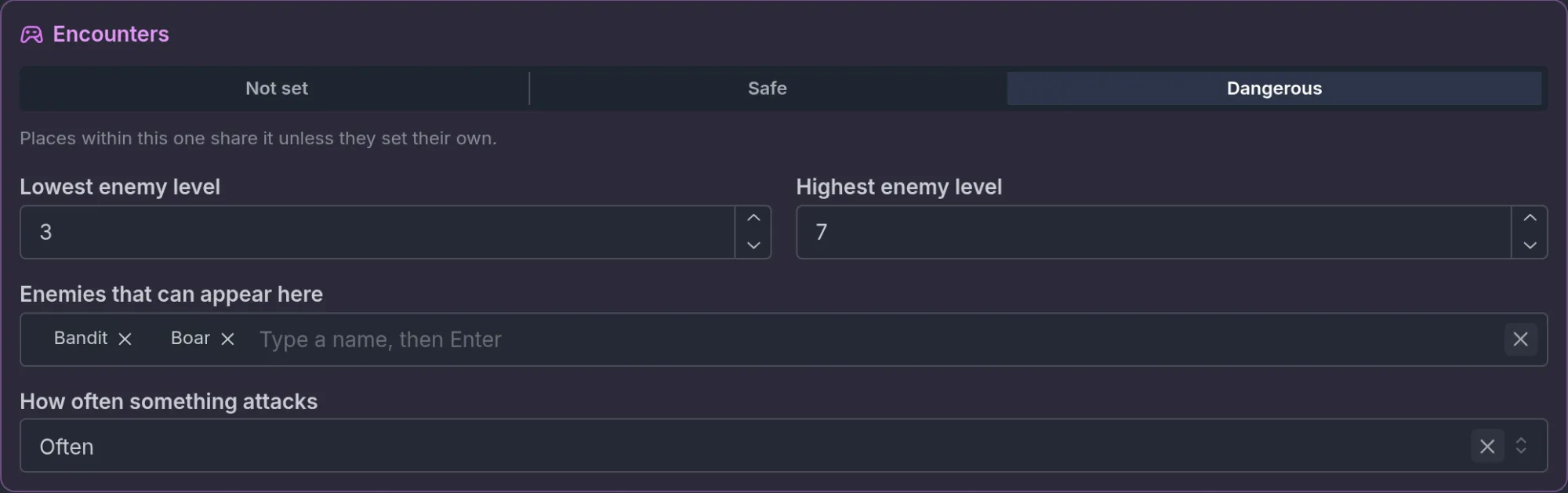
Under the control of a top-level place set to Safe or Dangerous, a line reads "Places within this one share it unless they set their own."
Back in the Locations list, each row carries a small chip with the place's own level range, or Safe. It shows what is set on that place, never what the place gets from the one it sits within.
Switching between the three choices
- Dangerous with nothing typed stores nothing. The control stays on Dangerous while the location is open. After you close and reopen it, it reads Not set or Same as again.
- Safe replaces what was there. Moving a place from Dangerous to Safe removes its levels, enemies and attack frequency from the world. They come back if you pick Dangerous again before closing the location. After that they are gone.
- The first choice removes everything, with the same grace period while the location stays open.
A Safe place can still hold levels or enemies when something other than this control wrote them, such as an AI helper. A line then reads "Also stores" followed by what it holds, for example "Also stores Lv 2 to 4, Wolf." They stay as written until you pick Dangerous, which keeps them.
Places within places
A place with Within (optional) set sits inside another place. With nothing of its own, it uses the encounters of the place it is within, then of the place above that one, and so on up. Places nest up to six deep, a top-level place plus five levels inside it, and the settings pass all the way down.
Hask's Camp is within The Tollroad. Left alone, its first choice reads Same as The Tollroad, with the line "Same encounters as The Tollroad: Lv 3 to 7." underneath. When no place above has anything set, the line says that nothing is set for the place it is within either.
Three rules matter here:
- A place takes everything or nothing. Settings are never mixed field by field. A nested place that sets only How often something attacks has its own encounters now, without levels, and no longer gets the level range of the place above it.
- Safe is a setting of its own. Picking Safe on a place inside a dangerous one makes it a refuge, whatever surrounds it.
- The name in "Same as" is the place that holds the settings, the nearest one up the chain. It is not always the place the location is directly within.
Places found during play follow the same logic. A place the journey has recorded uses the place it was recorded within. A place the storyteller makes up on the spot is matched by its name: "Kettleford market" counts as inside Kettleford, "Road to Kettleford" does not. A name that matches nothing has no encounters.
What players see
Players see the level range, Safe, and whether the range is well above them. They never see the enemy names or how often something attacks.
The range reads "Lv 3 to 7", "Lv 4" when both levels are the same, "Lv 3+" with only a lowest level, and "Up to Lv 6" with only a highest. A place shows Safe only when it is Safe and holds no levels. A Dangerous place without levels (enemies only, or only a frequency) shows nothing at all: it only changes what the storyteller is told.
On the map
Each pin carries the range under its label, and the pin and its range turn red when the place is well above the player. On the desktop, picking a place that has a Codex page opens its panel with the range above that page and, when it applies, Well above your level in red. Maps with five pins or fewer also list their places under the map, each with its range.
Pins exist only for places the player knows, so a place not yet discovered gives nothing away.
On the scene card
The range also appears on the card that announces a new place in the story, after the place's name. This needs Scene transition cards turned on in the Locations section, which is off by default, and players can hide the cards on their own device. Without cards, the reading view shows no range. The map still does.

The card carries the range only when the scene enters different encounters, not on every card. Riding from Kettleford onto The Tollroad shows "Lv 3 to 7". Walking on to the Wayside Shrine shows nothing new, since the shrine shares the road's settings. Returning to Kettleford shows Safe.
In visual novel mode
There are no scene cards there, so the range or Safe sits with the place name on screen, on every turn spent in a place that has one. It turns red when the place is well above the player.
What counts as well above
A place is well above the player when its lowest enemy level is 3 or more above the player's level. A place at levels 8 to 12 is red for a level 5 character and not for a level 6 one. A range with only a highest level is never red, since "Up to Lv 6" starts at the bottom.
The comparison needs a number for the player's level:
- Levels and identity has to be on.
- The Level row of the Linked fields card must not be set to None.
- The level itself has to hold a number. "Lv. 12" reads as 12, "Level 3" as 3 and "Rank II" as 2. "S-rank" or "Novice" gives no level.
- If the Level row of Linked fields is set to A row of the sheet, that row's number is the level instead.
Without a level, nothing turns red and the storyteller gets no comparison. The ranges still show. See Levels and points.
Each player is compared with their own character, guests included. See Playing together.
What the storyteller decides and what the game settles
Nothing here blocks an action or forces an attack. The only roll is which encounter group comes, and how many of each enemy, once the storyteller has decided that an encounter happens. How often something attacks is a hint to the storyteller, and it alone decides when a threat shows up.
What the storyteller is told:
- At the current place: the level range, the enemies that can appear, how often something attacks, or that the place is safe. With a range, it is asked to keep the foes met there inside it unless the story gives a reason. On The Tollroad it knows that threats are usually level 3 to 7, that Bandit and Boar are found there, and that attacks are frequent.
- How the player compares: when the place's lowest level is 3 or more above the player's, the storyteller is told the player is outclassed, and to make the threat plain and let them choose to fight, hide or leave. When the place's highest level is 3 or more under the player's, it is told most of what lives there is no match. A level 10 Mara gets that second note on The Tollroad. With several players, the strongest player character is the measure. Companions such as Brannoc do not count.
- Before the player arrives: the storyteller knows the range of every place the player knows that has a range of its own, and is asked to let the story feel the danger on the way. When the player's action names a known place that has a level range, inherited or not, it is also told how that place compares with the player.
Enemy names and your Enemies list
A name in Enemies that can appear here that matches an enemy from your Enemies list is pointed out to the storyteller as a real enemy it can bring in. Capitals and accents do not matter, and a final "s" is forgiven, so "Boars" matches Boar. Enemies have to be on for the world, and that enemy needs The storyteller knows about it turned on. A name that matches nothing stays a hint for the prose.
The level enemies arrive at
This part the game settles by itself. When the storyteller brings an enemy into a place that has a level range, each copy takes the player's level, held inside both the place's range and the enemy's own range. With several players, the strongest one counts. Enemies a story beat brings in arrive at the same level.
The Bandit has its level written as "5-9" and The Tollroad runs from 3 to 7, so a Bandit there lands between 5 and 7. If Mara is level 4, Bandits the storyteller brings in on The Tollroad arrive at level 5. If she is level 6, they arrive at level 6.
- The enemy must leave its level open. Leave the Level field of its sheet empty, or write a bare range such as "5-9" or "5 to 9". A fixed level such as "4" or "Lv. 4" is kept as it is. So is "Lv. 5-9", which is read as a fixed level because of its prefix.
- The place needs a level. One of the two is enough. Without one, the enemy keeps its own level.
- Ranges that do not overlap. The enemy's own range decides.
- No level for the player. The copy takes the lowest level the place and the enemy's own range both allow.
- The world needs levels and NPC sheets. Levels and identity and NPC sheets have to be on, and the enemy needs a stat block, since the level is written on the copy's sheet.
Enemies the storyteller brings in during the turn the scene moves take the level of the place the scene arrives in. That level is then what a fight uses.
Limits
- Enemy levels are whole numbers from 0 to 9999.
- A place lists up to 20 enemy names, each up to 120 characters.
- A place picks up to 12 encounter groups.
- A value over a limit is refused, never trimmed.
Common mistakes
- Only a frequency on a nested place. The place stops sharing the level range of the place above it and shows no range. Give it levels of its own, or leave it on Same as.
- Dangerous with nothing typed. Nothing is stored, and the place goes back to Not set or Same as once the location is closed.
- Trying Safe on a finished place. Its levels and enemies are removed, and they are only kept until you close the location.
- A place with no levels. Enemies or a frequency alone show no chip to players. Only the storyteller knows.
- A level with no number. "S-rank" cannot be compared, so no place ever turns red.
- "Lv. 5-9" on an enemy. It is read as a fixed level. Write "5-9" so the place can set it.
- An enemy name that almost matches. "Road bandit" is not Bandit. Use the name from your Enemies list when you want the storyteller to bring in the real one.
- Scene transition cards left off. The reading view then shows no range at all.
- Location awareness off. The Encounters box stays in the editor, greyed out, and does nothing in play.
Frequently asked questions
Abilities
Learn how to give your Imagina world spells and techniques with ranks, costs paid from each character's Energy, cooldowns and learning requirements, and what players see in the spellbook.
Enemies
Learn how to author stock enemies for your Imagina world, from templates and the copies that enter a scene to levels, experience and loot, out rules, battle sprites, and bringing enemies in from a beat or by the storyteller.