Abilities
Learn how to give your Imagina world spells and techniques with ranks, costs paid from each character's Energy, cooldowns and learning requirements, and what players see in the spellbook.
Beta
The RPG system is in beta and only accounts with the RPG beta can set it up. It may still change.
Abilities are the spells and techniques of your world. Each one has up to five ranks, and each rank has a cost per use, an optional cooldown and a line of effect. When a character uses one, the game pays the cost and starts the cooldown, or refuses the attempt, and the storyteller narrates the result.
The list lives in the editor under RPG game system → Abilities. On a world without the RPG beta, or while the game system is off, it is the Abilities section under World & lore. A character knows an ability when their Skills list holds a skill with its name.
What abilities need
Four things must hold before an ability does anything in play:
- Enable the RPG game system is on, on the Features page of the RPG game system group.
- The Abilities card is on, in step 3 of the same page. A new world starts with it off: turn it on there, or take Living world, Classic RPG or Party adventure, which include it. Turning it off keeps everything you wrote.
- The character sheet has a Skills list. Learned abilities are rows of that list. See Character sheets.
- At least one ability has a name.
While the card is off, the Abilities entry is greyed with the tag Off, and its page opens with a dashed card reading "Abilities is off" with a Turn on button, above the list. Outside the group, the section says "Abilities are off for this world, so the storyteller and players do not see them." and offers Turn them on in RPG game system.
No Skills list, no abilities
The section stays editable on a world whose sheet has no Skills list. A yellow note says "Abilities need a Skills table on the character sheet. Without one, nobody can learn or use them." with a link to the sheet. Abilities are then off in play: nothing is shown and nothing is paid.
The Abilities section
The header shows a counter such as "7 of 80 abilities used" and the Add ability button. Each row gives the ability's name, a lock when it is secret, a badge when it is only for NSFW journeys, its group, then the first rank's cost, its cooldown, the number of ranks and "has requirements" when it has any. A cost in Energy reads "8 Energy" here, since the list does not know who pays.
Drag a row to reorder it. The order sets how abilities are listed inside a group in the spellbook. Groups themselves appear in the order of their first ability.
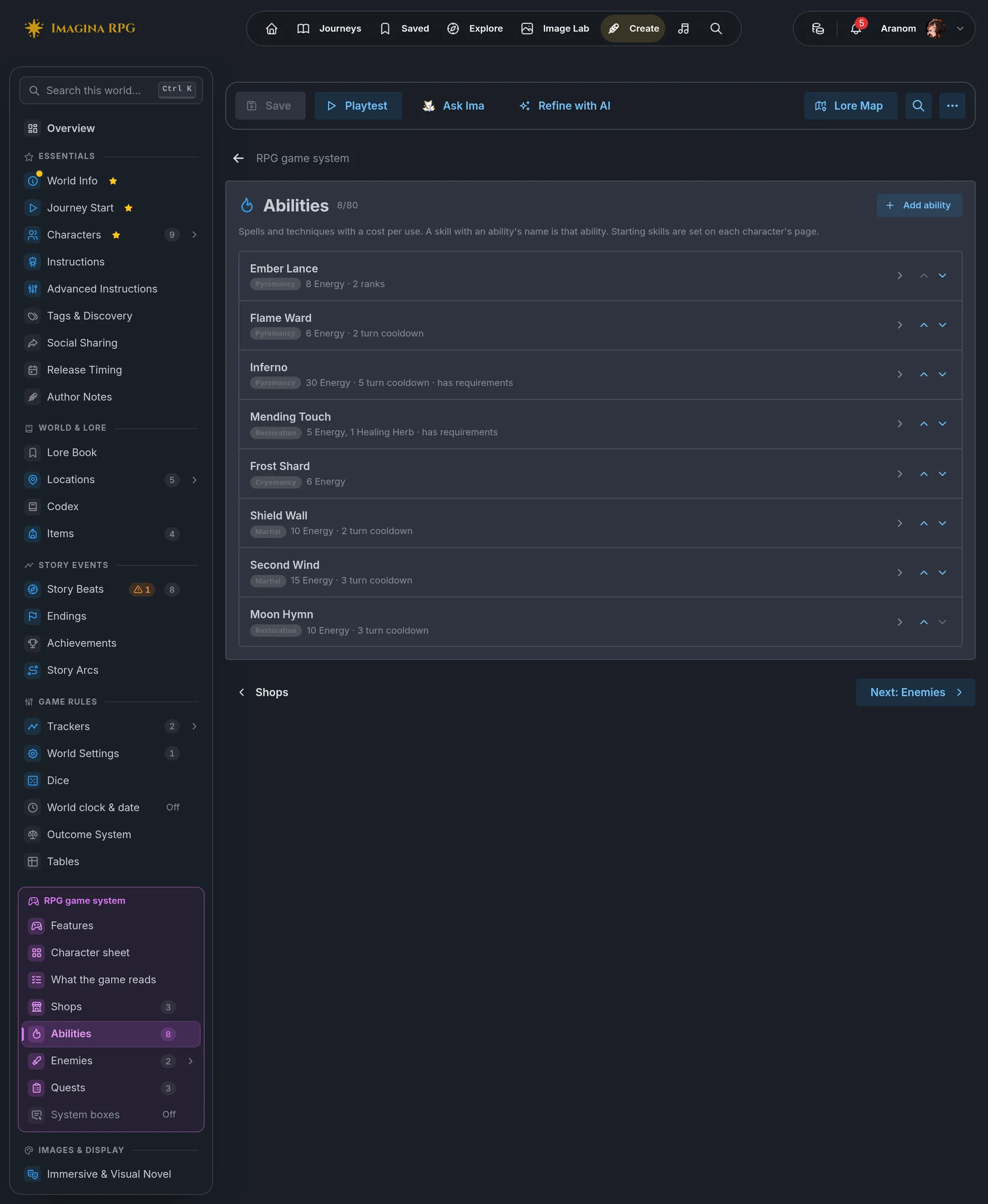
Clicking a row opens the ability, with Remove ability and Done at the bottom. A new ability left completely blank is discarded when you return to the list.
An ability
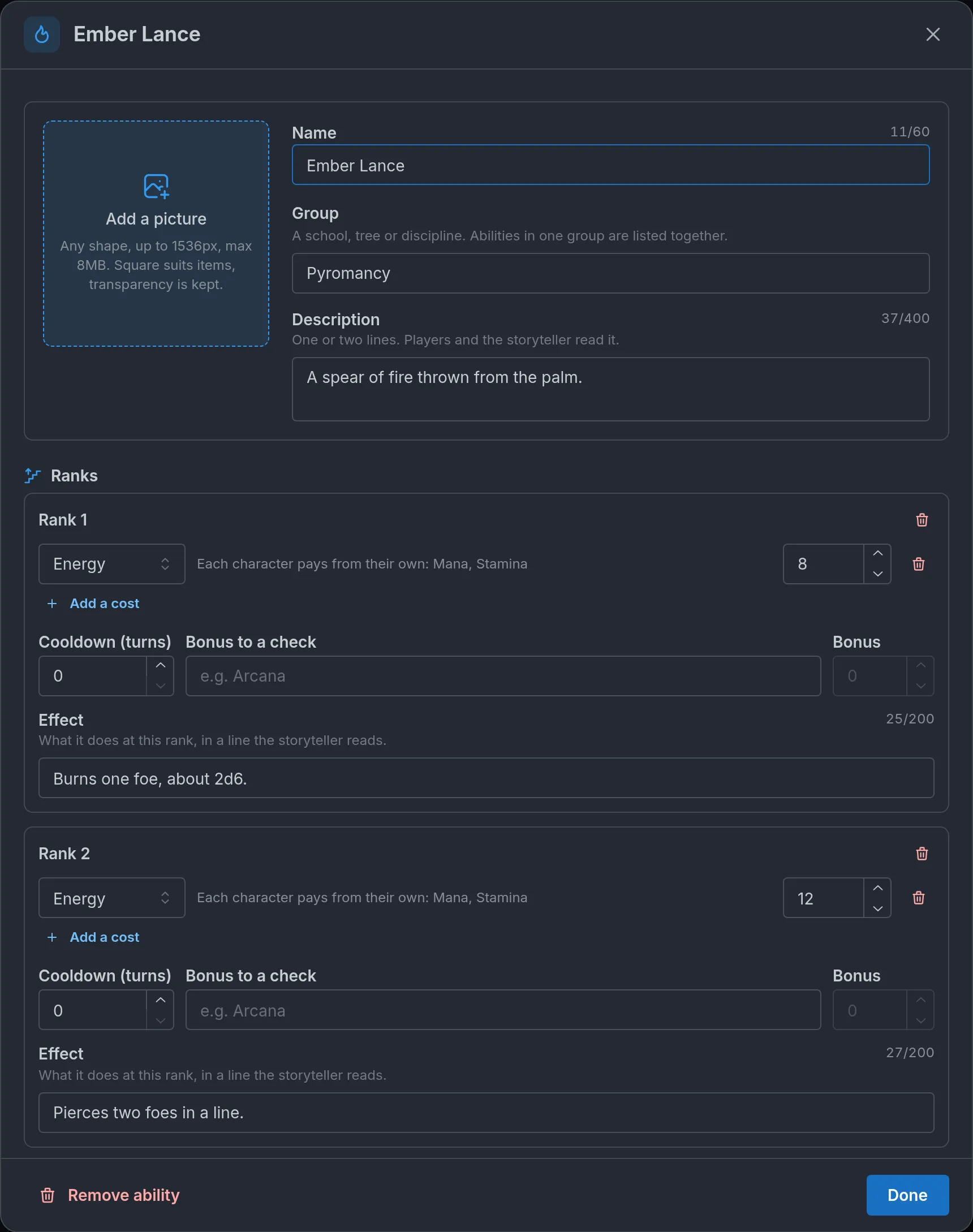
The top of the editor describes the ability as a whole:
- Add a picture: optional, with Replace and Remove afterwards. PNG, JPEG or WebP, up to 8 MB, fitted inside 1536px, transparency kept. Players see it in the spellbook and on a trainer's card.
- Name: required, up to 60 characters. Two abilities cannot share a name, whatever the case or accents: "Another ability already has this name."
- Group: a school, tree or discipline, up to 40 characters. It suggests the groups you already used. Abilities of one group are listed together in the spellbook, such as Ember Lance and Flame Ward under Pyromancy.
- Description: one or two lines, up to 400 characters. Players read it in the spellbook, and the storyteller reads it when a rank has no effect line.
You can rename an ability later. Skills already linked to it in a journey stay linked. A starting skill on a character is matched by name, so rename that row too.
Ranks
Under Ranks, an ability has one to five ranks, and rank 1 is the first. A rank does not repeat the name or the description. Add a rank adds a copy of the last rank, so edit the copy. Each rank holds:
- Costs: what one use takes. See Costs.
- Cooldown (turns): a whole number from 0 to 99, where 0 means none. A turn is one player action, not a stretch of time in the story. An ability with a cooldown of 3 used on turn 10 is ready again on turn 13.
- Bonus to a check and Bonus: the name of a check, such as Arcana, and a number from -10 to 10. The storyteller reads it as a note. It adds nothing to the dice. Setting Bonus to 0 removes the bonus. The check name stays in its field.
- Effect: what the ability does at this rank, in one line of up to 200 characters. The storyteller and the players both read it.
An Ember Lance with two ranks could cost 8 Energy at rank 1 with "Burns one foe, about 2d6." and 12 Energy at rank 2 with "Pierces two foes in a line."
Costs
A rank with no cost reads "Free to use." Add a cost adds one, up to three per rank. Each cost has a kind and an amount from 1 to 9999:
- Tracker: spends from a number you name, such as Mana. The field suggests the world's numeric trackers and the number and bar rows of your sheets. The name is taken literally, so a character whose sheet has no row with that name cannot pay. A scale or text tracker cannot be spent.
- Energy: spends from each character's own Energy bar. See the next section.
- Item: gives up that many copies of an item from your Items section, like a reagent.
- Charges: spends charges of a held item that has charges, like a wand.
Several costs combine, and all of them must be payable or the use is refused. Nothing is taken on a refusal. Mending Touch could cost 5 Energy and 1 Healing Herb: without a herb in the bag, the Energy stays where it is.
Changing a cost's kind resets it. A cost left half filled (a tracker with no name, an item cost with no item) is ignored in play. If it was the only cost, the ability is free.
Energy: one cost, each character's own bar
Energy lets one ability cost Mana for a mage and Stamina for a knight. You tell the game which bar is Energy on the Linked fields page, on the Energy row. That row is there when the Character stats card is on.
- On a world where Per-character sheets is on, pick A row of the sheet. Only bar rows are offered.
- On other worlds, pick A tracker and name one of the player's meter or gauge trackers.
- With None, the card says "Abilities have no shared cost."
A sheet variant can read Energy from another bar. Open the variant under Alternate sheets and set Energy in Linked fields on this sheet. Each character picks a variant with Sheet variant. In The Tollroad Wardens, the Mage variant reads Mana and the Knight variant reads Stamina, so an ability that costs 8 Energy takes 8 Mana from Mara Vey and 8 Stamina from Brannoc. The cost editor confirms it: "Each character pays from their own: Mana, Stamina".
Energy only appears among the cost kinds once a sheet reads Energy from a row. An Energy cost written before the row was unset reads "Pick a row for Energy in Linked fields." A character whose sheet has no Energy bar cannot pay an Energy cost at all, and the use is refused.
Requirements to learn
To learn it lists what a character needs before learning the ability. Empty, it reads "Anyone can learn it." Otherwise: "The storyteller can only teach it when all of these hold." Add a requirement adds one, up to four:
- Level: at least a given level, read from the level set in Linked fields (the main level). On a world with two or more progression tracks, a Level of picker beside it chooses which level it reads. See Levels and points.
- Tracker: a numeric tracker with At least a given value.
- Skill: a skill by name, with an optional Rank. The rank is the first number in that skill's Level text.
- Ability: another ability, with an optional Rank.
- Item: holding at least one copy of an item.
- Class or race: Class or Race, and the value to match on the character, such as Wizard.
An Inferno that asks for level 9 and Ember Lance at rank 2 stays out of reach until both hold. The game checks requirements when the storyteller teaches the ability and when a trainer sells it. It does not check them for starting skills, for raising the rank of an ability already known, or for party members.
Statuses an ability gives
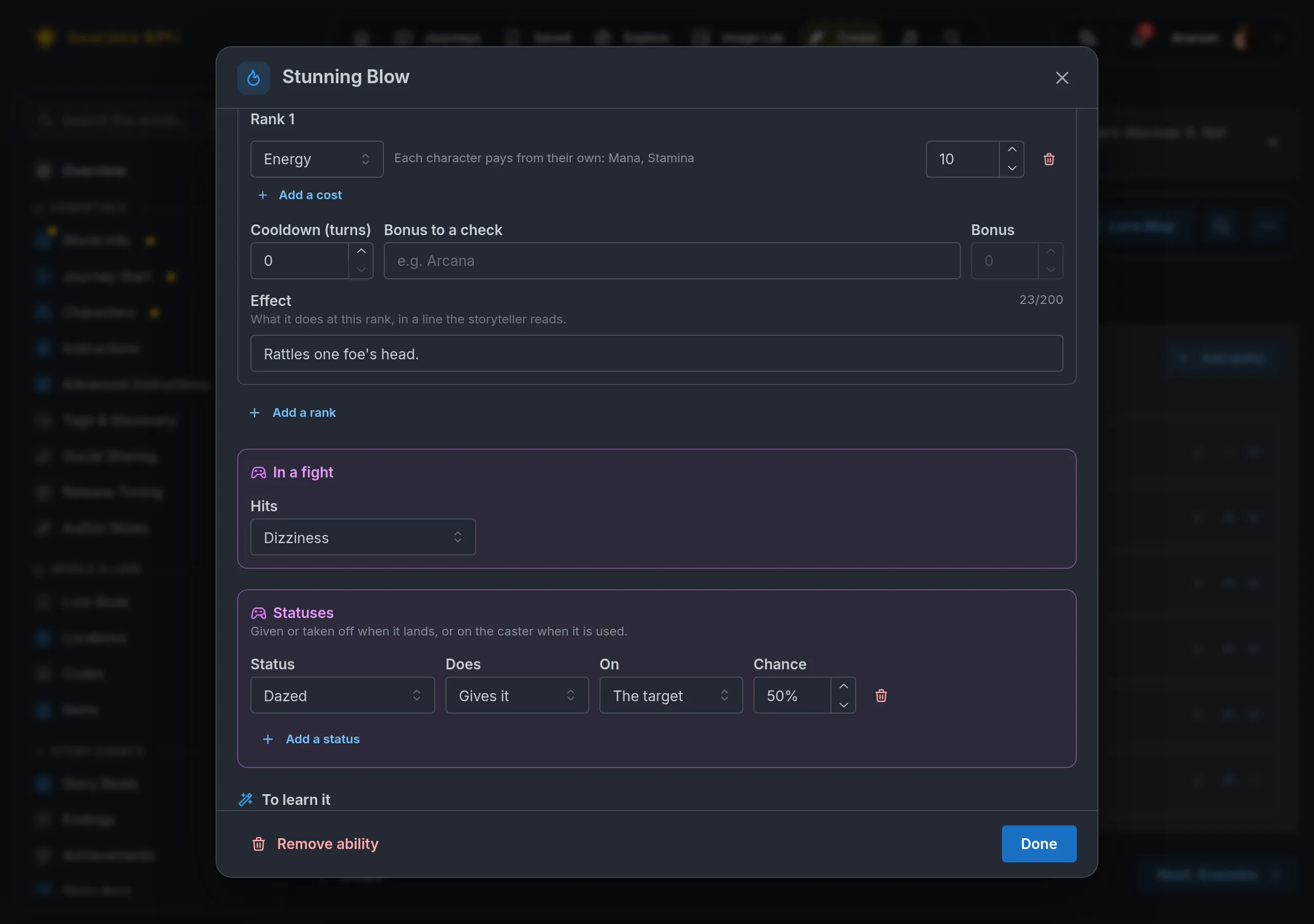
With Statuses on, an ability's window has a purple Statuses box: "Given or taken off when it lands, or on the caster when it is used." Add a status adds a row, up to three, each with a Status, what it Does, who it is On and a Chance. The game applies these itself.
Secret abilities and the storyteller's note
- Secret: hidden from the spellbook until learned. The storyteller knows the ability exists and is told never to name it before the player learns it. Once learned in a journey, it shows in the spellbook the next time the journey is loaded.
- Only if NSFW is on: the ability is left out of journeys with NSFW off.
- Only for the storyteller: a note of up to 400 characters, under the Storyteller heading. The storyteller reads it once the player knows the ability. Players never see it.
- Author notes: "Only you see these." Up to 1,000 characters, for your own reminders. Neither the storyteller nor the players read them.
Who knows an ability at the start
An ability has no "known at start" control. You give it to a character as an ordinary skill:
- The player character: add a row to their starting Skills table with the ability's name. Case and accents do not matter.
- An NPC or party member: on their page, under RPG game system and Sheet, add a row with the ability's name to the Skills table.
- An enemy: a skill on the template's stat block that names an ability is that ability. See Enemies.
The row's Level text sets the rank. The first number in it counts, so "Lv.2", "Rank 2" and "2" all start at rank 2. A word such as "Adept" or "Novice" is rank 1. A number above the ability's last rank is brought down to it.
How players use an ability
There is no cast button. The player writes the ability into their action, and the storyteller reports the attempt to the game. The interface only shows what the character knows and what it costs.
Skills on the sheet
On the character sheet, a skill that is an ability shows its cost in place of its Level text: "8 Mana", "5 Mana, 1 Healing Herb" or "Free". Energy appears under the character's own bar name, so Mara Vey reads "8 Mana" where Brannoc would read "8 Stamina". An ability with several ranks adds a chip such as "Rank 1/2". A cooldown shows as "2 turn cooldown", then "Ready in 2 turns" while it runs.
The entry is dimmed while the ability is on cooldown or the character cannot pay for it. In the second case its tooltip reads "Not enough to pay for it".
The spellbook
All abilities, under the skills, opens the spellbook in place. It lists every ability of the world by group, with the known ones first, then those the character can learn, then the locked ones. Abilities without a group sit under "Other" when the world also has named groups. A secret ability is absent until the character learns it.
Each entry shows the picture, the name and a standing: Known (with the rank when the ability has several, as in "Known, rank 2 of 2"), Can learn, or "Needs" followed by the missing requirements, such as "Needs Level 9". Below come the description and one line per rank with its cost, cooldown and effect. The current rank is highlighted.
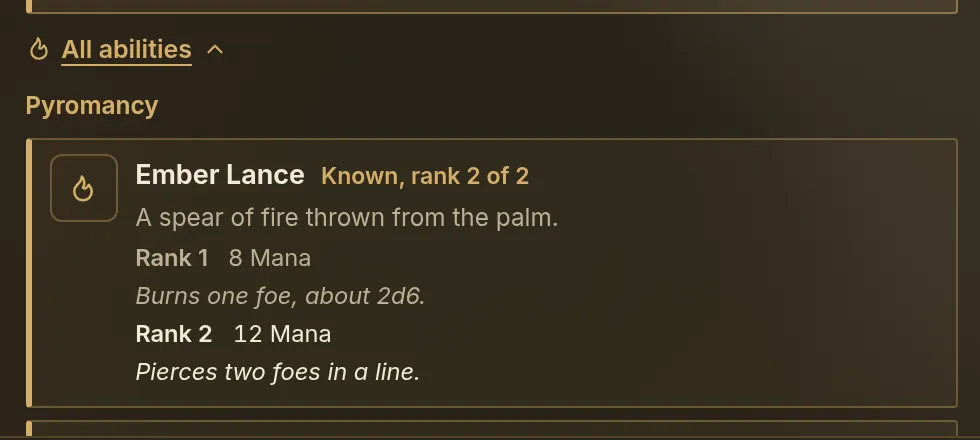
The spellbook is read-only. Nothing is bought or cast from it, and the check bonus and the storyteller's note never appear in it.
The @ menu
Typing @ in the action box lists the player's learned abilities under Abilities, each with its picture and cost, and "Ready in 2 turns" when it is cooling down. Picking one inserts its name into the action.
What the game settles and what the storyteller decides
The storyteller decides whether the player is trying an ability, how it looks, and what it does to the world. Effect and Description are prose: the game applies neither. Damage, healing and other changes happen because the storyteller records them as it does for any other event. The statuses in the ability's Statuses box are the exception: the game gives or takes them off.
The game settles the rest:
- Paying. Every cost is paid, or none is. A use is refused when the ability is not learned, is on cooldown, or cannot be paid. A character uses their learned rank, or a lower one when the story calls for it.
- Refusals. The player never sees a refusal message. The storyteller reads the reason and narrates the failed attempt.
- Cooldowns. They count down at the start of every turn.
- No double charge. If the storyteller takes the same amount from the same bar, or the same reagent, later in the turn, the game refuses that once.
- Undo, retry and regenerate. Energy, reagents and cooldowns all come back together.
The game only settles an attempt the storyteller reports. It is told to report every one, including those that look unaffordable. If it narrates a spell without doing so, nothing is paid.
Party members and enemies
A party member uses their own abilities when Per-character sheets is on and the member has a sheet of their own with the ability's name in its Skills. They pay from their own rows, with Energy read from their own variant, and they keep their own cooldowns. Item and charge costs come out of the player's inventory, since the party shares one bag. Each member's page on the party screen shows their skills and spellbook, priced in their own Energy.
An enemy pays from its own sheet only, never from the player's bag, and keeps its own cooldowns. In a fight, an opponent without a sheet of its own strikes plainly.
In a shared journey, a guest's character is such a member. Their sheet and spellbook are their own, priced in their own Energy, and on a guest's turn the storyteller casts for that guest's character unless it names someone else. Without Per-character sheets, the game settles no ability for a guest's character. A guest's @ menu has no Abilities category: the host character's skills are listed under their name as plain skills, their own under You. See Playing together.
Abilities in fights
With Fights on, an ability aimed at an opponent is a move of the fight. The game pays it first. If it cannot be paid or is not ready, or the caster carries a status that stops abilities, it fizzles: no cost, no blow, and the opponents still answer. The fight card marks it Fizzled.
A paid ability is rolled on the world's dice like any blow, with more weight than a plain attack: 1.5 at rank 1 and 0.25 more per rank, against 1 for a plain attack. The fight card shows the ability's name and the cost paid. Cooldowns run in fights as anywhere else. An ability that lands gives or takes off the statuses set on it for the target, and those set on the caster apply whenever it is paid, even on a miss. An ability that lands gives or takes off the statuses set on it for the target, and those set on the caster apply whenever it is paid, even on a miss.
A blow with an ability goes at the target's Health unless the ability says otherwise. With Fights on, the ability's window has a purple In a fight box between the ranks and Statuses. Its Hits field names the bar: Health (the default), Energy, or one of the bars on the player characters' sheets and the cast's stat blocks. Every blow with the ability then goes at that bar, whoever uses it. A target without the bar takes the blow on Health, and a bar nobody carries shows an orange line under the field. Stunning Blow costs 10 Energy and has Hits on Dizziness, so it goes at the target's Dizziness and not their Health. See A second bar.
Learning during a journey
The storyteller can teach an ability by giving the character a skill with its name. The game checks To learn it first. If a requirement fails, the skill is refused and the storyteller narrates the ability as out of reach. When the story bestows it outright, as a boon or a curse, the storyteller can grant it past the requirements.
Trainers sell abilities by rank. The player sees Learn on the shop card, or Pay at a vendor with Teaches by lesson, where the lesson is then played out in the story. The game checks the offer's own requirements, and the ability's To learn it when the character does not know the ability yet, takes the price, and sells ranks one at a time: Ember Lance rank 2 at Kell's Training Yard needs rank 1 first. Trainers teach the player character only.
Limits
A world holds up to 80 abilities. An ability has up to 5 ranks, 4 requirements and 3 statuses, and a rank has up to 3 costs. Text limits are 60 characters for the name, 40 for the group, 400 for the description, 200 for an effect, 400 for the storyteller's note and 1,000 for the author notes.
Common mistakes
- A sheet without a Skills list. Abilities are off in play, and the section's yellow note says so. Keep the Skills list on the sheet.
- A word for the starting rank. "Adept" is rank 1. Write "Rank 2" or "Lv.2" in the starting skill's Level text to start higher.
- A starting skill that does not match. The row must carry the ability's name. A nickname or a shortened name stays an ordinary skill.
- A half-filled cost. A tracker cost without a name, or an item cost without an item, is ignored. If it was the only cost on rank 1, the row in the list reads "Free".
- A named tracker where Energy belongs. A cost in "Mana" cannot be paid by a character whose sheet has no Mana row. Use Energy for anything several kinds of character share.
- An untouched copied rank. Add a rank repeats the last rank. Change its cost, cooldown and effect.
- Expecting the effect to apply itself. The game handles cost, cooldown, learning and the statuses in the Statuses box. The effect line is what the storyteller reads, so write it clearly.
- Counting on the bonus. Bonus to a check is a note for the storyteller and does not change a roll.
Frequently asked questions
Trainers
Learn how a vendor in your Imagina world can teach ability ranks and sell lasting stat upgrades, covering the Training switch, offers, prices, requirements, lessons taught in the story, and what players see on the shop card.
Location encounters
Learn how to set the encounters of each location in your Imagina world, with Safe and Dangerous places, enemy levels, the enemies that can appear, how often something attacks, how places within places share those settings, and what players see on the map and the scene card.