Items and inventory
Define an item catalogue with pictures, equipment slots and dice bonuses. Covers inventory, equipping, conditional bonuses, Codex entries and item-dependent boosts.
The inventory records the player's possessions. A world's Items section is a catalogue: each item is defined once, with a picture, a rarity, a description, an equipment slot and the bonuses it gives to dice checks while it is equipped. An inventory row with the same name as a catalogue item is that item, however it got there, and the engine adds its bonuses to every check of that skill automatically.
Use a catalogue when gear should affect dice checks or need equipment slots. Ordinary possessions can stay in the inventory without one.
What is an item?
- The inventory is a list on the player's character sheet: a row per possession, with a quantity and a few columns. The storyteller adds to it, beats write to it, and players read it in their status panel. Turn it on with Track inventory at the top of the Items section. Stats, levels and the rest of RPG mode stay off unless you want them. In a world that already has an RPG sheet, the inventory is its Inventory table, which you can rename (a picnic world can call it Bento Box). Without the inventory, items are still Codex pages, but nobody holds them, so a secret item is only found by a beat or a lore entry.
- An item in the Items section defines a possession's picture, rarity, description, slot, bonuses and Codex entry. Inventory rows link to it by name. A row called Velvet Choker is the Velvet Choker from the catalogue, whether it was there at the start, written by a beat, drawn from a table, or handed over by the storyteller.
Bonuses are stored as numbers, independently of the item's wording or language. A journey played in French can list the choker as "Collier de velours" and it keeps its +2 Charm.
When should you use items?
Use items for the things of your world: a key, a letter, a ring. A slot makes one of them the one in use, which matters even without dice (one charm worn at a time). Bonuses add numbers to dice checks, so they need checks with a system.
Items, trackers and boosts
- An item is a possession with a standing effect: while it is equipped, a skill reads higher or lower on every check. There is no cost per check. Use it for gear the player wears, wields or selects as their active item.
- A tracker is a value that moves: health, reputation, a curse that grows. A blade could have an Edge tracker that decreases as it dulls. See Trackers.
- A boost is something the player spends on one roll, from the roll card: a reroll, a sure success, a bonus bought with tracker points or an item. Use it for consumables or favors spent on a roll. A boost can require an item, and even require it to be equipped (see Boosts tied to an item), so an ability a worn item grants is a boost whose cost is that item.
The Items section
It lives under World & lore → Items, after Codex. Track inventory gives characters an inventory to carry items in. Starting possessions are set on each character's page. The header shows N of 80 items used and Add item. The storyteller can invent items with bonuses is off by default. See What the storyteller can invent. Each row shows the picture, the name, the rarity in its colour, a Secret chip and an NSFW only chip when set, a crossed-book icon when the item is hidden from the Codex, the slot as an outline chip, and each bonus as a chip: green for a bonus, red for a penalty, with a pin for one tied to a place and a speech bubble for one the storyteller judges.
Each item opens on its own page, like a Codex entry. Their order in the editor has no effect in play.
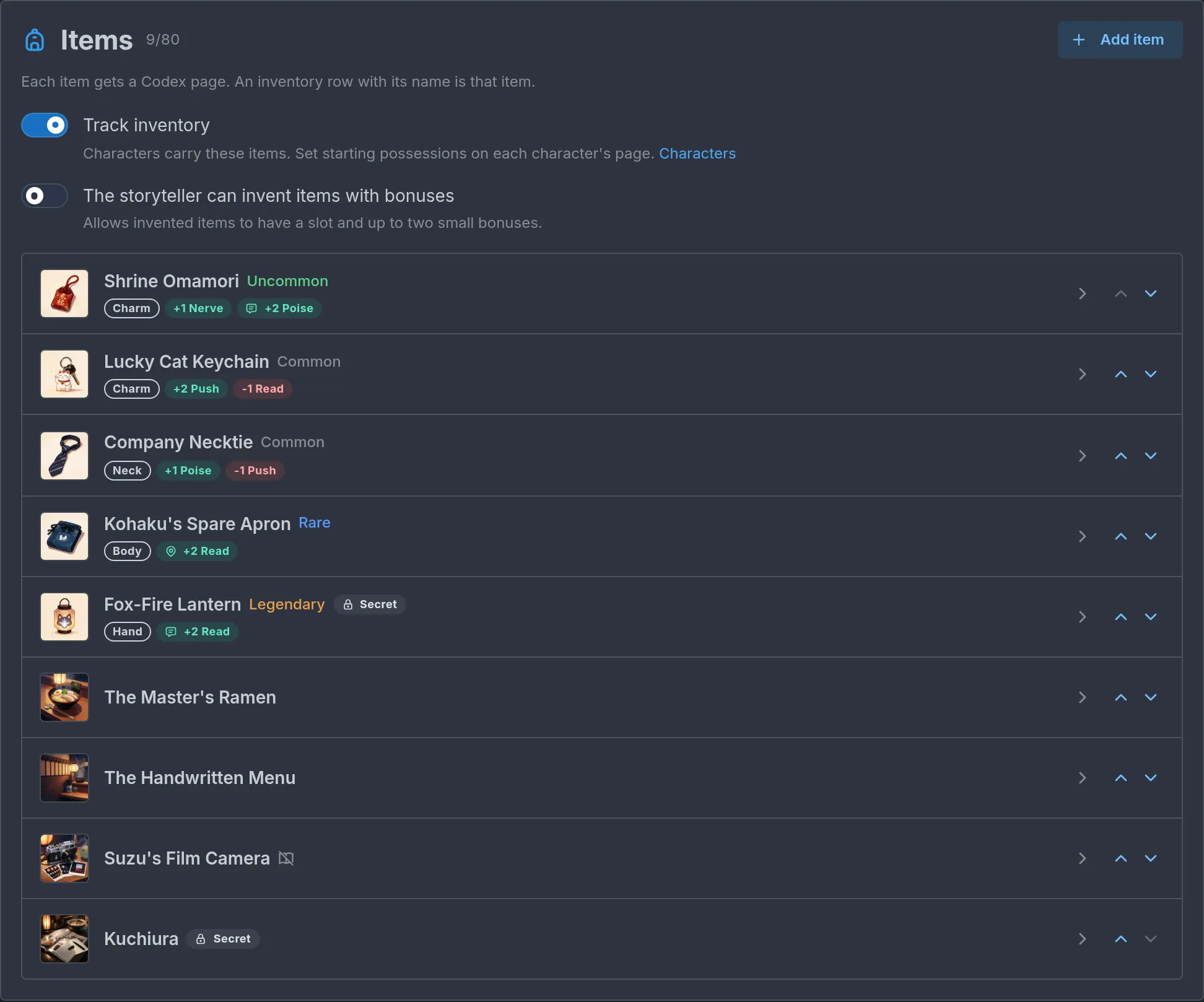
Anatomy of an item
The fields, in order:
- Picture: optional, the same slot as a Codex picture: any shape, up to 1536px and 8 MB, with Replace and Remove once set. Square suits most gear, and a transparent cut-out keeps its transparency. The inventory and the Codex both show it.
- Name: the match key. Up to 60 characters, unique in the world (the editor refuses a second item with the same name, ignoring case and accents). It is what starting inventories, beats, loot tables and the storyteller call the item, so pick it before you use it elsewhere, or read Renaming an item.
- Rarity: free text, coloured like the inventory's Rarity column. The box suggests Common, Uncommon, Rare, Epic and Legendary, plus any rarity your other items already use. Up to 40 characters.
- Description: one or two lines, up to 400 characters. Players and the storyteller read it. Describe the item's appearance or feel. Enter its bonuses below.
- Codex text: the long entry players read when they open the item in the Codex, in Markdown, up to 30,000 characters. The storyteller reads it only when The storyteller reads says so.
- Secret: listed in the Codex once the journey finds it, by holding it unless you say otherwise, or through a beat or a lore entry. Until then it is not in the Codex at all. See Secret items.
- Spoiler: listed, but blurred until the reader taps it.
- Hide from the Codex: never listed in the Codex. The inventory still shows the picture.
- Only if NSFW is on: the item exists only in journeys where NSFW content is on, like a marked beat or tracker. See Only if NSFW is on.
- How players find it: a panel under the tiles, shown while Secret is on. Covered in Secret items.
- Tell the storyteller about it: a switch in the Storyteller part, after the Codex part, on by default. On, the storyteller gets the item's name, slot, bonuses and what the next picker selects, on one line every turn. See Telling the storyteller.
- The storyteller reads: a picker under the switch while it is on. The description, Description + Codex text or Its own text.
- Only for the storyteller: a box under the picker, up to 400 characters, read after the description. With Its own text it is called Storyteller text and is read instead of the description and Codex text. Players never see it, in the inventory or the Codex.
- Slot: a short label such as Neck, Weapon or Charm, up to 24 characters. One equipped item per slot: equipping a second item of that slot takes the first off. The box suggests the slots your other items use, so spelling stays consistent. An item with no slot can still be equipped when it has bonuses, and then it never pushes anything off.
- While equipped: the bonuses, up to 4, one collapsible row each. Covered next. Slot and While equipped sit together in the Equipment area, after the Storyteller part, closed until you open it or the item has one of them.
- Author notes: only you see these. Up to 1,000 characters.
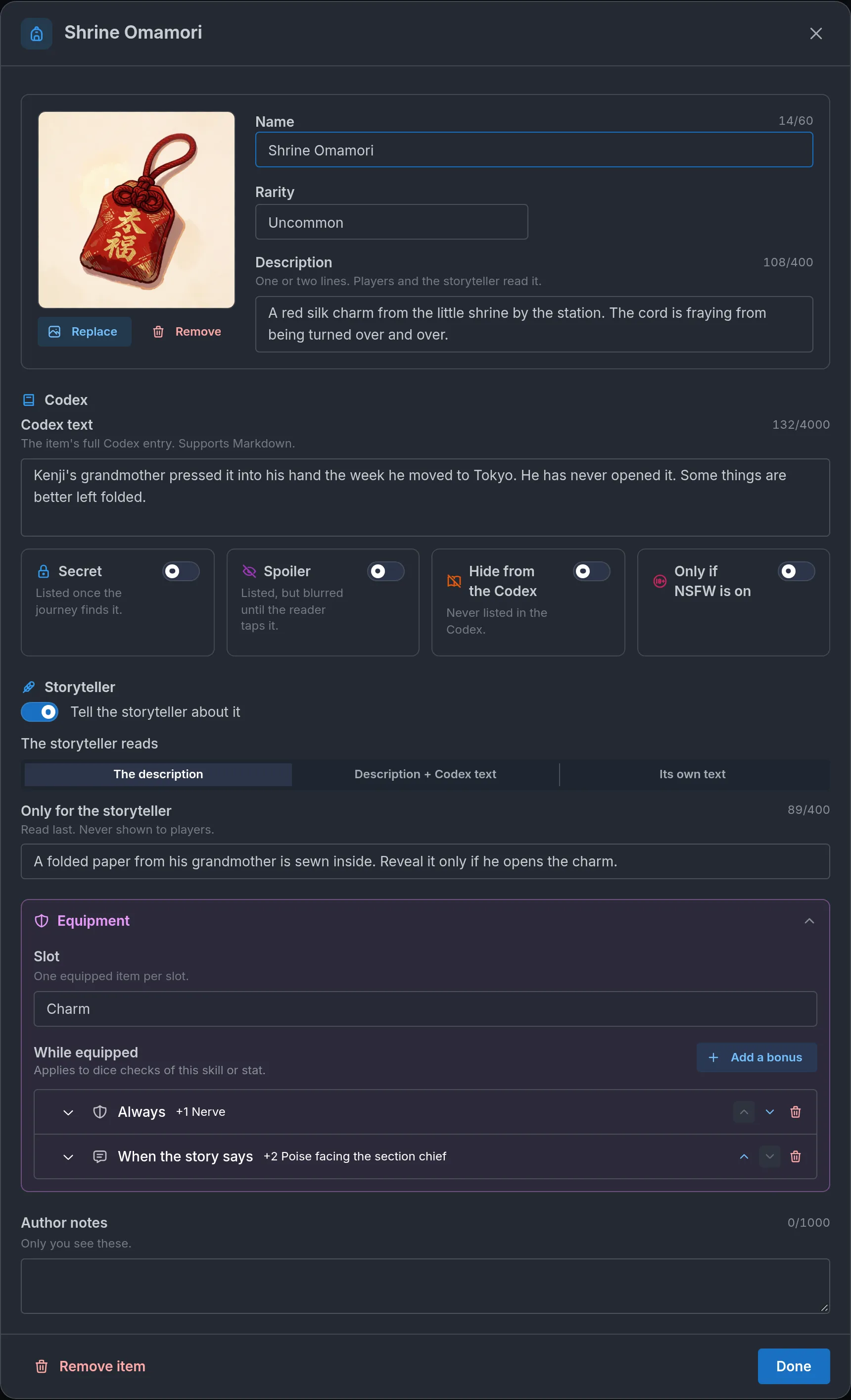
Bonuses: While equipped
Add a bonus opens a picker, When does it count?, with three choices:
- Always: counts on every check of the skill while equipped.
- At a place: counts while the player is at one of your locations, or inside it.
- When the story says: a short situation the storyteller judges at each check.
Each bonus is then a collapsible row, headed by its condition and a summary such as "+2 Poise facing the section chief", with move up, move down and remove buttons. Open it to fill in the fields:
- Skill or stat: the name a check rolls, matched like a dice skill. The box suggests your dice skills and the stats of your sheet. A bonus also counts on a skill that reads its number from that stat: +1 Strength adds to an Athletics skill whose number comes from Strength.
- Bonus: a whole number from -10 to +10, never 0. A negative number is a penalty. A penalty on one skill can balance a bonus on another.
- When it counts: the condition picked above, changeable here. At a place adds a Place picker of your seeded locations, and the bonus also counts at places inside it. When the story says adds a Situation box, "on a ride", "in the dark", up to 140 characters, and the storyteller decides at each check whether it holds.
An item has at most 4 bonuses. They only count on checks with a system (2d6 + skill or d20 + skill), where the engine does the arithmetic. In a world without them, the rows stay, dimmed and marked Inactive, with a link to Dice.
On every check. The engine adds the equipped items' lines after the player's own number: on the roll card and its roll, a check the story stops for, a tagged suggested action and the odds printed on its button, a check the narrator rolls while writing, and a roll a beat forces. Each bonus is listed on the card under the item's name, with its situation when it has one. The narrator never adds an equipped item itself, and a line it tries to add for one is dropped, so nothing counts twice. In a multiplayer party, a guest's own equipped gear counts on their checks the same way.
When the story says. A situation bonus is judged by the storyteller when it calls the check, so it only counts on checks the storyteller adjudicates. A roll forced by a beat, and a tagged suggested action on a world that does not stop the story for rolls, get the Always and At a place bonuses only. Use short, literal situations such as "on a ride". Avoid vague conditions such as "when it would be dramatically appropriate".
Renaming an item
The name is the link, so renaming an item that is already used elsewhere breaks that link. When you change the name of an item that a starting inventory, a beat or a boost refers to, the editor warns in yellow that they still say the old name and will no longer mean this item, with an Update them button that renames those references to the new name in one go. Items already held in a journey stay linked after a rename.
How items reach the player
An inventory row links to a catalogue item by name. Items reach the inventory in four ways:
- The starting inventory. Each player character's sheet grid has the Inventory table. Type the item's name in a row, spelled as in the catalogue, and it starts in the player's pack. With a catalogue, the table gains an Equipped box per row: tick it and the item starts equipped. Only an item from the Items section with a slot or bonuses can be ticked, and ticking one clears the others of its slot. See Filling it in per character.
- A beat that writes a sheet row. The Write character sheet row effect on Inventory, with the item's name as the Row, hands it over without relying on the storyteller. See Effects you can apply.
- A beat that draws from a table. A Draw from table effect whose results go to the character sheet's Inventory: a loot row whose name is a catalogue item yields that item. A drawn item always arrives unequipped.
- The storyteller. It is told the items with Tell the storyteller about it on, one line each, and can grant one in play. An item with the switch off arrives the other three ways. The item keeps its catalogue bonuses even when the storyteller names it in another language. See Telling the storyteller.
Deleting a catalogue item removes its picture, slot and bonuses from matching inventory rows. Journeys already started keep the catalogue they began with, so start a new journey to try a new item.
Equipping
Equipping happens in the story. There is no equip button. While a player carries gear and wears none of it, their sheet says to equip it by putting it on in the story. When the player puts something on, wields it, or picks it as the one they carry, the storyteller marks it equipped. Taking it off, sheathing it, or choosing another one does the reverse. Only items with a slot or bonuses can be equipped.
One per slot. Equipping an item takes off whatever else was equipped in that slot. To allow two rings at once, give them separate slots. An item without a slot occupies nothing and never pushes another off.
Bonuses count only while equipped. A sword in the pack adds nothing. The sheet shows the bonuses dimmed until the item is equipped.
From a beat. A beat can equip too. Give the sheet's Inventory table a column called Equipped in the sheet editor, and a Write character sheet row effect can set it to yes on the item's row (or no to take it off). The same column is readable by a Table row condition, Inventory, row Velvet Choker, column Equipped, equals yes, so a beat can wait for the player to wear something.
Removal and quantity. A removed row, or one whose quantity drops to 0, is no longer equipped. A stack is one possession: three equipped daggers provide one dagger's bonus.
What players see
- On the sheet. The inventory lists each item with its picture, its rarity in colour, an Equipped mark on the ones that are, and its bonuses under the name, lit while equipped and dimmed while not, with the place or situation spelled out on conditional lines ("+2 Nerve on a ride"). Stats show what equipped items always add next to the base value: Charm 5 +2, with the tip "From equipped items". The stored stat is unchanged. Conditional lines are not shown on the stat, since they depend on the moment.
- On the roll card. Each item line appears under the item's name with its value, next to the skill's own number and any boost, so the odds the player sees already include their gear.
- In the Codex. Each item is a Codex page of its own under the Items chip, with the picture, the description as its summary, a small card for Rarity, Slot and While equipped, and the Codex text as its body. Tapping the item's name in the inventory opens the same card. See Items in the Codex.
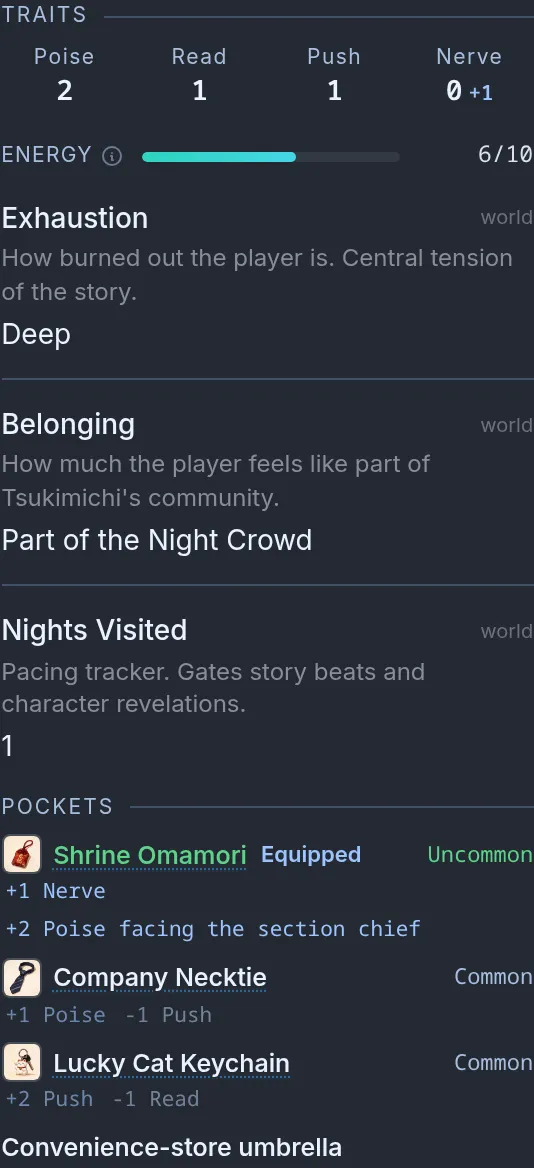

Telling the storyteller
Tell the storyteller about it, the switch in the Storyteller part, is on by default: the storyteller is given the item's name, slot, bonuses and text on one line every turn, so it can hand the item over or describe it when it comes up. Turn it off and the storyteller is not given that line. Its bonuses still count, and players still read it in the Codex. An inventory row with its name is still the item.
While the switch is on, The storyteller reads picks the text on that line:
- The description, the default: the description, then the note.
- Description + Codex text: the description and the note, plus the item's Codex text while the player carries it. Pick it when the page holds what the storyteller needs once the item is in hand: a letter's contents, a relic's history.
- Its own text: only the text in the box below, in place of the description and Codex text. Pick it when the player-facing description would mislead the storyteller, a disguised item for example. An empty box falls back to the description.
The box under the picker is Only for the storyteller with the first two choices, read last, and Storyteller text with the third, read instead of the description and Codex text. Up to 400 characters either way, and players never see it, in the inventory or the Codex. Use it for a secret or for how to play the item. For the Shrine Omamori: "A folded paper from his grandmother is sewn inside. Reveal it only if he opens the charm." With The description or Its own text, a secret written in the Codex text stays with the players.
Items moved in from the Codex start with the switch off. The storyteller never read Codex entries, so nothing changes for it.
Turn it off for the things that are mostly something to carry and read about, and for the bulk of a long catalogue where only a few pieces matter to the story. Keep it on for those few.
What the storyteller can invent
The storyteller can always add plain items to the inventory: a borrowed umbrella, a receipt, a stolen key. They have no slot or bonuses.
The storyteller can invent items with bonuses, the switch at the top of the section, allows an invented item to have a slot and up to two small bonuses, each at most 2 either way, always on or judged by the story. It never changes an item of yours. A row that matches one of your items takes your slot and your bonuses, and anything the storyteller tried to write on it is dropped. Leave the switch off to limit item bonuses to your catalogue. Enable it to allow improvised gear.
Items in the Codex
Items have automatic Codex entries, so they need no separate entry in the Codex section. The entry shows the picture, the description as the summary, the Rarity, Slot and While equipped card, and the Codex text as the body. Three switches on the item shape it: Secret keeps it out of a journey's Codex until the journey finds it, Spoiler blurs it until tapped, Hide from the Codex keeps it out for good. In the story text, the first mention of the item's name gets the usual dotted underline. Typing [[ in a Codex body, or using the link button, offers items along with the entries, and so does a beat's Reveal Codex entry picker. Items do not count toward the Codex's 100 entries.
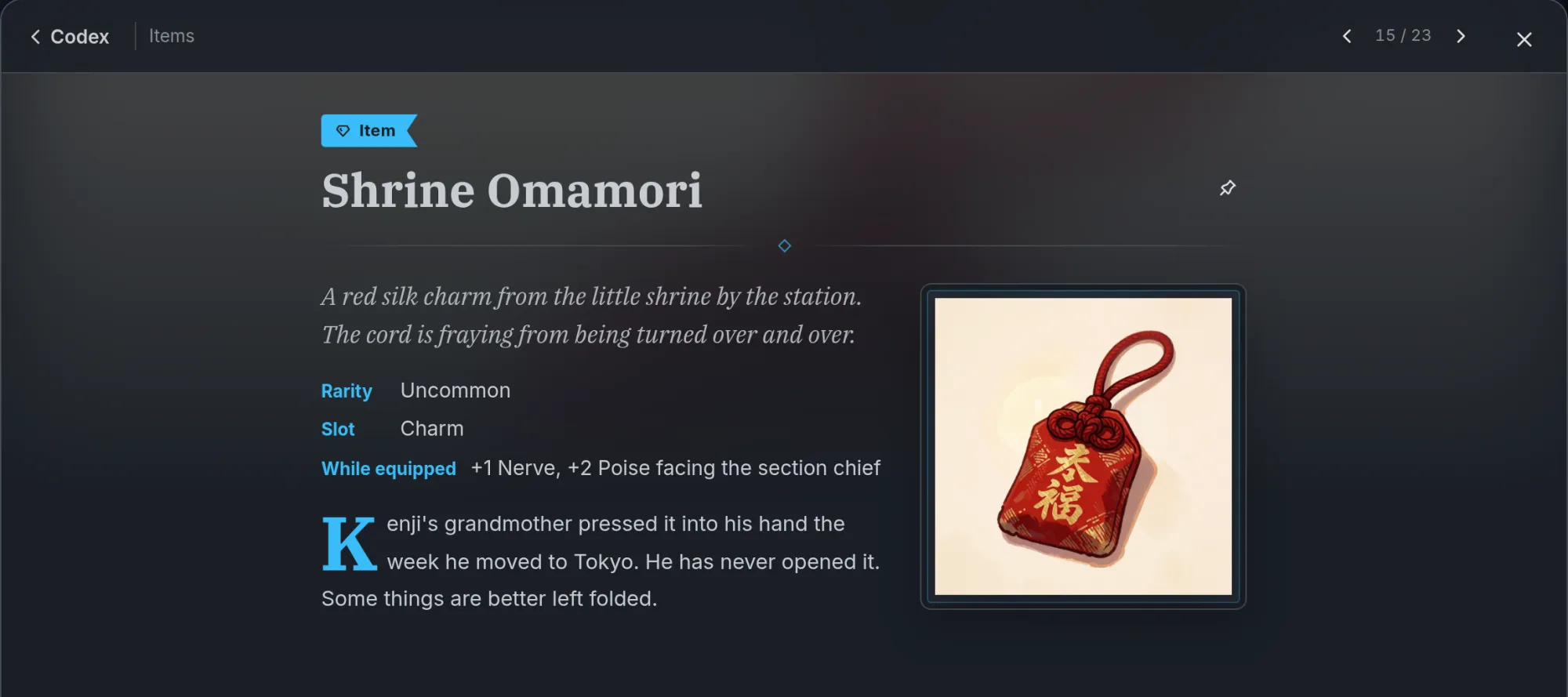
Secret items
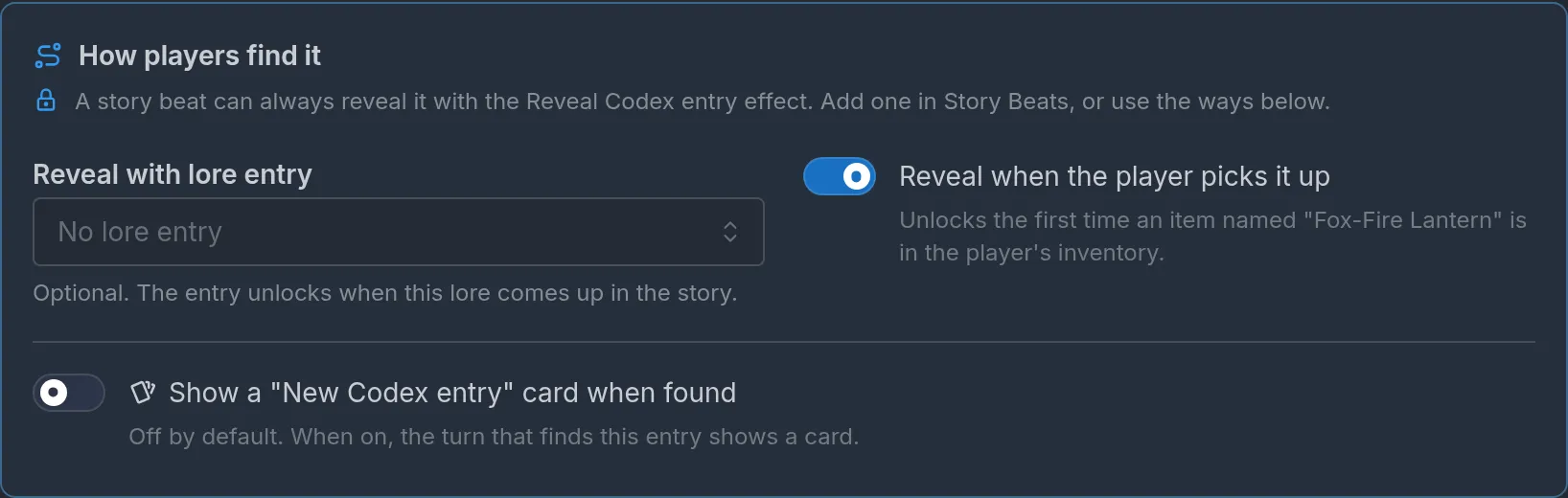
A secret item is listed in a journey's Codex once the journey finds it. Holding it counts, by default. A beat can also find it with the Reveal Codex entry effect, which lists items with the entries, and so can a lore entry. With Secret on, a How players find it panel appears under the tiles:
- Reveal with lore entry: pick a lore book entry. A secret lore entry finds the item when a beat reveals that lore. Any other lore entry finds it when one of its keywords comes up in the storyteller's narration.
- Reveal when the player picks it up: on by default. Unlocks the first time an item with this name is in the player's inventory. Turn it off when holding the item should not spoil it: a stolen disc whose meaning waits for a beat.
- Show a "New Codex entry" card when found: off by default, and works as for Codex entries. The world-wide Allow "New Codex entry" cards switch in the Codex section still applies.
The authoring checks warn about a secret item nothing can find.
Moving Codex entries into Items
Codex entries of type Item are items now. On November 4, 2026, every existing one was moved into the Items section with the same picture, text, links and reveal rules, and Tell the storyteller about it off, so players and the storyteller see no change. Opening a world in the editor moves any that are left (a notification, Items have their own section, says so, and the next save keeps the move), and one written since, in an imported world for example, is moved when the world is saved. Picking Item as an entry's type opens a dialog, Items are now in a dedicated section, with Cancel, Open Items and Make it an item, and the type stays as it was. See Type.
An entry is left in the Codex when it has no title, a title longer than 60 characters or one another item already has, or when the item list is full. It keeps a Make it an item button at the bottom of its page, and the button's tooltip says why it could not be moved. Fix the cause and press it.
Boosts tied to an item
A boost with the cost An item the player owns requires that item in the inventory. Only while equipped also requires it to be equipped before the roll card offers the boost. A Lucky Coin on a chain gives +1 Nerve as a modifier, and its reroll is a boost costing the Lucky Coin, Used up off, Only while equipped on. Put the coin in the pocket and the reroll goes away with the bonus.
Tips
- Balance bonuses with penalties. +2 Charm and -1 Nerve gives the player a reason to switch items.
- Check bonuses against your difficulty ladder. A +2 has more effect on 2d6 + skill than on d20 + skill. Aim for gear that moves a check about one difficulty rung.
- Enter bonuses as modifiers. The engine cannot derive +2 Charm from "a choker that makes you more charming".
- Use consistent slot names. Charm and Charms are separate slots. Reuse the suggestions in the Slot box.
- Choose names before using items elsewhere. After a rename, press Update them to update starting inventories, beats and boosts.
- Describe the object. The storyteller uses the description when narrating it.
- Keep filler away from the storyteller. Dozens of trinkets to read about in the Codex need no line in every turn. Turn Tell the storyteller about it off on those, and leave it on for the few that drive the story.
- Choose conditions to match the bonus. Use At a place for a guild signet's bonus in its hall. Use When the story says for situations such as riding or singing.
- Give interchangeable items the same slot. To allow one equipped charm at a time, give every charm the Charm slot.
Examples
A cozy world of charms. RPG mode, 2d6 + skill, a sheet with Charm, Observation and Nerve as Number rows. Every charm shares the slot Charm. Velvet Choker, Rare: +2 Charm, +1 Observation, -1 Nerve, description "Soft, a little too tight, the one you wear when you want to be looked at." Spare Bike Key, Common: +1 Nerve, and +2 Nerve When the story says "on a ride". Pressed Clover, Uncommon: +1 Observation, -1 Charm. The player character starts with all three in the inventory and the clover ticked Equipped. In play, "I take off the clover and clasp the choker before the party" is enough: the sheet shows the choker lit and Charm 4 +2, and the next time she tries to talk her way past the doorman, the card reads Charm +4, Velvet Choker +2. Key back on for the ride home on a friend's scooter, a Nerve check lists Spare Bike Key +1 and Spare Bike Key (on a ride) +2.
Weapon and armor with separate slots. A harbor adventure, d20 + skill, Swordplay and Stealth on the sheet. Dockside Cutlass, slot Weapon: +2 Swordplay. Oilskin Coat, slot Body: +1 Stealth When the story says "in rain or fog", -1 Swordplay. Boarding Axe, slot Weapon: +3 Swordplay, -2 Stealth. The player starts with the cutlass and the coat equipped. A beat on the shipwreck fires Write character sheet row, Inventory, row Boarding Axe, and the axe lands in the pack unequipped. "I sling the cutlass and take up the axe" equips the axe, and the cutlass comes off since both are Weapon. The coat stays on, being Body, so a fight on deck in the fog rolls Swordplay with Boarding Axe +3, Oilskin Coat -1, and a creep along the quay rolls Stealth with Boarding Axe -2, Oilskin Coat +1 (in rain or fog).
A place-bound bonus. A city of guilds with a Merchants' Hall among its seeded locations and a Counting Room nested inside it. Guild Signet, slot Ring: +2 Charm At a place Merchants' Hall. Worn on the street it does nothing. The moment the scene moves into the hall, or its counting room, every Charm check lists Guild Signet +2. A rival's Forged Signet, same slot, gives +3 Charm at the hall and -2 Observation always, trading a larger Charm bonus for an Observation penalty.
A worn item that grants a trick. The same guild city with boosts on. Lucky Coin, slot Charm: +1 Nerve. One boost, "Flip the coin": Reroll (keeps the better roll), cost An item the player owns, Item Lucky Coin, Used up off, Only while equipped on. While the coin is on its chain the roll card offers the reroll after a failed check. Pocketed to make room for another charm, the reroll and the +1 Nerve go away together.
Frequently asked questions
Codex
Learn how the Codex gives players of your Imagina world a reference book for its characters, places, items and ideas. Covers entries and pictures, Draft, Spoiler and Secret visibility, how secret entries are found, the automatic character and place pages, and what players see during play.
Trackers
Learn how to use trackers to make your Imagina world remember choices, track progress, and react to changing conditions. Covers world-level and per-character trackers, display types, update rules, and story variables for beat-only logic.