Trackers
Learn how to use trackers to make your Imagina world remember choices, track progress, and react to changing conditions. Covers world-level and per-character trackers, display types, and update rules.
Trackers are how your world remembers. They are named pieces of state that the storyteller keeps across the whole journey: resources, relationships, progress, hidden conditions. They change as the story unfolds, and the story changes because of them.
A concrete example: a Trust tracker starts at 50. It rises when the player helps Priya and falls when they lie to her. Below 20, Priya stops sharing what she knows. Above 80, she tells the player about the tunnel under the chapel. The player never sees a number in the prose. They see Priya go quiet, or lean in.
Trackers are easy to over-use. Start with a few whose values change how the story continues, and add more when playtests show a need.
Why trackers matter
- Continuity. The story keeps its own memory of past events, but a tracker is an explicit value that instructions and beats can refer to, and it survives fifty turns of prose unchanged.
- Consequences. When a tracker changes, the world responds. The guard who waved the player through at low Suspicion follows them at high Suspicion.
- Replayability. Different choices produce different tracker states, which unlock different story beats. Two playthroughs of one world can go to genuinely different places.
World-level and per-character trackers
There are two places to define trackers, and the difference is scope.
- World trackers live under Gameplay → Trackers. They are shared by every player character and represent global state: the kingdom's stability, a faction's influence, days until the eclipse, whether the bridge is down.
- Per-character trackers live on each player character, under Starting Trackers in Characters → Player Characters. They represent personal state: reputation, a mana pool, a private debt. Because each character can start with different values, this is also how you make characters feel mechanically and dramatically distinct from turn one.
Both kinds work in any world. You do not need the RPG Game System to give a character personal trackers. The RPG system builds on trackers by giving you a shared character sheet and letting the storyteller grow inventory, skills, and bonds on top. See RPG mode and dice.
At journey start the two lists are merged. If a character tracker and a world tracker share a name, the character's value wins.
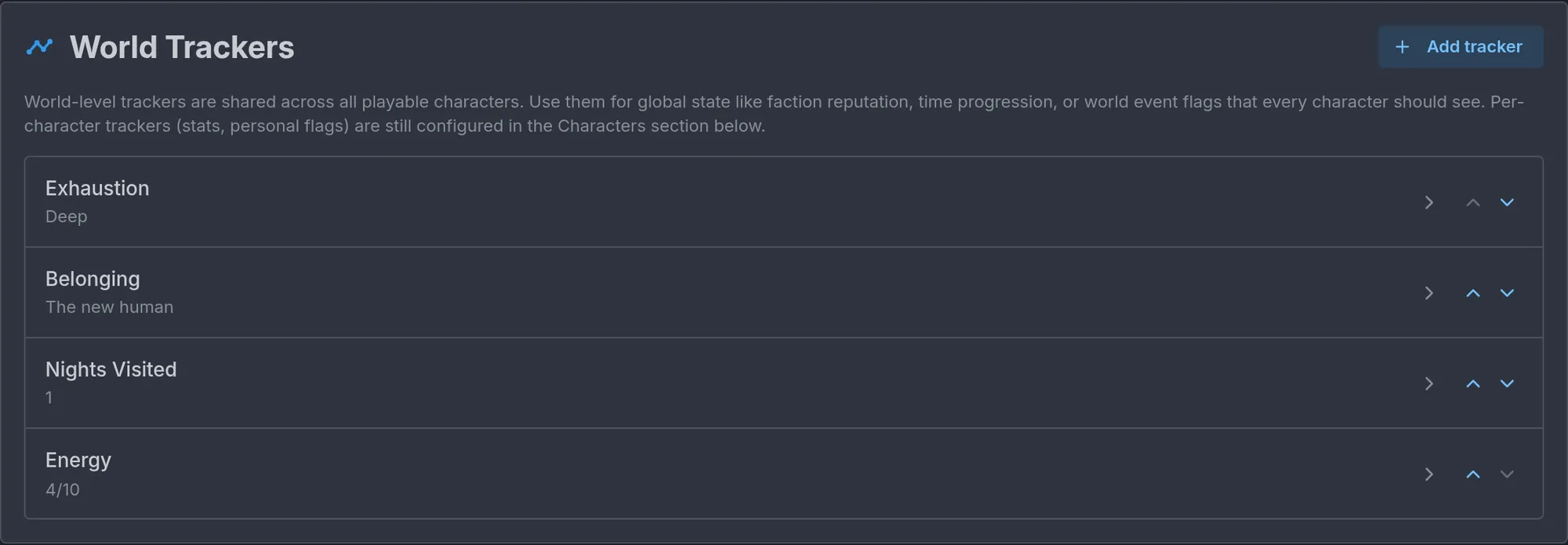
Tracker anatomy
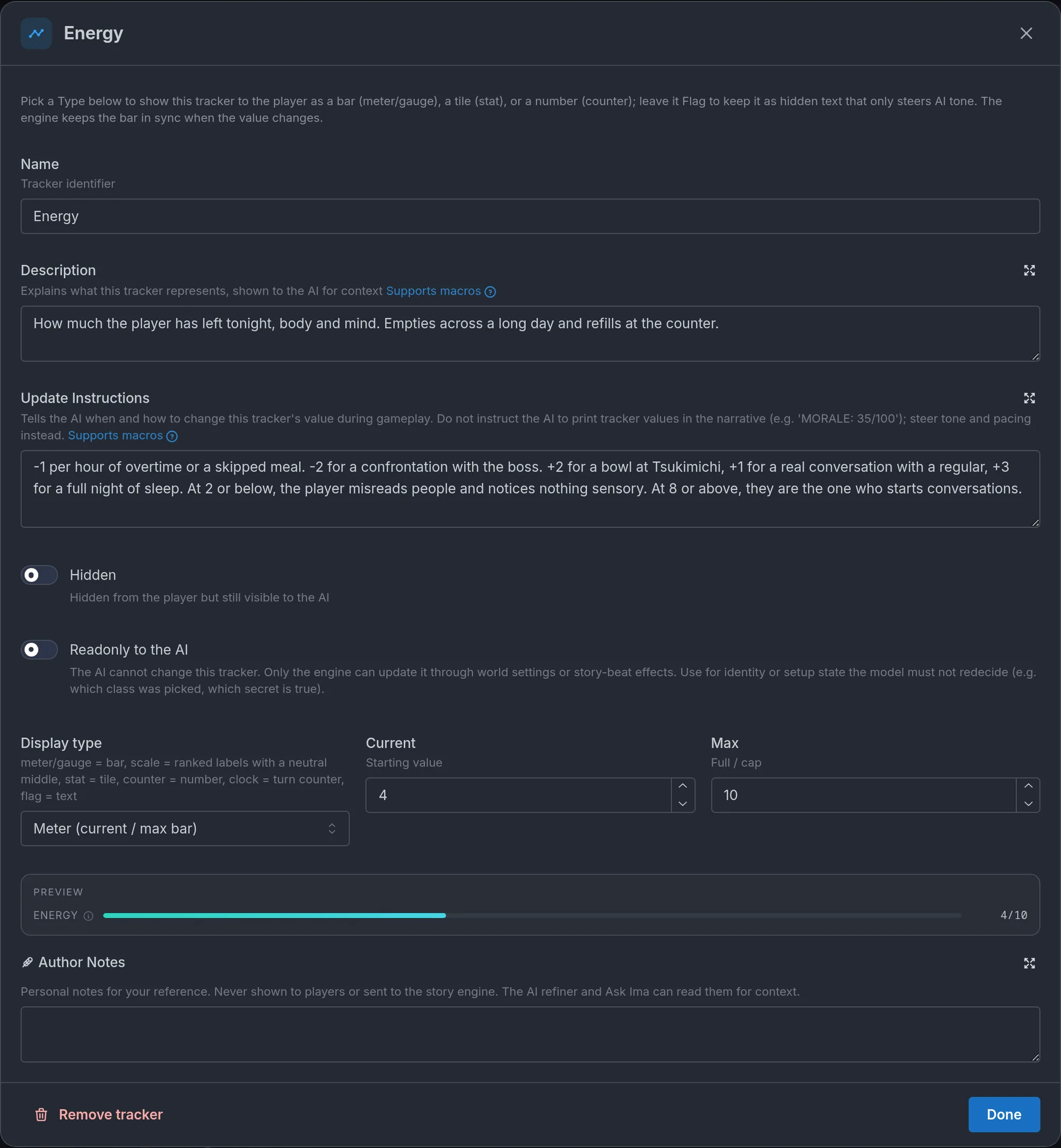
- Name: clear and specific. "Trust", "Mana", "Days Until the Eclipse". The storyteller refers to it by this name, and so do beat conditions.
- Description: what the tracker represents in the world. The storyteller uses it to understand what the value means.
- Display type: how the tracker is shaped and shown. See the next section.
- Starting value: where it begins. A number for numeric types, current and max for a bar, a step for a scale, text for a flag.
- Update Instructions: when and how the tracker changes. The most important field, covered in depth below.
- Hidden: the player never sees it, the storyteller still does.
- Readonly to the AI: the storyteller cannot change it. Only a player's setting choice at journey start or a story beat effect can. Use it for identity and setup state the storyteller must not redecide: which class was picked, which secret is true.
- Author Notes: private notes, never sent to the storyteller.
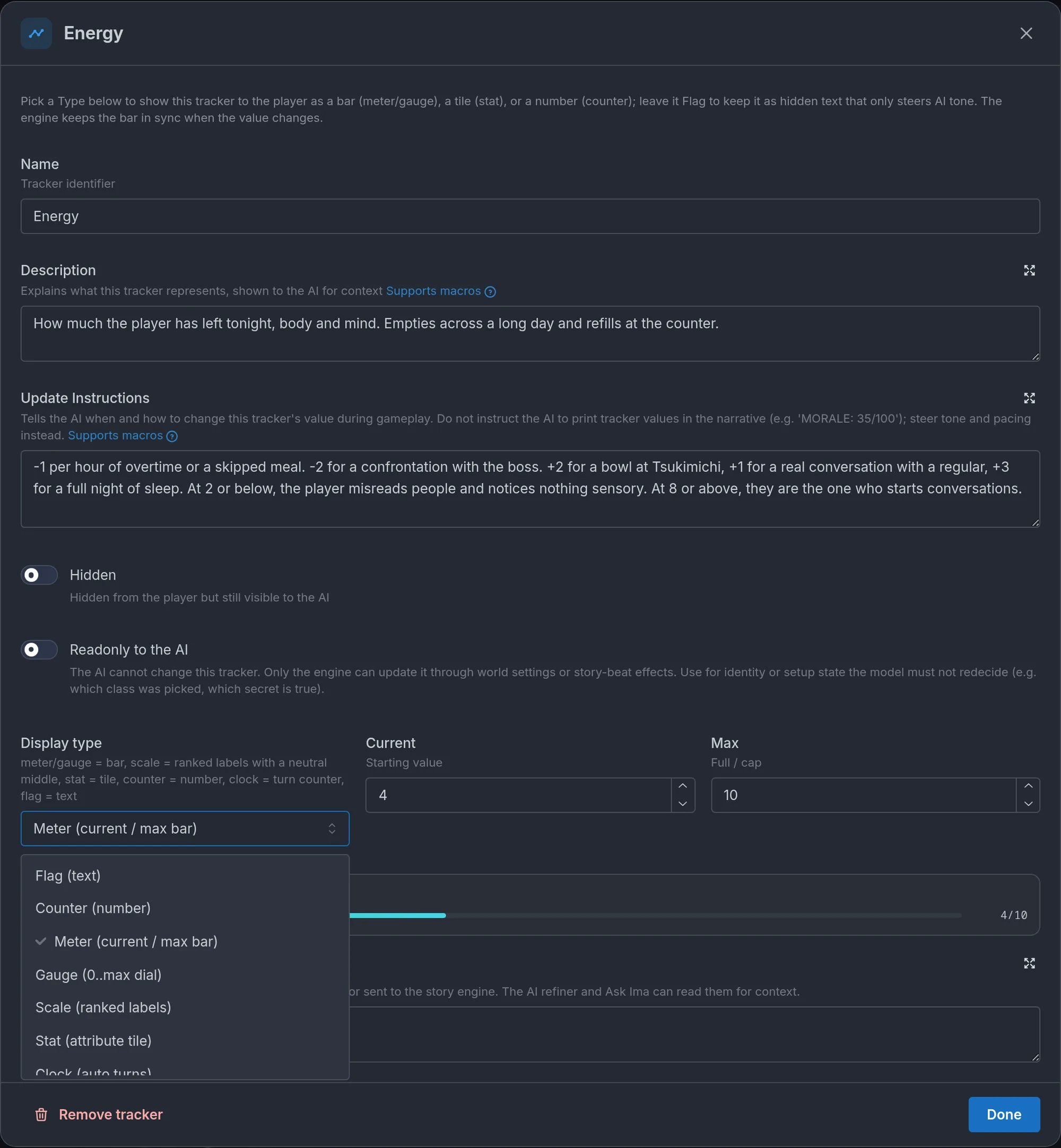
Display types
The display type sets both what the storyteller can do with a tracker and what the player sees in the Trackers panel during play.
| Type | What it is | Good for |
|---|---|---|
| Flag | Text. Any word or short phrase. | Hidden story state, "known / unknown", a mode the world is in |
| Counter | A plain number. | Gold, days passed, clues found |
| Meter | A bar with a current value and a max. | Health, mana, stamina, hull integrity |
| Gauge | A dial from zero to a max. | Suspicion, corruption, heat |
| Scale | Ranked labels with a neutral middle. | Trust ("Hostile, Cold, Neutral, Warm, Devoted"), rank, alignment |
| Stat | An attribute tile. | Strength, Charm, and other RPG-style attributes |
| Clock | A turn counter the engine advances by one every turn. The storyteller can only reset it to zero. | "Turns since the last rest", countdowns you want to be exact |
A few notes:
- Scales want an odd number of steps (3, 5, 7) so there is a true neutral middle. The storyteller moves a scale by naming a step or nudging it one rung at a time.
- Word values often steer the story better than numbers. A Flag holding "open inquiry" tells the storyteller what to do. A Counter holding "2" does not.
- Clocks are exact. The engine, not the storyteller, adds one each turn. Say in Update Instructions when it resets, and gate a beat on "at least N" to fire after N turns.
The player's panel draws meters and gauges as bars, scales as a diverging bar, stats as tiles, and everything else as a name and value. Hidden trackers never appear there.
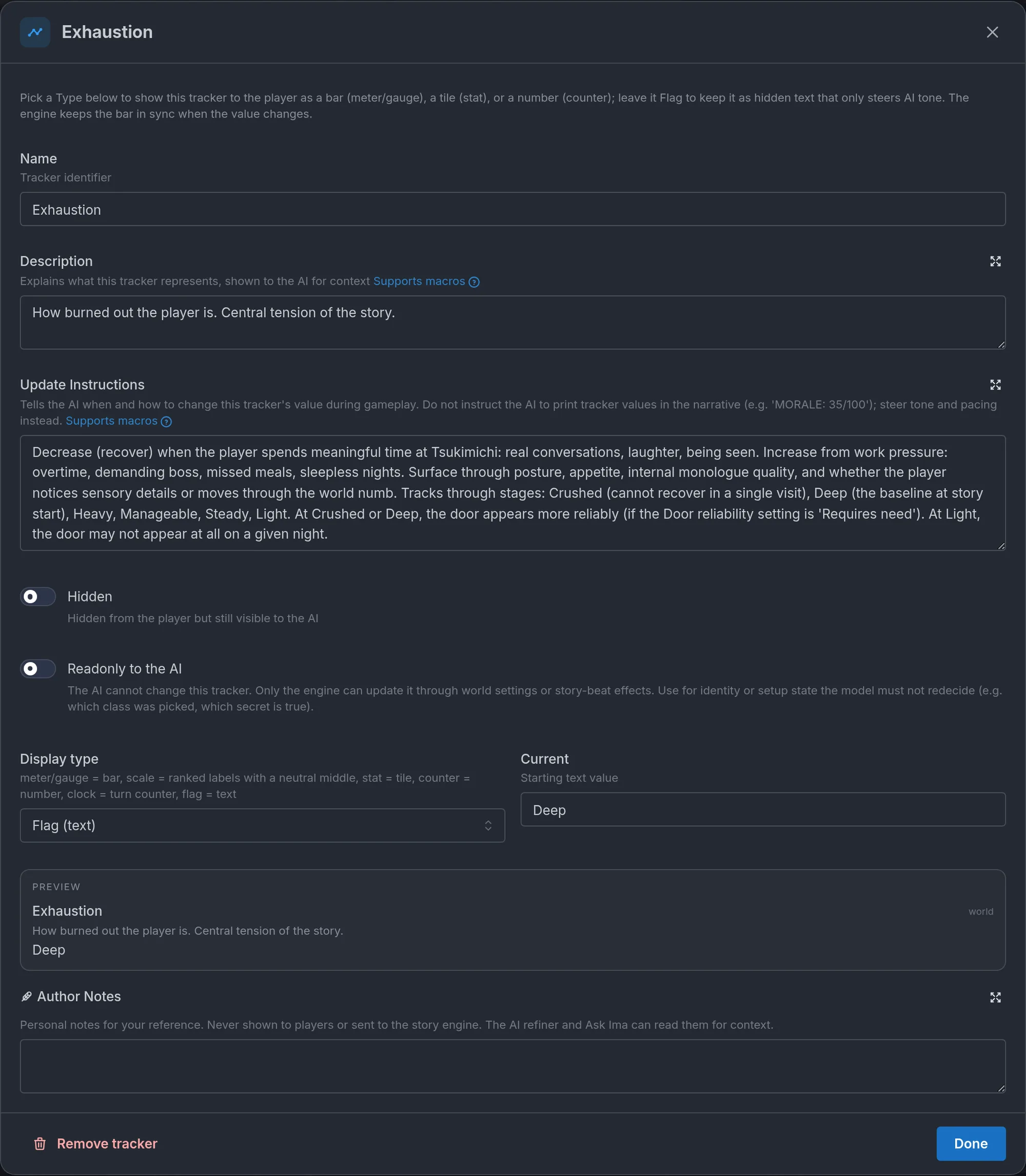
Update instructions
This is the part that makes a tracker work. The storyteller changes a tracker through a dedicated update step, guided by your Update Instructions. A value the narrator mentions in the prose is not recorded: only an actual update counts. So if the instructions are vague, the tracker drifts or never moves.
Be specific about cause and size.
Weak: "Trust changes based on the player's actions."
Strong: "+5 when the player keeps a promise to Priya or helps her without being asked. +10 if they take a risk on her behalf. -5 for a lie she catches, -15 for a betrayal she witnesses. Small talk and routine cooperation do not move it."
The strong version names the events, gives sizes, and says what does not count. That last part prevents the most common drift, a tracker that creeps up every turn because "the player was nice".
Define what happens at key values. This is how a tracker drives consequences. "Below 20, Priya answers in single words and never volunteers information. Between 20 and 80, she is professional. Above 80, she shares what she knows about the tunnel and calls the player by their first name." Write it in the Update Instructions or in a named instruction block that references the tracker.
Explain how it goes up and how it goes down. A tracker that only rises feels like a score. Give reasons for both directions.
For resources, give a cost scale. If Mana depletes, say what a spell costs and how it is restored. "Minor spells cost 5, major spells 20. Mana recovers 10 per night of sleep and fully at the shrine."
Keep the format consistent. If one tracker uses "+5 / -3" notation, use it for all of them. Consistency helps the storyteller apply the rules the same way every time.
Numbers steer, never print
Never instruct the storyteller to print tracker values or thresholds in the prose. No "TRUST: 45/100", no "you are at 80 trust". Trackers steer tone, pacing, and sensation, and their effects should surface through what the character feels and how the scene moves. The player already has the panel for the numbers, and hidden trackers are hidden for a reason.
How trackers interact with other features
- Instructions. Reference trackers by name in your instructions so the storyteller knows how values should shape the narrative: "when Suspicion is high, guards follow the player and shopkeepers refuse to haggle."
- Story beats. Trackers are the most common beat trigger (a beat fires when a tracker reaches a value) and the most common beat effect (a beat sets or adjusts a tracker when it fires). A beat can write an absolute value, a delta such as "+5", a new current/max for a bar, or a scale step. Beats can also retire a tracker. See Beats and story arcs.
- Player settings. A choice the player makes at journey start (difficulty, faction, a starting path) can write its value into a tracker, so beats can read it later. See the World Settings note in Foundations.
- Starting values. Different player characters can start with different values for the same tracker. See Worldbuilding and characters.
- Playtesting. In your own journeys, the Debug panel's Turns tab lists every tracker change per turn, and its State tab shows current values, including hidden ones behind a spoiler toggle.
Limits and prioritization
- A journey holds up to 20 active trackers, counting world trackers plus the most tracker-heavy player character. Once it reaches 20, nothing new can be added during play, so keep your starting set well under the cap. The editor warns you when your definition exceeds it.
- You rarely need that many. Most worlds do well with three to seven. Every tracker is a set of update rules to maintain and one more thing the storyteller can get wrong.
- Track what changes the story. If a tracker does not change how the storyteller behaves at some value, it does not need to exist.
- Relationships are usually already tracked. Every recurring NPC has a built-in relationship record the story keeps current on its own, in any world, and RPG worlds also keep bond tiers on character sheets. Add a relationship tracker only when story beats must gate on or deterministically change that relationship, because beat conditions and effects read trackers, not the built-in record. See Worldbuilding and characters.
Examples by genre
Each example names the trackers, gives their type and starting value, and shows one update rule, so you can see what a complete tracker looks like in context.
Political drama
- Crown Favor (Gauge, 50 of 100). "+10 when the player delivers a result the king asked for. -10 when they are seen with the Duke's faction. -25 if they contradict the king in public. Below 30, the king stops receiving them. Above 80, they are named to the council."
- Duke's Faction (Scale: Enemy, Wary, Neutral, Useful, Ally, starts Neutral). "Move one step toward Ally when the player does the Duke a favor in secret. Move one step toward Enemy when they expose one of his people."
- Secrets Known (Counter, 0). "+1 each time the player learns a fact that could ruin a named noble. Never decreases."
Horror
- Dread (Gauge, 10 of 100, hidden). "+10 for each unexplained event the player witnesses, +20 for direct contact with the thing in the walls, -5 for a night of safe sleep. Above 60, sentences shorten and ordinary objects become wrong. Above 90, the player can no longer tell which memories are theirs."
- Evidence (Counter, 0). "+1 for each physical proof the player collects: the photograph, the ledger, the tooth. Story beats read this."
- Lantern Oil (Meter, 6 of 6). "-1 per in-story hour spent in the tunnels. Refill at the chapel. At 0, the dark is total and Dread rises twice as fast."
Romance
- Affection (Scale: Cold, Guarded, Warm, Close, Devoted, starts Guarded). "One step warmer for a moment of real honesty or a kept promise. One step colder for a lie she catches or a plan cancelled without a reason. Never move more than one step per scene."
- Jealousy (Gauge, 0 of 100, hidden). "+15 when the player spends a scene alone with Tunde. -10 per scene the player spends with her instead. Above 50, she brings him up unprompted. Above 80, she confronts the player."
Adventure and quest
- Expedition Supplies (Meter, 20 of 20). "-2 per day of travel, -4 in bad weather. Restock only in towns. At 0, the party eats from the land and travel takes twice as long."
- Party Morale (Scale: Mutinous, Grumbling, Steady, Eager, Inspired, starts Steady). "One step up for a victory or a good meal. One step down for a death, a wrong turn, or a night without shelter. At Mutinous, a companion leaves."
- Days Until Winter (Clock, starts 0, description "one turn is one travel day"). "Never reset. A beat fires at 30."
LitRPG and progression
- Level (Stat, 1), HP (Meter, 40 of 40), XP (Counter, 0). These become part of a shared character sheet in RPG mode, where inventory, skills, and bonds are tracked for you. See RPG mode and dice for the full treatment.
Common mistakes
- Too many trackers. The number one mistake. Fifteen trackers means fifteen rule sets and fifteen ways to be inconsistent. Start with the few that matter.
- Vague update instructions. "Changes based on the player's actions" gives the storyteller no guidance. Name the causes and the sizes.
- Trackers that never change. No update instructions and no beat that touches it means dead data. Wire it up or remove it.
- The wrong display type. A Meter for something binary, or a Flag for something on a spectrum. Match the type to the concept.
- Printing numbers in the prose. Trackers steer. They never narrate.
- A tracker for a relationship the story already tracks. Recurring NPCs have built-in relationship records. Only add a tracker when beats need to read or write the value.
Frequently asked questions
Worldbuilding and characters
Learn how to create characters, lore, and locations for your Imagina world. Covers NPCs, player characters, world information, and how to organize what the narrator knows.
Beats and story arcs
Learn how to use story beats and story arcs to structure your Imagina world. Control when events fire, reveal information in the right order, and keep cause and effect intact across a long journey.