Difficulty
Learn how a world setting option can change how fights play in an Imagina RPG world, covering the Add difficulty setting button, the Fight rules group on an option, narrative battles, damage percentages, stacking settings and how the host switches during a journey.
Beta
The RPG system is in beta and only accounts with the RPG beta can set it up. It may still change.
A difficulty is a world setting whose options change how fights play in the journeys that pick them. An option can have fights told by the storyteller instead of rolled, or put a percentage on the damage the party takes or deals. One button builds the usual Story, Easy and Normal choice.
Players can already choose narrative battles on any world with Fights on, whatever its settings. A Story option adds nothing they lack. It puts that choice under your own name and description, and makes it the world's default when it is the setting's Default Value. See Narrative battles.
These rules touch fights and nothing else.
Before you start
Fight rules bend Fights, so that card comes first.
- Turn on Enable the RPG game system, on the Features page of the RPG game system group.
- On the same page, turn on Character stats and NPC sheets in step 1, then Fights in step 4. Without the first two, Fights cannot be switched on and its card shows the chip "Needs NPC sheets and Character stats", with a Turn them all on button.
The RPG beta that counts is the world owner's. Players and guests need nothing. When the owner's account does not have it, every journey of the world plays by the rules as written, for every player.
Adding the difficulty setting
With Fights on, a button sits on the Fights card: Add difficulty setting.
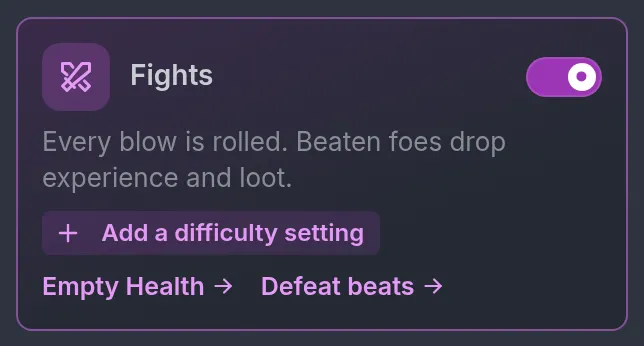
One click adds a setting to World Settings, in the Game rules group, and opens it. Its Name is Difficulty, its Shown as is Cards, and it has three options:
| Option | Player-facing description | Fight rules |
|---|---|---|
| Story | "The storyteller runs fights as part of the story." | Narrative battles is on |
| Easy | "The player's party takes half damage." | Damage the party takes is 50% |
| Normal | "Standard combat rules." | None. It is the Default Value. |
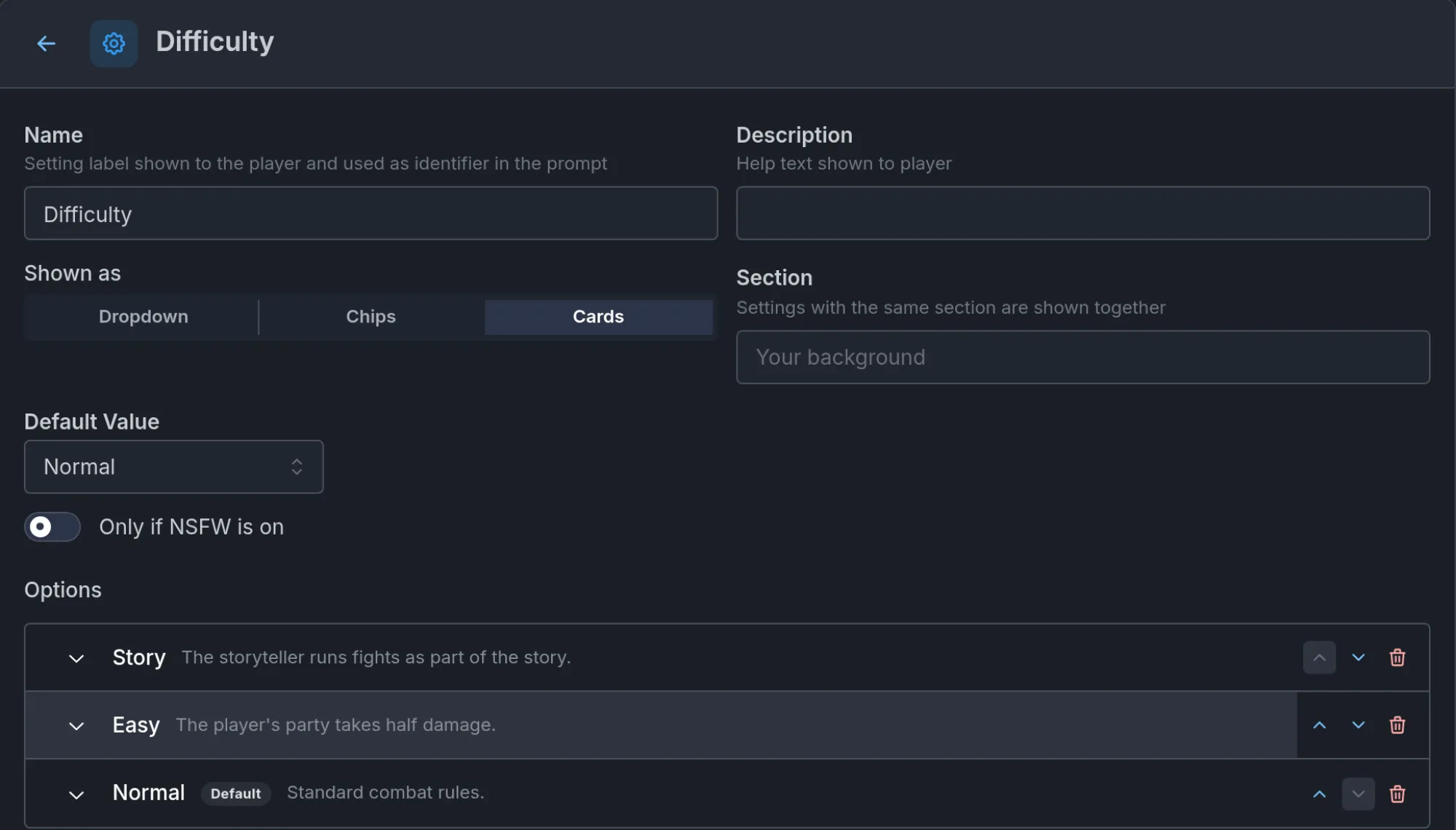
Nothing in it is locked. Rename it, rewrite the descriptions, reorder or delete options, and add your own with Add Option, as on any setting. The button writes no Instructions for the options.
Once a setting carries fight rules, the button gives way to Difficulty is set by and the setting's name, a link that opens it. A setting with no name reads "Untitled setting". When several settings carry rules, the link names the first one in your list.
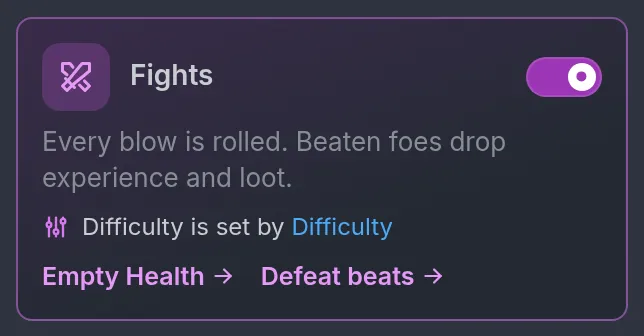
A difficulty is an ordinary setting in every other way. See World settings for the rest of its page.
Fight rules on an option
The button is a shortcut. While Fights is on, every option of every world setting ends with a Fight rules group, after Instructions. Open a setting, open an option, and set what that choice changes.
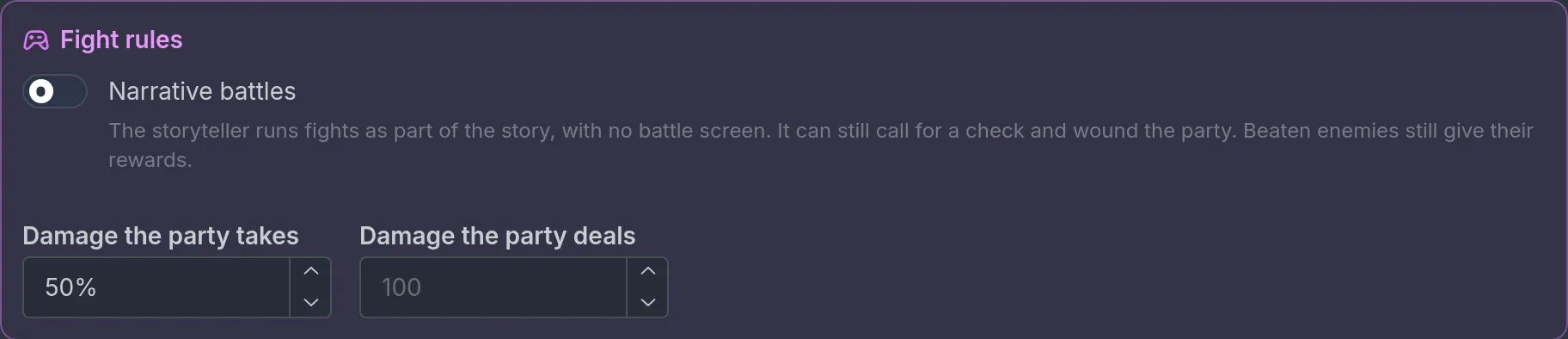
- Narrative battles: "The storyteller runs fights as part of the story, with no battle screen. It can still call for a check and wound the party. Beaten enemies still give their rewards." Off unless you turn it on.
- Damage the party takes: a whole percentage from 25 to 200. The arrows move it in steps of 5, and you can type any whole number in between. It applies to the blows opponents land.
- Damage the party deals: the same control, for the blows of the player's side.
An empty percentage means 100, the rules as written, and typing 100 empties the field. A number outside the range is brought back inside it when you leave the field.
Both percentages are disabled while Narrative battles is on. If one holds a number, a line reads "Narrative battles roll no blows, so these are not used." The numbers are kept and count again once the switch is off.
An option with no fight rules plays as written. That is all Normal needs.
Two more shapes the same controls allow:
- A harder option. A "Nightmare" option with Damage the party takes at 150 and Damage the party deals at 75.
- A world without rolled fights. A setting with a single Story option makes every fight a scene to tell, which suits a romance or a cozy world.
Fight rules can always be removed. The group stays visible on an option that already holds rules, even when the rest of the conditions are gone. An account without the beta cannot save a world that adds or changes them.
Narrative battles
With Narrative battles on, the storyteller runs each fight as part of the story and the game rolls no blow. It is the same mode as the Narrative choice every player has: the storyteller gets the same instructions and the display is the same. The Fights page covers it in full under Narrative battles.
What the storyteller does
- Each move. It decides how a move goes from the story and the player's action, as on a world without Fights.
- Checks. On a world with dice on, it may call for a check when a move in a fight could go either way, and it tells the result as it fell.
- Bars. It lowers bars by hand on both sides, sized to the blow: an opponent's bar, and the bar of the player, of a guest's character or of a companion. No numbers go in the prose.
- A loss. The party can lose. When the player gives in, stops resisting or is overwhelmed in a fight they are losing, the storyteller brings their losing bar to its end. That is what tells the game the fight was lost.
- Blows on another bar. The blows you set to land on another bar, with Their blows go at or an ability's Hits, are listed for it, to be written on that bar.
- Knocked out, never killed. The characters set this way are named to it as before.
What the game still does
- Rewards. A beaten enemy pays its Experience and loot once, when a bar reaches the end its rules name or when the storyteller takes it out. A hand grant of the same Experience is refused once.
- The fight's start and end. A fight still starts, and still ends with one of its four outcomes. Beats on A fight starts, The fight ends and The fight is won still fire.
- When the player's Health is empty. The setting works as it does with rolled fights, and so do the bars under A character also falls when.
- Defeat and respawn. Defeat scenes, losing a life and waking at the respawn point all work.
- Statuses. They keep ticking. A status given on a hit is given by the storyteller when the story calls for it, not by a roll.
- Beats on a bar. A beat on a bar level fires whenever the storyteller writes that bar.
One kind of beat never fires in narrative battles: see The beat that never fires.
No Fight card and no end card appear under the turn, and the stage shows no battle screen. A Spoils card sits under every turn that paid Experience or loot.
Damage percentages
Fights are rolled as usual. The game works out each blow the normal way (see What the game settles), then applies the percentage of the attacker's side as the last step.
- Damage the party deals scales the blows of the player, the companions in the party and the guests' characters.
- Damage the party takes scales the blows of opponents.
The result is rounded up. A blow that lands takes at least 1, whatever the percentage, and never more than the bar's full size.
With 100 Health on both sides and equal levels, Mara's solid hit on an opponent of Average Strength takes 34 as written, 17 at 50% and 67 at 200%. That opponent's blow takes 9 from her as written, 5 at 50% and 3 at 25%.
What a percentage leaves alone:
- The chance to land. Only the damage changes. Who goes out, the rewards and what a move costs follow the usual rules.
- Anything that is not a blow. A heal, poison, a fall or a bar the storyteller moves by hand is not scaled.
A blow from one of the abilities is scaled like any other.
The Fight card shows the numbers after the percentage. The storyteller is never told the percentages. It reads the result of each blow and learns only the name of the option the player picked. If the prose should feel different on a difficulty, write that in the option's Instructions.
Several settings with rules
Any number of settings can carry fight rules, and a journey reads the chosen option of each one.
- Narrative wins. If any chosen option has Narrative battles on, the journey plays narrative battles, and every percentage is dropped.
- Percentages of the same kind multiply. The product is rounded and kept between 25 and 200.
- Statuses multiply too. A status that changes the damage dealt or taken multiplies with the difficulty's percentage, and the result is kept between 10% and 300%. See Statuses.
Say a second setting, "Heroes", has a "Mighty" option with Damage the party deals at 150 and Damage the party takes at 80. A journey on Easy and "Mighty" plays with damage taken at 40% and damage dealt at 150%. Two options at 25% and 50% play at 25%, the floor. One at 50% and one at 200% cancel out.
What the player sees
At the start
The difficulty is picked like any other setting when the journey starts. With Show settings as a step before play on, it appears on the How it begins step. See Start options.
Each option shows its name and its Player-facing description. When none of the options has Narrative battles on, the player finds one more value at the end of the list: Narrative, described as "The storyteller runs fights as part of the story."
An info button next to the setting opens a window titled Narrative battles, which tells the player what narrative battles change. Nothing else on that page names the rules or their numbers, so the description is the only explanation of a percentage the player gets. Write it for them.
During the journey
The host can switch in Journey settings, in the journey's menu, on the Story tab, under While you play. Each setting with at least one option that carries fight rules gets a dropdown there.
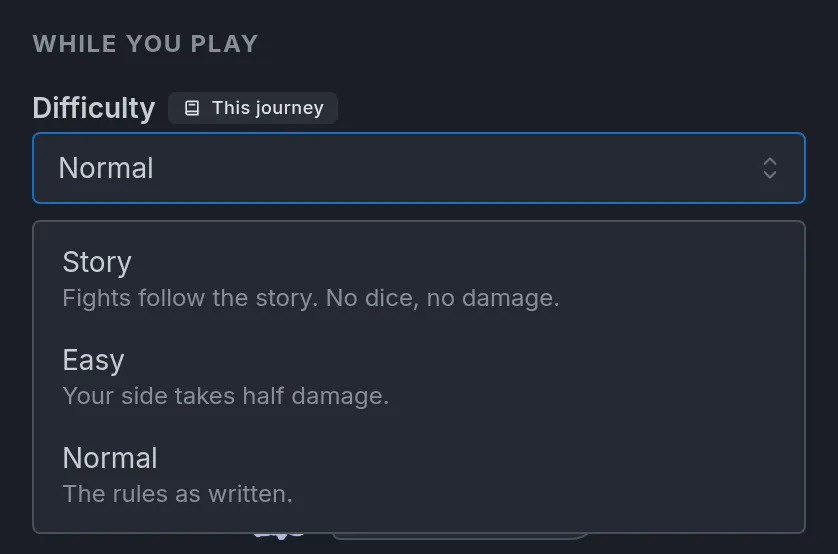
- The label is the setting's name with a This journey tag. Its tip reads "Only changes this journey. Your other journeys keep their own choice."
- The info button, next to the label, opens the Narrative battles window. See The info window.
- Under the label, the host reads the setting's Description when it has one. Everyone else reads "Only the host can change this."
- The list holds every option of the setting, including those with no rules. When none of them has Narrative battles on, a Narrative value follows them at the end. Under each name sits its Player-facing description, on two lines at most. When that is empty, a summary takes its place. For a narrative option it reads "The storyteller runs fights as part of the story." For the others it is "Damage taken 50%", "Damage dealt 150%" or "The rules as written". The summary's wording differs from the editor's labels.
In a shared journey the host's choice applies to everyone, and guests cannot change it. See Playing together. The dropdown is also disabled while a turn is being written.
Settings that carry no fight rules are not listed there. When no setting carries rules, the block holds a built-in Battles choice instead, with Battle system and Narrative. The whole block is absent when Fights is off or when the world owner's account lacks the beta.
What a switch changes
A switch applies from the next turn. The storyteller is told once that the host changed the setting, and to which option. When the change turns narrative battles on or off, it is told that too. From then on it reads the new option's name and Instructions. A beat with a condition on the setting reads the new choice too.
What an option does to the start is not replayed: the place, the clock, the trackers, the cast and the introduction stay as the journey began. Lore and instructions limited to one option were set aside at the start and do not come back.
When the host goes back to rolled fights in the middle of a fight, the fight carries on rolled from the next turn and its marks return on the stage.
Picking the option already in use changes nothing.
Limits
- Damage the party takes and Damage the party deals: whole numbers from 25 to 200.
- Settings: 30 per world, 30 options per setting.
- Setting Name: 120 characters. Description: 2,000. Section: 80.
- Option Value: 200 characters. Player-facing description: 300. Instructions: 8,000.
Common mistakes
- Fight rules without Fights. The percentages and the Narrative battles switch do nothing while the world's Fights card is off.
- A description that explains nothing. The start page shows no numbers. If Player-facing description does not say what the option does, the player cannot know.
- Counting on the storyteller to play the difficulty. It is not told the percentages. Put what it should do differently in the option's Instructions.
- Percentages on a narrative option. They are ignored while Narrative battles is on.
- A description that promises no dice or no damage. In narrative battles the storyteller can still call for a check and wound the party, and a fight can still be lost. Keep such promises out of the option's Player-facing description.
- A hand-made setting with no rules. A setting called Difficulty whose options carry no fight rules is not a difficulty: it never appears under While you play, and the button still shows and adds a second one.
- Editing an option for journeys already running. A journey takes its fight rules when it starts. Changing an option's percentages later affects new journeys, and a running one changes only when the host switches the option.
- Expecting a switch to replay a start. Changing the option mid-journey changes the fight rules and the instructions, not the place, the trackers or the cast.
- Looking for the Fight card on Story. Narrative battles have none, and no end card either. The rewards are paid all the same, and a Spoils card shows them.
Frequently asked questions
Statuses
Learn how to give your Imagina world statuses such as poison, stuns and blessings that the game keeps on characters and counts down. Covers turning Statuses on, writing a status with its duration in turns or story time, stacks and effects, the abilities, characters, enemies, items and beats that give and remove it, items that give a status while carried, cursed items, what players see, and party play.
Playing together
Learn how the RPG system behaves when several people play one journey of your Imagina world, covering whose account counts, each guest's sheet, Experience and points, abilities, money in shops and trainers, enemy levels, fights, statuses and the party screen.