Fights
Learn how the Fights switch lets the game roll every blow and work out damage before the story tells it, covering Strength, rewards for beaten enemies, out rules, the player's empty Health, defeat and respawn, boss phases, bars on stage, the fight card players see and narrative battles.
Beta
The RPG system is in beta and only accounts with the RPG beta can set it up. It may still change.
With Fights on, the game settles a fight and the storyteller tells it. When someone attacks a character who has bars (Health, Morale and so on), the game rolls each blow, works out the damage, moves the bars, takes out whoever drops and pays Experience and loot. Only then is the turn written.
Two companions complete it. Out rules name what happens to a character whose bar reaches its end, and Bars on stage shows those bars over the characters during play.
Turning it on
Open RPG game system → Features (Game rules → RPG game system while the system is off), turn on Enable the RPG game system, and find step 4, Fights. Two cards matter here:
- Fights: "Attacks roll automatically. Defeated enemies drop Experience and loot." It needs both Character stats and NPC sheets. Without them its switch is disabled and the card shows the chip "Needs NPC sheets and Character stats", with a Turn them all on button. It is off until you turn it on. While Bars on stage is off, a line on the card reads "Shows health and resource bars over characters in fights.", followed by a link, Turn on Bars on stage.
- Bars on stage: "Shows health and resource bars over characters on stage." It needs NPC sheets, and shows the chip "Needs NPC sheets" without it. A new world starts with it off, and Classic RPG, Party adventure and Monster fights turn it on.
A card whose requirement is off cannot be switched. Your choice is kept and comes back when the requirement does.
Fights does not need Enemies. A duel against an ordinary character works, as long as that character has bars. Fights does not need dice either: see Dice and fights.
A world can also bend these rules one journey at a time, through a setting the player picks: fights told by the story instead of rolled, or a percentage on the damage the party takes or deals. With Fights on, an account with the RPG beta sees an Add difficulty setting button on the Fights card, which creates that setting. See Difficulty. Whatever your settings, the player can also have the storyteller run the fights, with no blow rolled and no Fight card: see Narrative battles.
Once the cards are on, every NPC page and every enemy page carries a purple RPG game system box. Under its Sheet sit the parts this page covers: Fights, Defeat scene and Out of the fight. An On a hit part gives statuses on landed blows. The bars a fight moves are the ones on that sheet, so start with Character sheets.
Combat rules and stage bars
A fight runs in exchanges, one per player action. In each exchange the player's side acts, the opponents answer, and the game resolves every blow before any prose exists.
What the storyteller decides
- Whether it is a fight at all. An attack, a spell or any attempt to hurt, break or win over a character who has bars is an exchange. Words, threats, sneaking and a fight that is only talked about are not.
- The moves. Which party members join in (up to three characters act, once each), which opponents answer and whom they hit (each once, a Boss twice, three answers at most), which ability is used, and whether an improvised move is light, solid or heavy. Opponents do not hit back on their own. They answer only when the storyteller has them answer.
- The bar. Health by default, or another bar such as Morale. A bar named on the opponent or on the ability comes first: see A second bar.
- Defending and fleeing. Either side can defend. Only the player's side can flee.
- The story around it. Ending a fight, having someone yield or run, bringing reinforcements, changing a character's level, and what follows when the player is out.
What the game settles
- One roll per blow. The chance to land depends on the defender's Strength and on the level gap: 5 points per level, counted over 10 levels at most, and always kept between 10% and 95%.
- The damage. It comes from the bar's size and Strength, then from the result (a critical hit counts one and a half times, a graze half), the move (light half, solid full, heavy one and a half) and the level gap (10% per level, 50% at most either way). A blow that lands always takes at least 1.
- Defending. A defender deals nothing that exchange. Blows on them land 20 points less often and for half.
- Fleeing. It is rolled like an attack. On a success, the blows aimed at the fleeing character that exchange miss. On a failure, they land. When a flight succeeds, the fight ends as fled: see When a fight starts and ends.
- Abilities. An ability is paid first, from the caster's own Energy and any reagents. One that cannot be paid or is not ready fizzles: no damage, nothing spent, and the opponents still answer. An ability hits one and a half times as hard as a solid blow, plus a quarter per rank above the first, up to two and a half times. In a fight an ability deals damage and gives or takes off the statuses set on it. Healing and other effects are applied the usual way. See Abilities.
- Statuses. A fighter under a status that stops them acting has their move skipped. A status can also change the chance to hit and the damage dealt or taken, on every blow, and a landed blow gives the statuses set in the attacker's On a hit part. See Statuses.
- Who goes out. The out rules of the character decide, and an emptied bar with no rule ends as Defeated. A guest's character in a shared journey follows the player's setting instead: see When the player's Health is empty.
- Rewards. Experience and loot for a beaten enemy, once.
The storyteller writes the turn after reading the result and is told to keep numbers out of the prose: no damage, no totals, no Health left. The numbers live on the fight card. It also cannot count a blow twice. A second cut by hand to a bar the fight just moved, a second payment of Experience the fight just paid, or a second copy of loot the fight just delivered is refused once. Healing is never refused.
Levels only matter as a gap. The game levels no one up after a fight by itself, unless a progression track set to At an amount of Experience reaches its amount with the Experience the fight paid. Otherwise the storyteller may. See Levels and points.
Who fights on which side
The player's side is the player, the companions in the party and, in a shared journey, the guests' characters. With Party system off, a companion is on the player's side when their stat block's Threat / disposition reads friendly, such as "Allied". They never target one another. A character with no bar cannot be fought this way, and the storyteller is told to give them a sheet first.
The bar a blow lands on is the target's Health when nothing else is named. If the player has no Health bar the game can find, blows aimed at the player do nothing.
In a shared journey each player's action is its own exchange and everyone sees the same card. A move with no name on it is the acting player's character's, and the rewards line names each member. See Playing together.
Dice and fights
Fights work with dice on or off. See RPG mode and dice for the settings.
- Dice off. The game makes a hidden roll out of 100 for each blow. Nothing appears in a dice tray. The top five results are critical hits, and a roll that misses the hit line by 10 or less is a graze.
- Dice on. The game rolls your world's dice against the difficulty closest to the blow's chance. On a d20, a 75% chance needs 6 or more. A critical hit exists only when Critical margin (optional) is set, and a graze only when Near misses is above Off. Otherwise a blow is a hit or a miss. The player's own blow counts as one of the turn's dice rolls. The other rolls only show on the fight card, as a hit or a miss.
When a fight starts and ends
Every fight has a start and an end, and a journey runs one fight at a time.
A fight starts when one of these happens:
- The first blow is struck: a rolled exchange, or in a told fight the first hit on someone's bar.
- Someone who is not on the party's side is taken out.
- Hostile enemies arrive, brought in by the storyteller or by a Bring in enemies effect.
- The party aims an ability or a status at someone who is not on its side.
An enemy whose Threat reads as peaceful starts no fight by arriving. That covers a Threat written as an ally, and one with a word such as peaceful, passive, harmless, neutral, docile, tame, friendly or skittish. A grazing deer written as an enemy is one.
No card marks the start. The stage switching to its fight layout is the signal: see The stage in a fight.
How a fight ends
A fight ends once, with one of four outcomes:
- Won: nobody who fought the party is still standing, and the last ones went down beaten.
- Lost: every fighter on the party's side is out, with When the player's Health is empty on Out of the fight. That means the player, every other player's character in a shared journey and every companion who fought. An End the fight effect on Lost ends it the same way.
- Fled: the player's flight succeeds in the exchange, the party ends up somewhere else on a turn where nobody fought, or the storyteller says the party got away.
- No winner: nobody stands and the last ones went out without being beaten, as after a truce or when they are let go. The storyteller can also end it this way (a truce, a fight talked down or interrupted). So do two turns with no blow, no bar moved and nothing done in the fight.
The storyteller can always end a fight as fled or with no winner. It can never declare a win or a loss on its own. To win, it takes the last opponents out, and the game ends the fight as won on that same turn.
An End the fight effect ends the fight as Won or Lost. When the game already ended the fight on that turn, the effect changes nothing. With A beat decides, a loss needs that effect: see A beat decides.
The end card
Each fight leaves one card, on the turn it ended, under that turn's Fight card. Its title follows the outcome: Fight won, Fight lost, Fled or Fight over. The storyteller's few words on how it ended, such as "a truce", show next to the title. The card takes the world's RPG look, like the Fight card.
It holds:
- Who was beaten. A loss names who won instead, a truce who stops fighting and a flight who is left behind.
- The Experience and loot of the whole fight, not only of the last turn.
- The companions' Experience.
- The levels gained during the fight.
- How many turns the fight lasted.
On that turn the Fight card drops its rewards line and no Spoils card is drawn. The end card's totals include them.
On the next turn
The turn that ended the fight still shows it. The turn after is different:
- The stage leaves its fight layout: no opponent side, no bars over the characters, no out chips, no party plates and no battle sprites.
- Beaten enemies leave the cast. Enemies still standing after a truce or a flight stay in the story for a while and leave when the story stops using them. After a lost fight, the winners stay for two turns, the time of the defeat scene.
- Statuses that last until the fight ends stop at the start of that turn.
- The storyteller is told that the fight is over and how.
Narrative battles
Every journey of a world with Fights on gives the player a choice called Battles. Battle system, the default, is what the rest of this page describes: the game rolls each blow and shows the fight on screen. With Narrative, the storyteller runs each fight as part of the story and the game rolls no blow.
Like the rest of the RPG system, the choice needs the world owner's account to have the RPG beta.
Where the player chooses
At the start, the choice sits among the world's settings: behind the cog, or on the How it begins step when the world shows its settings as a step. Its shape depends on your settings.
- No setting carries fight rules. A built-in setting named Battles is added, with two values: Battle system ("The game rolls each blow and shows the fight on screen.") and Narrative ("The storyteller runs fights as part of the story.").
- A setting carries fight rules. That setting, a difficulty, is the control. When one of its options has Narrative battles on, such as the Story option of the Add difficulty setting button, that option is the narrative choice and nothing is added. Otherwise a Narrative value is added for the player at the end of the setting's options.
During the journey, the same control sits in Journey settings, on the Story tab, under While you play.
- Only the host changes it. Guests see it greyed, with "Only the host can change this." In a shared journey the host's choice applies to everyone.
- Not during a turn. It cannot be changed while a turn is being written.
- From the next turn. A change applies from the next turn. When the host goes back to the battle system in the middle of a fight, the fight carries on rolled from the next turn and its marks return on the stage.
The info window
An info button next to the control opens a window titled Narrative battles. It opens with "The storyteller runs each fight as part of the story. There is no battle screen and no automatic exchange of blows." Then come these lines:
- "It can still call for a check when a move could go either way." Only on a world with dice on.
- "It can still wound you and your companions, and a fight can still be lost."
- "Experience, loot, levels and quests work as usual."
- "This world has 1 story moment that only happens with the battle system." Only when the world has such beats, with their count: see The beat that never fires.
The window ends with "You can change this later in Journey settings."
What the storyteller does
- Each move. The game rolls no blow, and there is no exchange. The storyteller decides how each move goes from the story and the player's action, as on a world without Fights.
- Checks. On a world with dice on, it may call for a check when a move in a fight could go either way, and it tells the result as it fell.
- Bars. It lowers bars by hand on both sides, sized to the blow: an opponent's bar, and the bar of the player, of a guest's character or of a companion. No numbers go in the prose.
- A loss. The party can lose. When the player gives in, stops resisting or is overwhelmed in a fight they are losing, the storyteller brings their losing bar to its end. That bar is Health, or the bar the opponent's blows go at. This is what tells the game the fight was lost.
- Blows on another bar. The blows you set to land on another bar, with Their blows go at or an ability's Hits, are listed for it, to be written on that bar. See Which bar a blow moves.
- Knocked out, never killed. The characters set to Knocked out, never killed are named to it as before.
What the game still does
- Rewards. A beaten enemy pays its Experience and loot once, when a bar reaches the end its rules name or when the storyteller takes it out. A hand grant of the same Experience is refused once.
- The fight's start and end. A fight still starts, and still ends with one of its four outcomes. Beats on A fight starts, The fight ends and The fight is won still fire.
- When the player's Health is empty. On Out of the fight, the player is marked out, and the fight is lost once everyone on the party's side is out. On A beat decides, your beat fires after the turn. The bars under A character also falls when count the same way.
- Defeat and respawn. Defeat scenes, losing a life and waking at the respawn point all work. In live runs on a demo world with lives, 4 narrative battles lost cost 4 lives and ended in 4 wakes. See Defeat and respawn.
- Statuses. They keep ticking. A status given on a hit is given by the storyteller when the story calls for it, not by a roll.
- Beats on a bar level. A beat on an enemy at half Health, or on the player at 40%, fires whenever the storyteller writes that bar.
- Defeated as. A beat with Defeated as fires when the enemy went out under that rule's label. In live runs, 13 of 17 beaten enemies went out on a bar rule. The others went out under a label of the storyteller's own, such as "Yielded". Leave Defeated as empty on a beat that must fire however the enemy went out.
The beat that never fires
One kind of beat needs the battle system: A character or enemy is defeated with Defeated by naming anyone other than a player character, such as a companion. Only rolled blows record who struck last. In narrative battles every win is credited to the player character.
Such a beat shows a warning in the beat list and in the beat editor: "fires only with the battle system: in narrative battles every win counts as the player character's, so "by Brannoc" never matches".
The player's info window counts these beats. Any player can choose narrative battles, so keep a moment the story needs off such a beat.
What the player sees in a narrative battle
A narrative battle has no battle screen.
- On the stage: no bars or plates over the fighters, no fight formation, no battle sprites and no status chips. Enemies still stand on the stage as characters.
- Under the turn: no Fight card and no end card, whether Fight won, Fight lost, Fled or Fight over. The visual novel's History has no "Fight recap" line.
- Spoils: a Spoils card under every turn that paid Experience or loot, the last turn of a fight included.
- Bars: the character sheet, the trackers and the party screen still show them.
Nothing to set up
Narrative battles need nothing from you. No field of the world turns them on, and nothing turns the player's choice off.
An option with Narrative battles on in a difficulty is the same mode as the player's choice: same instructions for the storyteller, same display. It only makes narrative battles your world's default, when that option is the setting's Default Value. See Difficulty.
Strength
In the Fights part of a character ("How hard they hit and how many blows they take."), Strength sets how tough an opponent is. It is Average unless you change it.
| Strength | Ordinary hits to empty its bar | Share of the player's bar its ordinary blow takes | Chance a blow lands on it, at equal level | Default Experience per level |
|---|---|---|---|---|
| Trivial | 1 | 4% | 90% | 2.5 |
| Weak | 2 | 6% | 85% | 5 |
| Average | 3 | 9% | 75% | 10 |
| Strong | 4 | 12% | 70% | 15 |
| Elite | 6 | 15% | 60% | 25 |
| Boss | 8 | 18% | 55% | 50 |
A Boss also answers twice per exchange, where everyone else answers once.
With 100 Health on both sides and equal levels, Mara's solid hit takes 34 from an Average opponent, 25 from a Strong one and 13 from a Boss. An Average opponent's blow takes 9 from her, a Boss's takes 18. An attacker three levels above the target deals 30% more and lands 15 points more often.
As a rough guide, with dice off, a fight against an Average or Strong opponent of the player's level lasts four or five exchanges, and an Elite alone about eight. Alone, the player wins about half the time against an Elite and loses to a Boss. Two companions turn an Elite into a fight the party wins.
Strength only counts for opponents. The player is always average, and so is a party member, whatever their page says. Brannoc fights at average strength for as long as he rides with Mara. An enemy brought into the story reads the Strength of its template, and a character the storyteller invents is average.
Rewards for beaten enemies
On an enemy page (see Enemies), the Fights part has two more fields.
- Experience: "Given once for each one beaten." On a world with two or more progression tracks, there is one box per track, the main track first, and the rest of this paragraph is about each of them. Left empty, the amount is 10 times the enemy's level, times the factor of its Strength, and the field shows that default in grey. The level used in play is the one the enemy arrives with, such as the level of the place it attacks in (see Encounters), so the grey number can differ from what is paid. A number you type, from 0 to 100,000, is paid as is at any level. The Bandit's 30 Experience is 30 whether he arrives at level 5 or level 7. Type 0 and the enemy pays nothing.
- Loot: up to 6 lines. Each line has an item from your world's items (Pick an item), a chance from 1 to 100 percent (empty means always) and a quantity from 1 to 99. Every line is rolled once on its own chance, and what drops goes into the player's bag. The Bandit's Healing Herb at 50% drops in about one fight out of two. With no item in the world yet, the part reads "Loot comes from the world's items." See Items and inventory.
The game pays when an enemy goes out of the fight, whether an out rule fired, the storyteller took it out or it was killed. It pays once per enemy, even if that enemy is brought back and beaten again.
- Experience goes to the row the game reads as the player's Experience, or, with progression tracks, to each track's Experience. If the world has neither, nothing is paid.
- Companions each receive the same amount on their own record, in worlds that use the built-in trackers or progression tracks. It is not split. With Party system off, a companion is read by stance, as for level-up points: one whose Threat / disposition reads friendly. A Starts in the party mark alone earns nothing then. In a shared journey, each guest's character that has a sheet receives the same amount.
- No win, no reward. When an enemy runs or is let go, the storyteller can take it out without the reward.
Only enemies pay by themselves. Odran Hask, written as an ordinary NPC, pays nothing when he falls, and the storyteller grants what he is worth as it always did.
Out of the fight
An out rule says when a character is out of the fight and under which word. The part reads: "When a bar reaches its end, the character is out of the fight under your label. They stay in the story. Without a label, it reads Defeated."
Each rule is one sentence: When a bar is empty or is full, out as your label.
- The bar. Type it or pick one of the suggested bars, which come from the character's sheet and the world's. A blank field shows Name a bar. A name the sheet does not have shows Not on the stat block, and that rule never fires. Up to 40 characters.
- The end. is empty for a bar that drains to 0, is full for one that fills to its maximum. There is no threshold in between.
- The label. Up to 24 characters: letters, digits, spaces and dashes. A yellow note says when it cannot. The grey hints (Defeated, Yields, Overcome, Spent, Fled) are suggestions, not a list. Left blank, it reads Defeated.
Add rule adds another, up to 4 per character. Rules are read in order and the first one that fires names the label.
The Bandit has one rule: when Health is empty, out as "Runs off". He leaves the fight under that word instead of dying, and the storyteller writes the rest.
A rule set to is full changes how blows work on that bar: they fill it instead of draining it. A Fear bar with "When Fear is full, out as Fled" rises with every blow aimed at it.
A character with no rule of their own is still taken out when a blow empties their bar, under Defeated.
An out that came from a rule lifts by itself when the bar leaves its end, so a healed character is back in. An out the storyteller declared stays until the storyteller brings the character back.
Out rules are for NPCs and enemies. The player's side has two settings of its own: what an empty Health does, under When the player's Health is empty, and the other bars that defeat a player character, under A second bar.
Knocked out, never killed
A companion can be kept from dying. On a character page, the Fights part of the purple RPG game system box has a When they fall field while Fights is on: "For a companion or a character who may join the party."
- The story decides: the default. The character can die.
- Knocked out, never killed: the character is knocked out and gets back up.
Knocked out, never killed opens a second field, Gets up with: "Of the bar, once the fight is over." It is a percent from 1 to 100, 10 unless you change it, and always gives at least 1 point.
Enemy pages do not have these fields. A named opponent set this way keeps the setting when they later join the party.
Such a character is knocked out when their Health runs out, or when another bar named in their Out of the fight rules reaches its end. They are out of the fight under that rule's word and cannot act. Brannoc, set this way, falls to a Bandit's blow, sits out the rest of the fight and is up again at the start of the turn after it ends.
The storyteller is told never to kill them. If it tries to mark them dead, the game refuses, every time. An out word that reads like a death, such as "Slain" or "Killed", is refused for them too. A beat can still kill them, since a beat is your own choice.
When they get up:
- After a fight: at the start of the turn after the fight ends, whatever the outcome, with their share of the bar.
- Outside a fight: two turns later, as after a trap or a poison.
- On a heal: at once, when the heal comes before then.
A character or enemy is defeated still fires when they are knocked out, so a beat can react. Its Beaten as field can match the knockout word.
Player characters are not affected, and neither are other players' characters in a shared journey. Their fall stays ruled by When the player's Health is empty.
On The story decides, the character can die. For one the story cannot lose, add a beat on A character or enemy is defeated with Who on that character, and have it offer a quest to bring them back. See Quests.
When the player's Health is empty
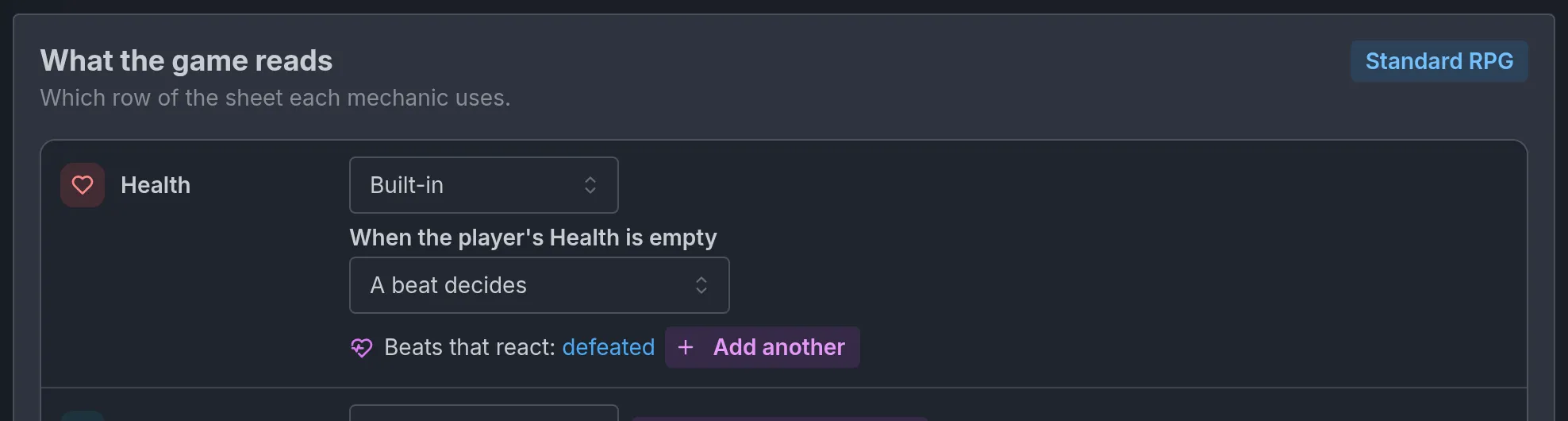
On the Linked fields card, under the Health row, When the player's Health is empty has three options. It appears while Fights is on and Health is not set to None.
- The story decides: the default. The storyteller plays an empty Health as it sees fit.
- Out of the fight: the player's character is marked out under the word in Shown as, up to 24 characters. Left blank, it reads Down.
- A beat decides: nobody is marked out. The turn ends on the fall, and a beat you wrote takes over from there.
In a shared journey, a guest's character follows the same setting.
With Out of the fight, the moment Mara's Health reaches 0 she is out under "Down" and the storyteller is told. When a blow in the fight caused it, the card says "Mara is out: Down". There is no game over. She cannot act in a fight, and opponents find no one to hit, until her Health rises above 0. That clears it. What happens in between (a rescue, a capture, waking up at the Wayside Shrine) is the storyteller's to write, so say in your instructions what losing means in your world.

Going back to The story decides also erases the word you typed.
A beat decides
With A beat decides, a line on the card lists the beats that react: "Beats that react:" followed by each beat's id, as a link that opens it. A beat is listed when one of its conditions, alone or inside a Match any of group, reads Health on The player character or Any player character and passes when it is empty (or at or below 0). In the beat editor, the empty form of that condition is titled A player character is defeated. A beat whose condition has How on Any way is listed too: see A second bar. With none, the line reads "No beat reacts yet." in orange.
The line does not count every beat that works. One set to Every player character, or reading a bar other than Health, fires in play and is still not listed, so the card can read "No beat reacts yet." over a world that has one.
Add a beat for it adds a beat and opens it. Once one exists, the button reads Add another. This is the quick version of a knockout: Health comes straight back and a card says so. The new beat is an ordinary one, yours to edit or delete, and it comes filled in:
- Its id is
health-empties, thenhealth-empties-2and so on. Rename it if you like. - Its condition is A player character is defeated on Any player character, Health, Is empty.
- One-shot is off, so it can fire at every fall.
- Describe to AI (one-shot) reads: "Their Health ran out at the end of the previous turn. Open with them coming to some time later, back on their feet, their Health restored. If others in the party are still standing, they carried them to safety."
- It has two effects: Set character bar on The character whose bar crossed, Health, Full, and Show story card with the Omen look and the title "Knocked out".
On a world where another bar can defeat a player character (see A second bar), the beat comes filled in for those bars as well:
- Its condition has How on Any way in place of Health and Is empty.
- It has one more Set character bar for each losing bar, which puts that bar back at its safe end. A Dizziness bar that ends full goes back to 0.
- Describe to AI (one-shot) reads: "They fell at the end of the previous turn. Open with them coming to some time later, back on their feet and recovered. If others in the party are still standing, they carried them to safety."
The card is there for a reason. The beat refills Health right after the fall turn, so without a card the player would see that turn's Fight card at 0 Health above a sheet at full Health. The card says what happened.
The quick beat ends no fight, plays no scene and moves no one. A fall that costs a life, plays the winner's scene and wakes the party somewhere else is built by hand: see Defeat and respawn.
With A beat decides the game marks nobody out, so it never ends a fight as lost by itself. Give the setting a beat with End the fight on Lost. Without one, a fight where everyone is at 0 ends when the storyteller ends it or after two quiet turns, with no winner. See How a fight ends.
How a fall plays out
The storyteller writing the fall turn is told that a beat of yours takes over once the turn is written, so it ends the turn on the fall and tells nothing of what comes after: no rescue, no waking up.
With the quick beat, the beat fires right after that turn and its effects land on it. Mara's Health reaches 0 on a Bandit's blow and the prose stops as she falls. Under it sit the Fight card, with her Health at 0, then the Knocked out card. The blows come first and the fall after them. Her sheet, and her bars on stage, already show Health full.
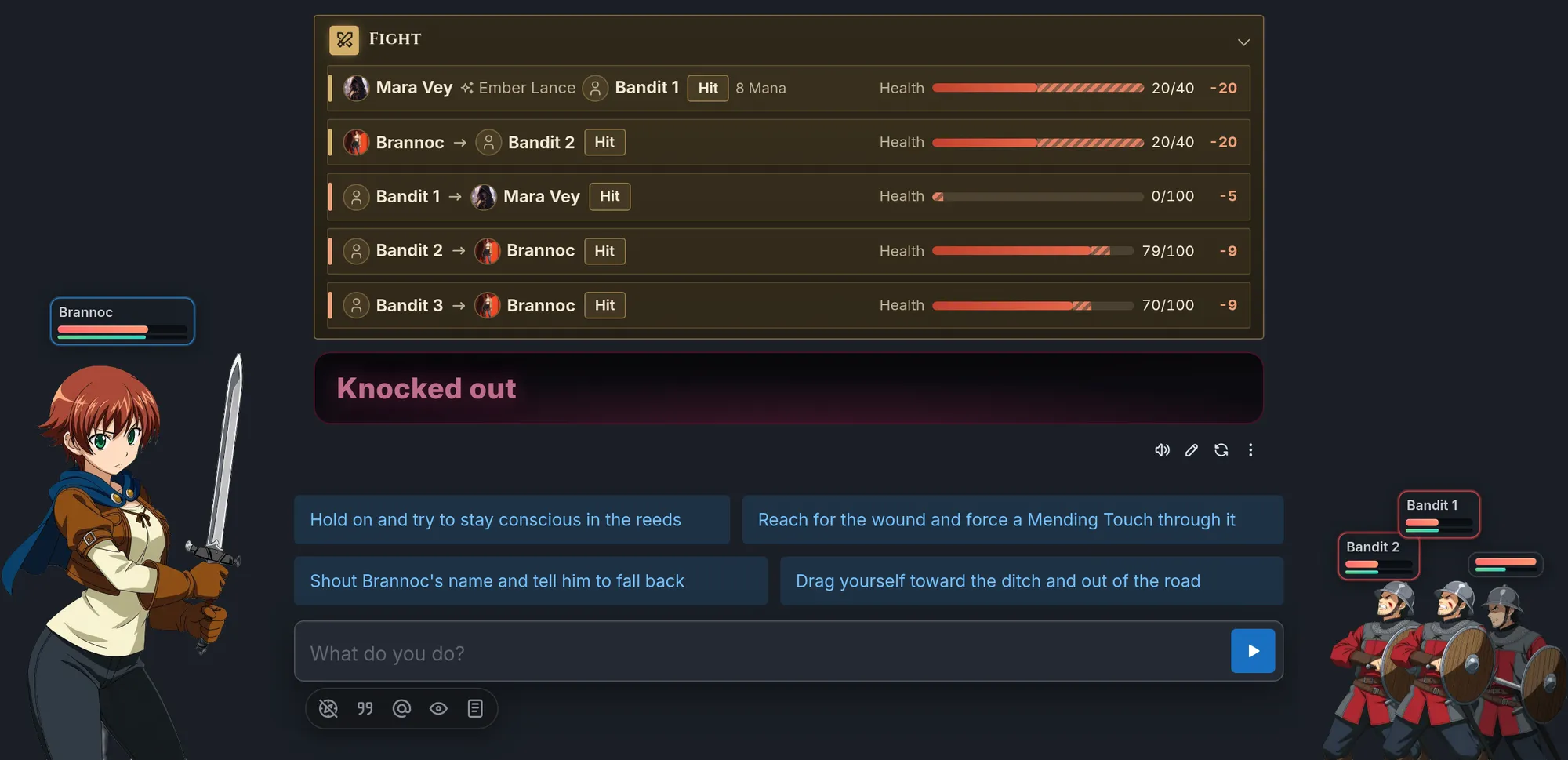
The beat's text comes one turn later. At the start of the next turn, the storyteller reads a line naming who fell ("Mara Vey's Health ran out."), then your Describe to AI (one-shot) text, as something that happened at the end of the previous turn. It is also told what Set character bar already wrote, so it does not write it again. Write the text as what follows the fall, already happened: "Open with them waking at the shrine".
A blow is not the only way down. A fall or a poison the storyteller writes empties Health too, and the beat fires the same way.
With no beat reacting, nothing refills Health. The player stays at 0, and the storyteller was still told to stop at the fall. Add the beat.
In a shared journey
With A beat decides, a guest's character is not marked out either. Any player character catches a guest's fall and names that player in the line the storyteller reads, and The character whose bar crossed acts on that player's character. A condition on The player character reads the host's character only. When two players go down at once, the beat fires for the first now and for the second at the next check. On Every player character, the beat waits until every player character's bar is empty at once and fires a single time for the party. The character whose bar crossed then refills all of them. Everyone sees the same result.
The scene is shared, with no place per character. An effect that moves the scene, Move scene to location or Go to the respawn point, moves the whole party and not only the one who fell.
A second bar
A fight can be won or lost on a bar other than Health, in either direction. A brawler is knocked out by Dizziness and not killed. Poison builds up on a Toxin bar, a spirit is purified through its Corruption bar, morale breaks on a Morale bar, a beast is tamed through a Trust bar. On an adult world, the same settings run a seduction fight on a Lust bar.
All of it needs Fights on, except the beat conditions, which are offered with the rest of the purple group of the beat picker.
The examples here come from one small world. Behind the Copper Inn, Dunmore the pit master runs the Fighting Pit, where Tamsin Hale fights the Pit Brawler. Each of them carries a Dizziness bar that starts at 0 beside their Health: hers holds 40, his 30.
Which bar a blow moves
A plain attack goes at the target's Health. Two fields name another bar.
- Their blows go at: on a character page or an enemy page, in the Fights part of the purple RPG game system box, next to Strength. Its list has two groups. Roles holds Health, the default, and Energy. Bars holds the bars the player characters carry: the bars of the character sheet and of the sheet template, and the starting meter trackers. Every blow that character lands goes at that bar of its target, and so does every blow of a copy of that enemy.
- Hits: in an ability's window, in a purple box titled In a fight, between the ranks and Statuses. The list is the same, and its Bars group holds the player characters' bars and the bars on the cast's stat blocks. Every blow with that ability goes at that bar, whoever uses it: the player, a companion or an enemy. The box shows while Fights is on. See Abilities.
Each field takes one bar. The Pit Brawler's blows go at Dizziness, and Tamsin's Stunning Blow has Hits on Dizziness.
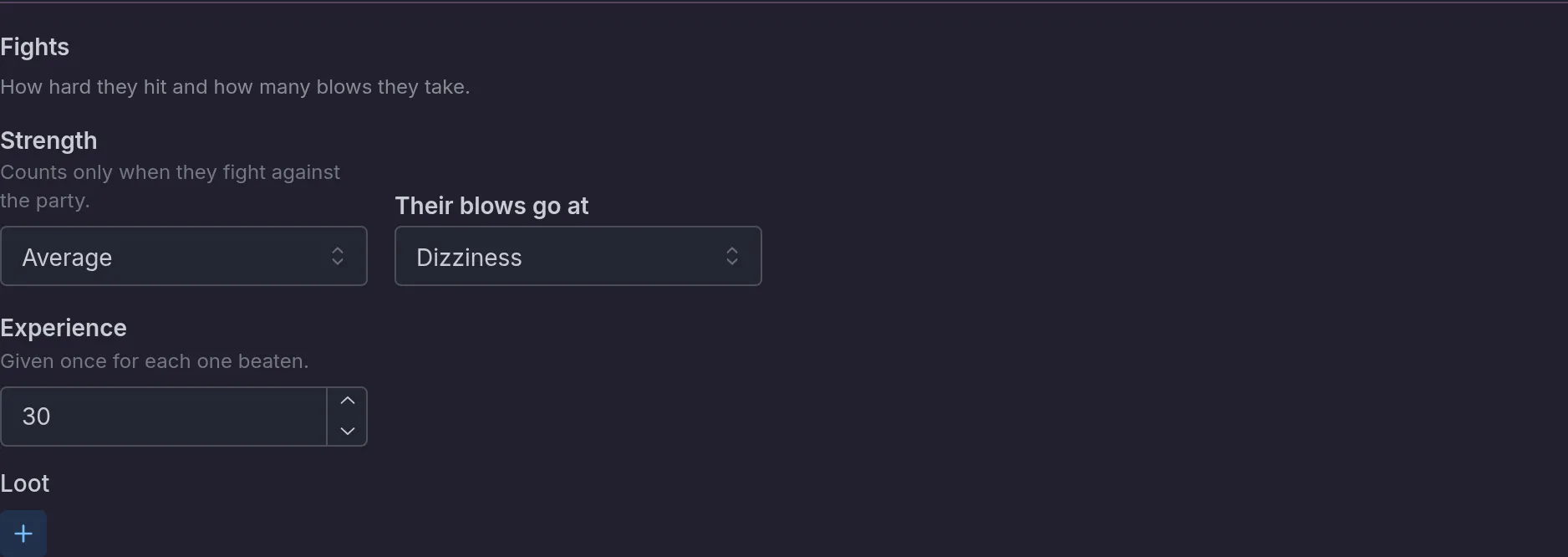
When more than one of them could apply, the first in this order decides:
- The Hits of the ability used.
- For an opponent's blow, that opponent's Their blows go at.
- The bar the storyteller picked.
- Health.
The storyteller can still aim a plain blow at another bar when nothing above it in the list names one.
A target that does not have the bar takes the blow on Health, and the storyteller is told. The editor warns before that: under either field, a bar that nobody carries shows an orange line, "No one carries this bar, so the blow lands on Health."
Whether a blow fills the bar or drains it follows the target:
- An NPC or an enemy: its own out rules decide. A bar whose rule is is full fills.
- The player's side: the world's losing bars decide, covered next. A bar that defeats them when full fills.
Any other bar drains. The Fight card shows the bar that moved, its gauge filling or draining, and the out label.
A character also falls when
The player's side can lose on other bars than Health. On the Linked fields card, in the Health row, these bars sit right under When the player's Health is empty. They show while Fights is on and Health is not set to None.
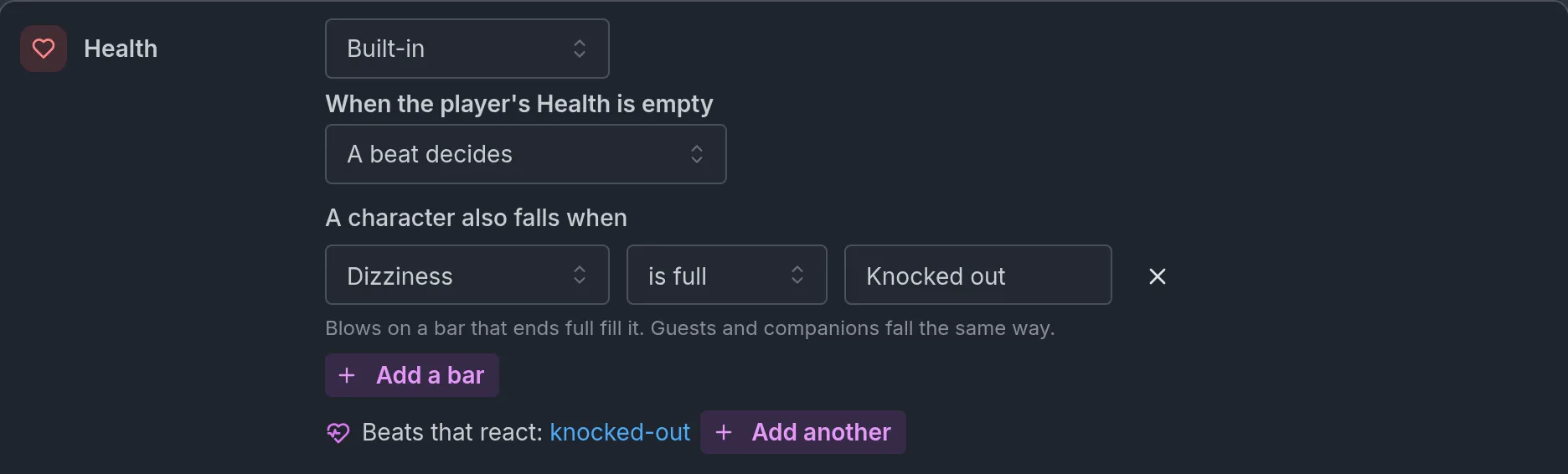
Another bar can defeat them adds the first row. The button is there once the player characters carry a bar other than the Health row. With a row in place, the title A character also falls when shows above the rows and the button reads Add a bar. A world holds up to 3 rows, and each one has:
- The bar. Pick a bar lists the player characters' bars, without the Health row. Each bar can be picked once.
- The end. is full or is empty.
- The word. What the character is shown as, up to 24 characters. Left blank, it is the word of the Health setting, Down unless you typed one.
Remove, at the end of a row, deletes it. Under the rows, a line reads "Blows on a bar that ends full fill it. Guests and companions fall the same way."
The Fighting Pit has one row: Dizziness, is full, "Knocked out".
The rows stay whatever When the player's Health is empty says. Each option uses them its own way:
- The story decides: the storyteller plays the fall. The rows still decide which bars fill.
- Out of the fight: the first rule at its end marks the character out under that row's word. The mark clears once no rule holds any more, which means the bar moved back and Health is above 0. Until then, opponents find no one to hit.
- A beat decides: nobody is marked out, and your beats react.
A guest's character in a shared journey falls by the same rows, read on their own sheet. So does a companion who has no out rules of their own, besides their Health. The storyteller is told about each row in its fight rules.
Once the world has a losing bar, the A player character is defeated condition of a beat has three fields: Whose bar, How and Beaten by. How lists:
- Any way: any bar that defeats a player character, Health or a losing bar.
- Health runs out: Health and nothing else.
- One entry per losing bar, such as "Dizziness is full (Knocked out)".
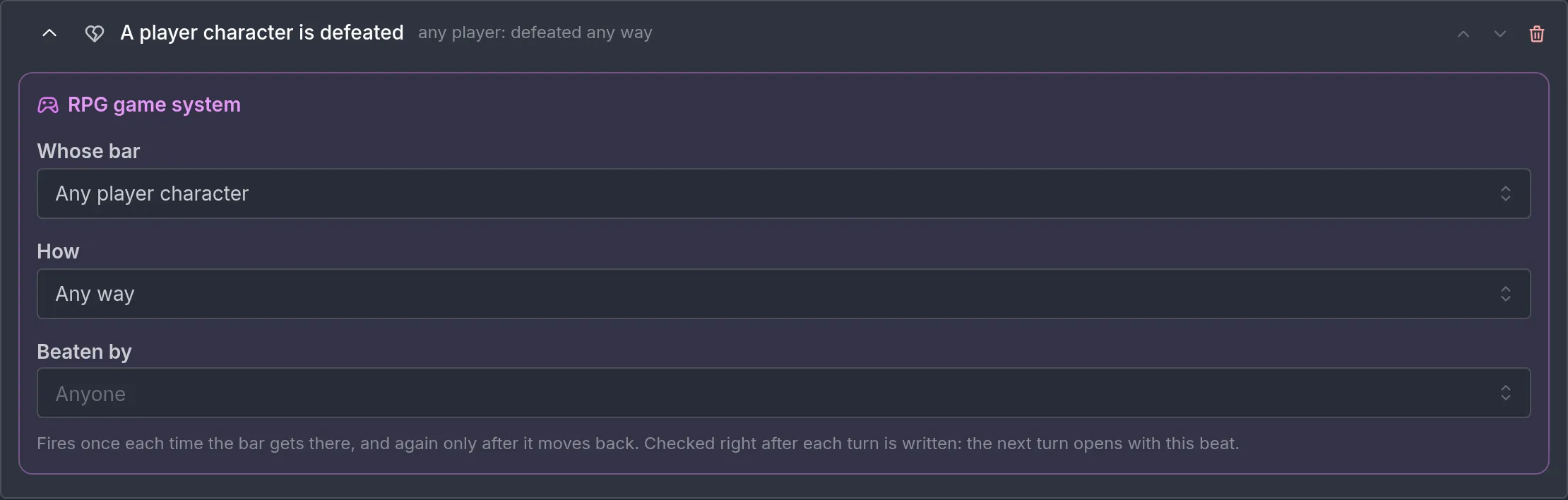
The line the storyteller reads names the bar, as in "Tamsin Hale's Dizziness is full." <<foe>> names whoever beat them, as it does for Health.
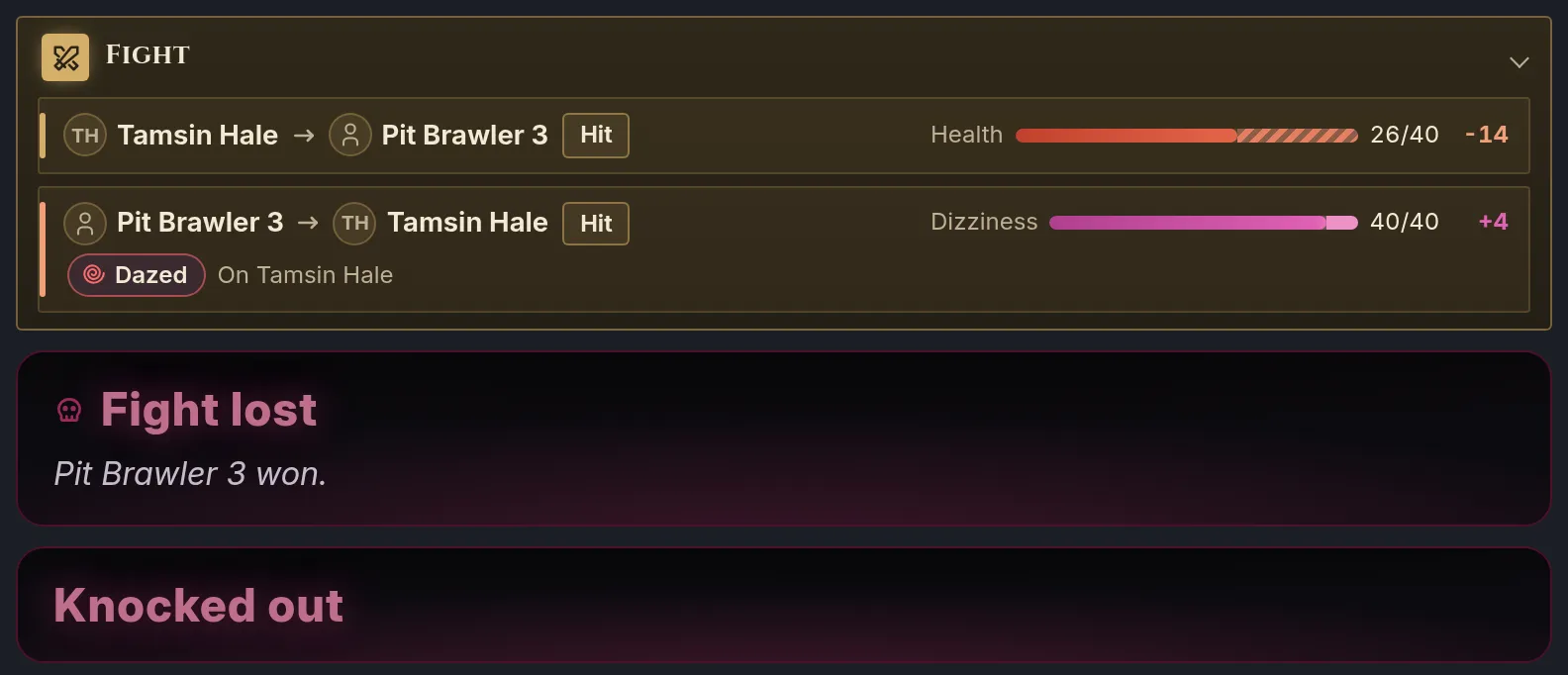
The Fighting Pit is set to A beat decides, and its beat knocked-out reads Any player character and Any way. Tamsin's punch drains the Pit Brawler's Health. His answer goes at her Dizziness, fills it to 40 out of 40 and leaves her Dazed. The beat then ends the fight as lost and puts both bars back: Health to full, Dizziness to 0. Under the turn sit the Fight card, a Fight lost card naming the Pit Brawler and a Knocked out card.
A beat can also warn before the fall. Character bar… reads a bar that fills as well as one that drains: When it also offers Is full, Is at or above a percent and Is at or above a value. It fires once each time the bar gets there, and again only after it moves back. A beat on The player character, Dizziness, Is at or above a percent, 75, can tell the storyteller that one more knock drops them.
Two ways to win against one enemy
An Out of the fight part holds up to 4 rules, each on its own bar with its own label. The Pit Brawler has two: "When Health is empty, out as Defeated" and "When Dizziness is full, out as Knocked out". He goes out under the rule whose bar reached its end first. Experience and loot are paid once per copy, whichever rule ended it.
Tamsin can beat him down with plain blows, which go at his Health, or knock him out with Stunning Blow, which fills his Dizziness.
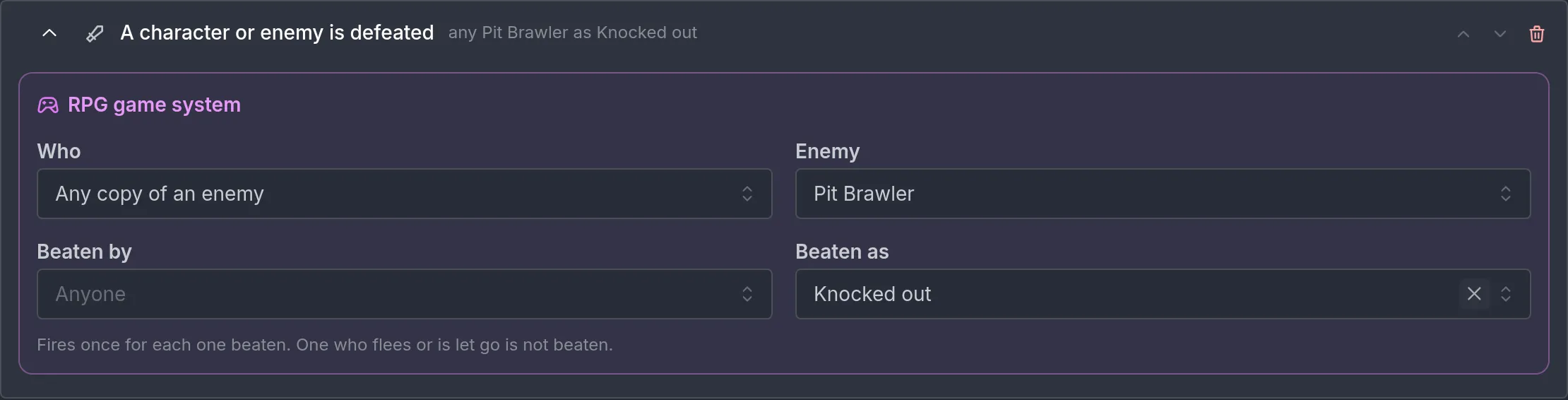
A beat tells the two wins apart with Beaten as, a field of A character or enemy is defeated. It lists the labels that character can go out under: Defeated, plus the label of each of its rules. For an encounter group, or for anyone fighting the party, it lists all of them. The field only shows when there is more than one label to choose from. Left empty, it reads Any way. With a label picked, the condition passes only when they went out under that label.
Use it for a different moment or a different reward per way of winning. The Fighting Pit pays Renown, a tracker, by how the bout ended. Its beat won-by-knockout reads Any copy of an enemy, Pit Brawler, Beaten as Knocked out, and adds 2 to Renown. A second beat, won-by-beating, reads Beaten as Defeated and adds 1. The row of the first one sums it up as "any Pit Brawler as Knocked out".
Statuses that fill a bar
A status that fills a bar each turn can end a fight. Dazed adds 8 to Dizziness per turn. The Pit Brawler's On a hit part gives it at 35%, and Stunning Blow gives it to its target at 50%.
When a status brings a bar to the end of a rule, an enemy's is full rule or a player's losing bar, the same out, beats and rewards follow as after a blow. Whoever gave the status counts as the one who won. The defeat scene and <<foe>> name them.
Words for each way of losing
An enemy has one defeat scene, and it does not change with the rule that ended the fight. To give each way of losing its own words, keep one defeat beat and add small ones beside it:
- One beat on A player character is defeated, with How on Any way, carries the loss: End the fight, Play the defeat scene and the wake beat after it, as in Lose a life and wake at the shrine.
- A second beat has How on one losing bar, such as "Dizziness is full (Knocked out)". It holds no effect, only its own Describe to AI (one-shot):
<<foe>> never beat them down. One knock too many put them out.
Both fire on the same check. Turn One-shot off on both.
In the wake beat, put each losing bar back at its safe end with one Set character bar per bar. For Dizziness, that is Set to on A value and Value on 0. The condition fires again only after the bar moves back.
Defeat and respawn
A fall can cost more than a refill. Beats can end a fight as lost or as won, play a scene written for whoever won, remember a place and bring the party back to it. Two things carry this: one group of the beat picker, and a Defeat scene part on the characters who can win.
The RPG game system group of the beat picker
Open a beat in Story events → Story Beats. The Add a condition and Add an engine effect windows end with a purple group headed RPG game system, with a gamepad icon. It is offered when the world's RPG game system is on and your account has the RPG beta.
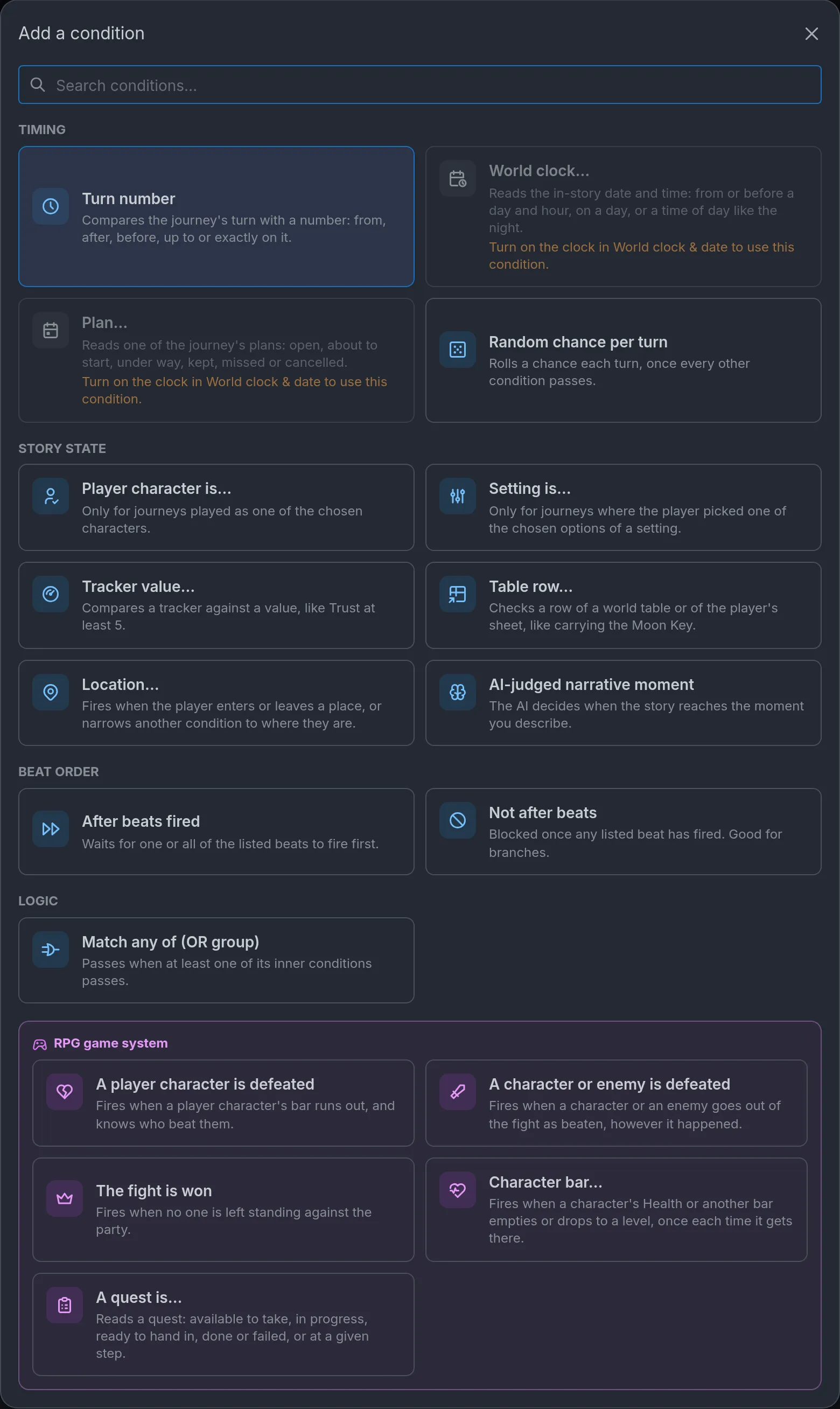
Its conditions:
- A player character is defeated: a player character's bar runs out. A new one reads The player character, Health, Is empty. Beaten by narrows it to one opponent and means Anyone when left empty. Once another bar can defeat a player character, a How field picks which bar counts: see A character also falls when.
- A character or enemy is defeated: someone goes out of the fight as beaten, however it happened. Who picks a character, any copy of an enemy, any enemy of an encounter group, or anyone fighting the party. It fires once for each one beaten. One who flees or is let go is not beaten. Beaten as narrows it to one out label: see Two ways to win against one enemy.
- A fight starts: once per fight, on the turn it breaks out: the first blow, or hostile enemies arriving. A fight that starts and ends on the same turn counts. It has no fields. A Play music effect on it gives the world a battle theme.
- The fight ends: once per fight, on the turn it ends. It is checked right after that turn, like the other fight conditions, so its effects land on that turn and its text opens the next. How it ends picks the outcome that counts: Any way, Won, Lost, The party got away or Without a winner. Under Without a winner, a hint reads "A truce, a fight talked down, or two turns with nothing happening." A quest step can use it too, as a condition under Completed when. See When a fight starts and ends.
- The fight is won: once per fight, when the last one standing against the party is beaten. It means the same as The fight ends on Won.
- Character bar…: any character's bar empties or fills, or drops or rises to a percent or a value.
Its effects:
- End the fight: ends the fight as Won or Lost, whatever fired the beat. With no one fighting the party, it does nothing and shows no card.
- Play the defeat scene: plays the defeat scene of whoever beat the player character, with its picture.
- Remember the respawn point: remembers Place as where the party wakes after a defeat. Left empty, Place reads Where the player is now. A later one replaces the earlier one, and players are never shown the respawn point.
- Go to the respawn point: takes the whole party to the remembered place. Until one is remembered names a place to use in the meantime. Left on Stay where they are, the effect does nothing until a place is remembered.
- Set character bar: refills a bar or sets it to a value.
- Out of the fight: takes a character out of the fight or brings them back in.
The group can also hold A quest is… and Change a quest (see Quests) and, with Statuses on, A character has a status, Give a status and Remove a status (see Statuses).
A player character is defeated and Character bar… are one condition under two titles. Point Whose bar at a character or an enemy, or set When it to a percent or a value, and the row reads Character bar… again, without Beaten by. Anything that empties the bar counts: a blow in a fight, a status that drains the bar, a fall or a poison the storyteller writes, an ability's cost, another beat's effect. When a status empties it, whoever gave the status counts as the one who struck last.
The three defeat and win conditions fire once for each fall or win, and they are checked right after each turn is written, as is A fight starts. The effects land on that turn and the beat's text opens the next one. They go at the top level of a beat or inside a Match any of (OR group), not in the cases of an If / otherwise effect. The four effects in the list from End the fight to Go to the respawn point also work inside If / otherwise cases and under When the player answers.
Six of these need a world that keeps fights: Fights on, Bars on stage on, or an enemy in a world with Enemies on. They are End the fight, Play the defeat scene, A character or enemy is defeated, A fight starts, The fight ends and The fight is won. Without fights they are greyed out in the picker, with a line such as "Turn on Fights in RPG game system to use this condition." One that is already in a beat stays, under an orange line: "Needs Fights in the RPG game system, which is off: this condition never passes." The respawn effects, Set character bar and the two bar conditions only need the RPG game system.
Every field of the bar condition, Set character bar and Out of the fight is described in Beats and story arcs.
Defeat scenes
On an NPC page or an enemy page, the purple RPG game system box has a Defeat scene part between Fights and Out of the fight: "What happens when they beat a player character. A beat with Play the defeat scene plays it." It needs the game system, not the Fights switch. Player characters have no such part.
- Scene: what the winner does with the loser, up to 4,000 characters. The empty field suggests "She ties the hero up and leaves them for the guards." It is used in every journey.
- Adult version: "Used instead in a journey with adult content on." Same length. The field appears on an adult world, or when your account is allowed adult images.
- Picture: one of the character's gallery pictures, listed by label, with "(adult)" after an adult one. Sprite cutouts are left out. With an empty gallery the field reads "Add pictures in the gallery first".
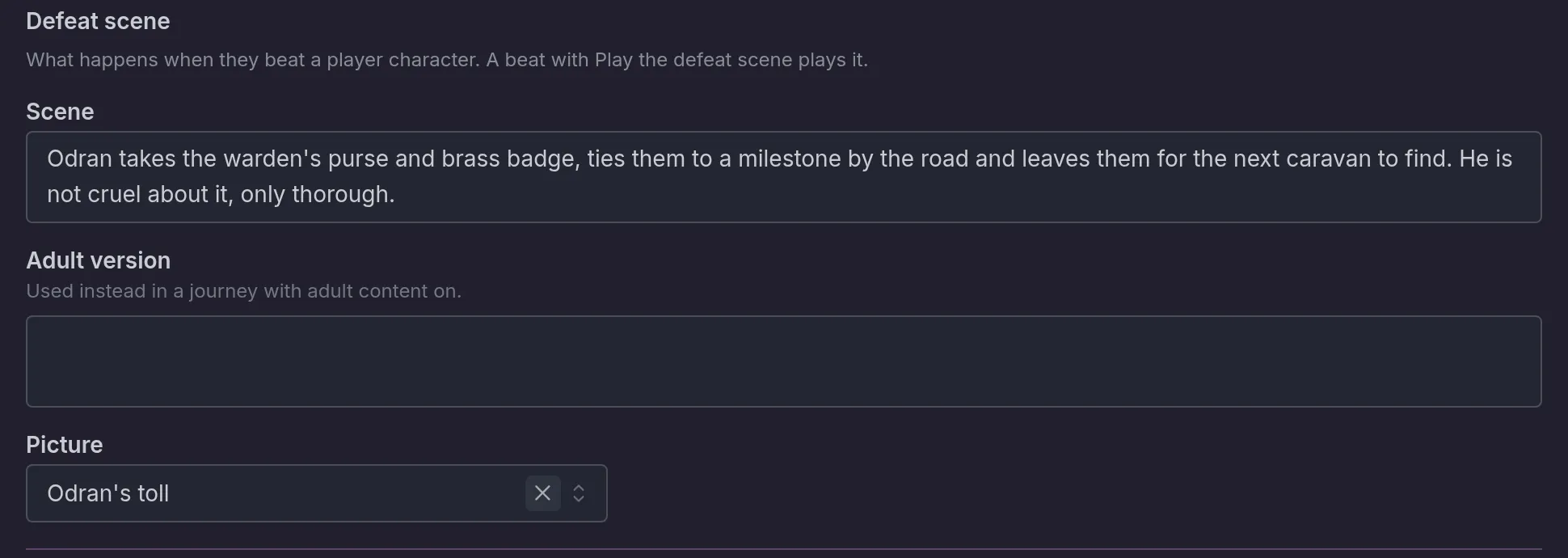
Which version a journey gets:
- Without adult content: the Scene, and nothing else.
- With adult content: the Adult version when there is one, the Scene otherwise.
A character with only an Adult version has no scene at all in a journey without adult content. Write a Scene for every character that has one.
The scene is a brief for the storyteller, not text shown to the player. The storyteller is told who won and to play the scene as you wrote it, keeping its events, tone and outcome and writing the prose itself. Write <<foe>> in the text where the winner's name should go.
The picture is shown with the turn the scene is told on. Two cases show nothing, without a warning: an adult picture in a journey without adult content, and a gallery entry that has no image uploaded yet. If the picture later leaves the gallery, the field reads "A picture no longer in the gallery".
A copy of an enemy plays the scene written on its enemy page. See Enemies.
Lose a life and wake at the shrine
Mara starts with three lives. When she is defeated, the fight ends as lost, she loses a life and the winner's defeat scene plays. One turn after that she wakes at the Wayside Shrine with full Health. With no life left, the journey can end in defeat.
The loop needs a world that keeps fights and a Health the game reads. A Defeat scene is only needed for the scene itself: in The Tollroad Wardens, Odran Hask has one and the Bandits do not.
- On Linked fields, set When the player's Health is empty to A beat decides. Skip Add a beat for it, which makes the quick beat and not this one.
- Add a tracker named Lives: a Counter (number) starting at 3, with Readonly to the AI on so that only your beats change it.
- Add a beat
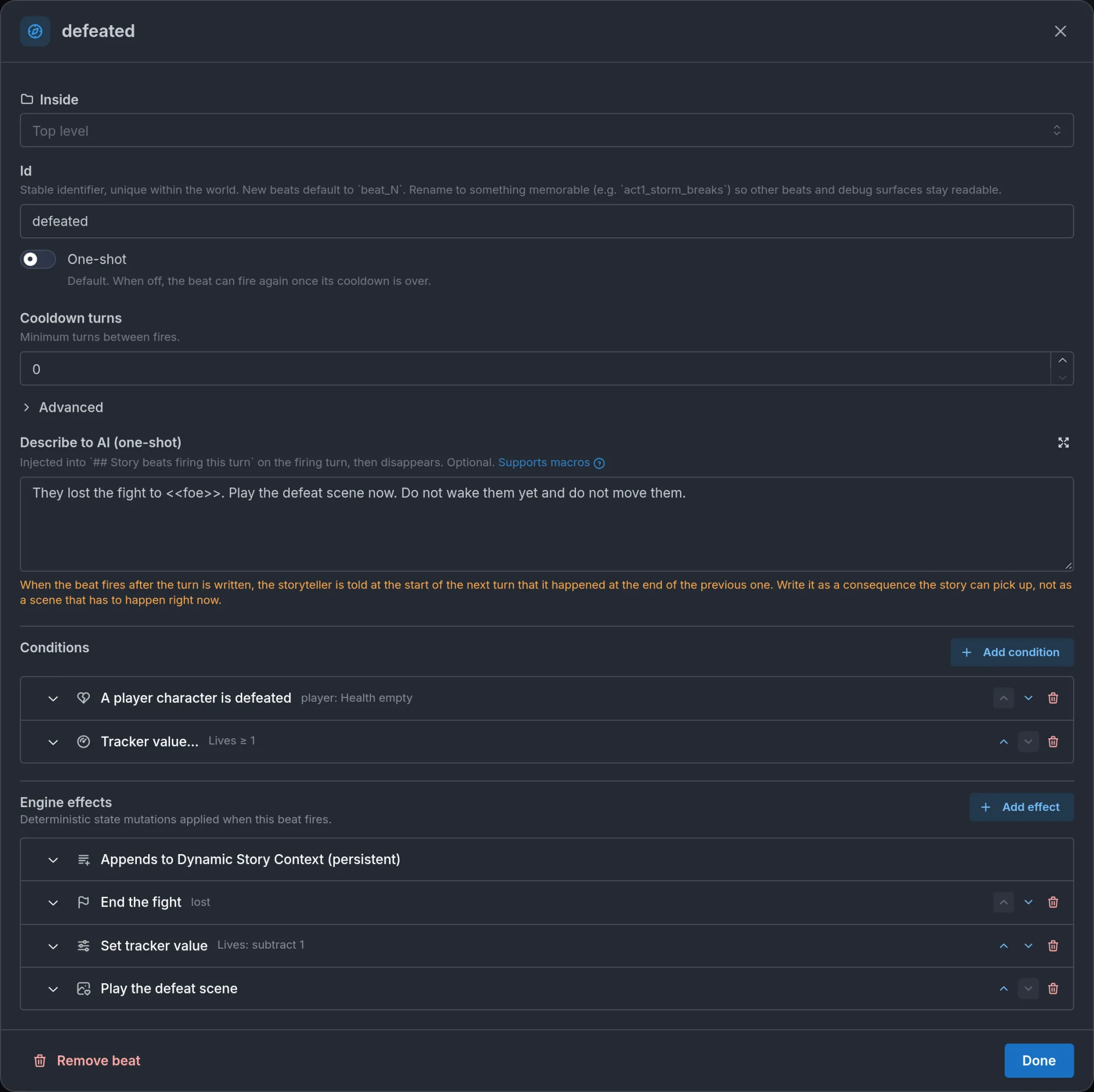
shrine-reachedand turn One-shot off. Its condition is Location…, with When the player on enters and Location on the Wayside Shrine. Its effect is Remember the respawn point with Place on the Wayside Shrine. - Add a beat
defeatedand turn One-shot off.- Conditions: A player character is defeated, left as it comes (The player character, Health, Is empty), and Tracker value…, Lives, at least 1.
- Effects, in this order: End the fight, left on Lost. Set tracker value, Lives, Subtract 1. Play the defeat scene.
- Describe to AI (one-shot):
They lost the fight to <<foe>>. Play the defeat scene now. Do not wake them yet and do not move them.
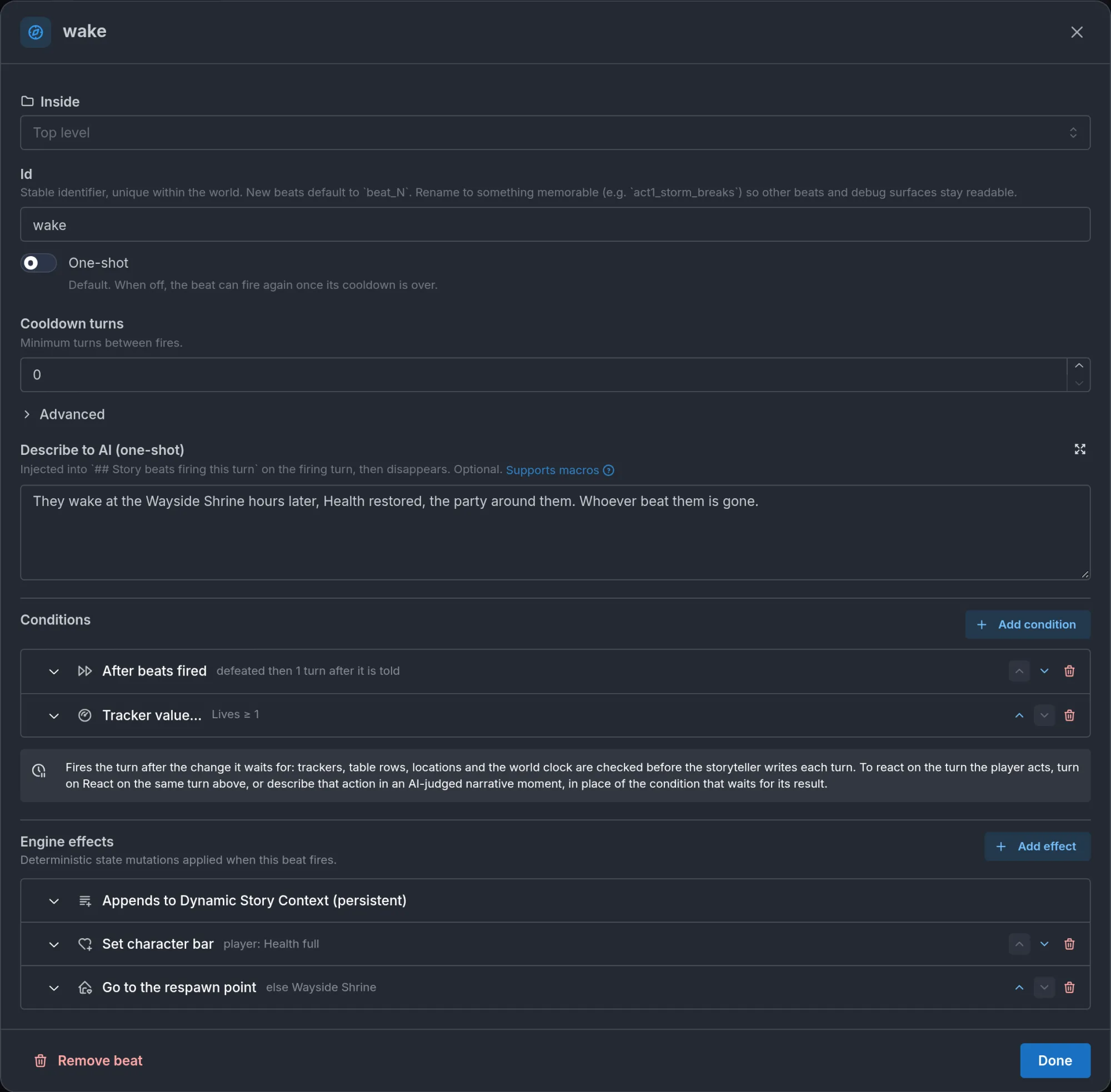
- Add a beat
wakeand turn One-shot off.- Conditions: After beats fired, with
defeatedin After these beats fired, When on Some turns after it is told, once each time and Turns after it is told on 1. Then Tracker value…, Lives, at least 1. - Effects: Set character bar with Whose bar on The player character, Bar on Health and Set to on Full, then Go to the respawn point with Until one is remembered on the Wayside Shrine.
- Describe to AI (one-shot): "They wake at the Wayside Shrine hours later, Health restored, the party around them. Whoever beat them is gone."
- Conditions: After beats fired, with
- Add a beat
out-of-liveswith a single condition: Tracker value…, Lives, at most 0. One-shot can stay on. Its Describe to AI (one-shot) says this is the end. - With Endings on Simple, list
out-of-livesin the Defeat ending's Requires story beats. The storyteller can only end the journey in defeat once that beat has fired. See Requiring story beats.
Why it is built this way:
- A new beat has One-shot on. Left on,
defeatedandwakewould serve the first fall only. Neither needs a cooldown: each fires once per fall. - The wake is a beat of its own. A refill and a move placed in
defeatedwould land on the turn of the fall, before the scene.wakepasses once for each timedefeatedfires, and Turns after its moment was told takes 1 to 50. - Lost leaves the winners standing. Everyone still standing against the party wins and stands down. Nobody is paid or called defeated, no bar is changed, and the storyteller is told the fight is over and who won. The winners stay in the journey and are drawn on stage when the storyteller puts them in the scene.
- Lives at least 1 stops the loop. On the last life
defeatedstill fires, Lives goes from 1 to 0 and the scene plays.wakedoes not pass,out-of-livesfires at the start of the next turn, and the ending can follow. <<foe>>is the winner's name. It works in Describe to AI (one-shot), in the title and message of a Show story card effect, and in the scene itself. When nobody is fighting the player and nobody struck them, as after a trap, it reads "their opponent".
When several opponents stood against her, the winner is the one who has a defeat scene, then the one with the highest Strength. A Bandit's blow that finishes Mara still plays Odran Hask's scene, as long as Odran is in the fight: hit this fight, or the one who landed the last blow. The Play the defeat scene effect lists everyone who has a scene. If the winner has none, the effect does nothing and the beat's own text is still told.
A world with several shrines needs one beat too. Put one Location… per shrine inside a Match any of (OR group), leave Place empty, then open Advanced in the beat and turn on React on the same turn so the place is taken on arrival.
The loop, turn by turn
Mara fights the Toll gang on the Tollroad, and a Bandit's blow empties her Health.
The turn of the fall. The prose ends as she falls. Under it sit the Fight card, then a Fight lost card naming who won, the one whose defeat scene plays first, then the enemies still standing: "Bandit 6, Bandit 7, and Bandit 8 won." Her Lives already read 2. Her Health is still 0. The winners stay on the stage, standing, through the turn of the scene.
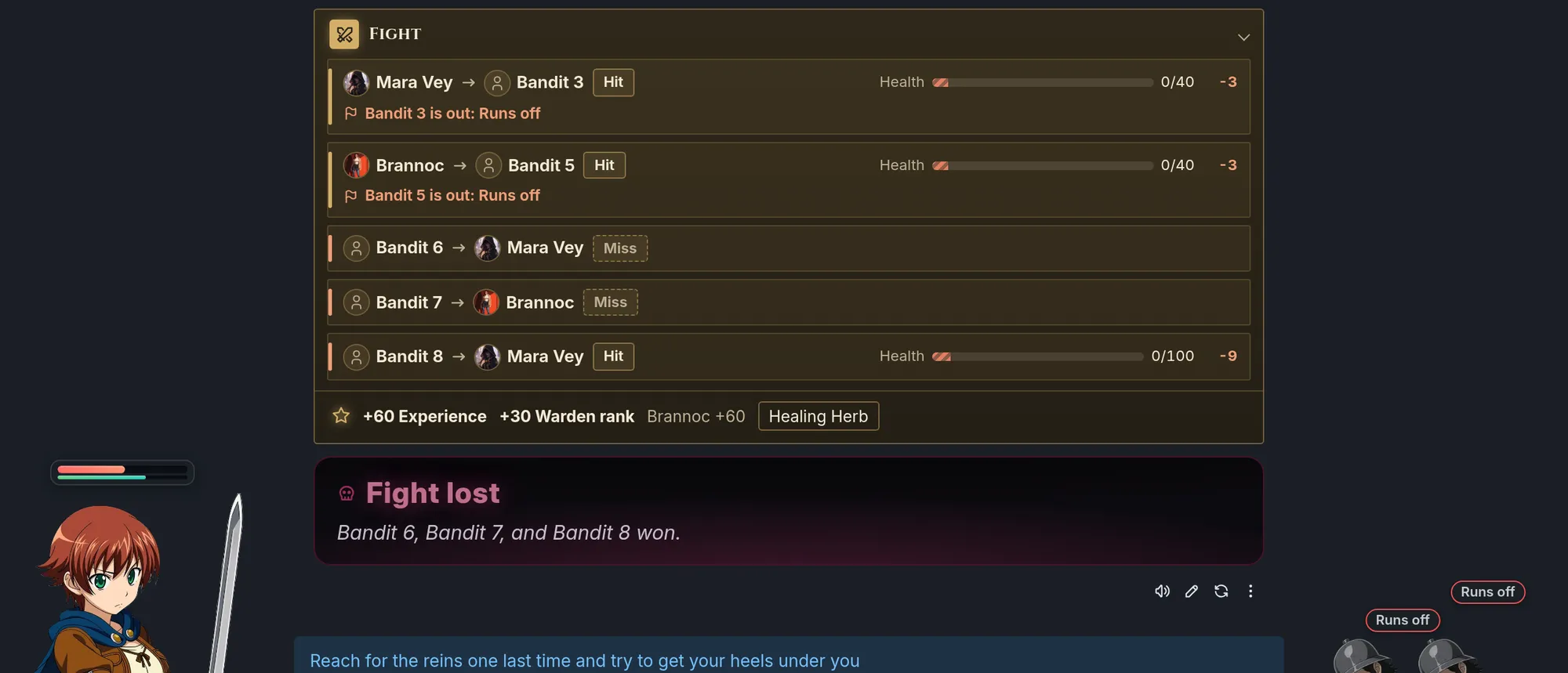
The next turn. It opens with the beat's text and the winner's defeat scene, in the storyteller's words, with its picture. The Bandits have no scene, so here only the beat's text is told. When Odran Hask wins at Hask's Camp, his scene plays with his picture, as below. Her Health is still 0.
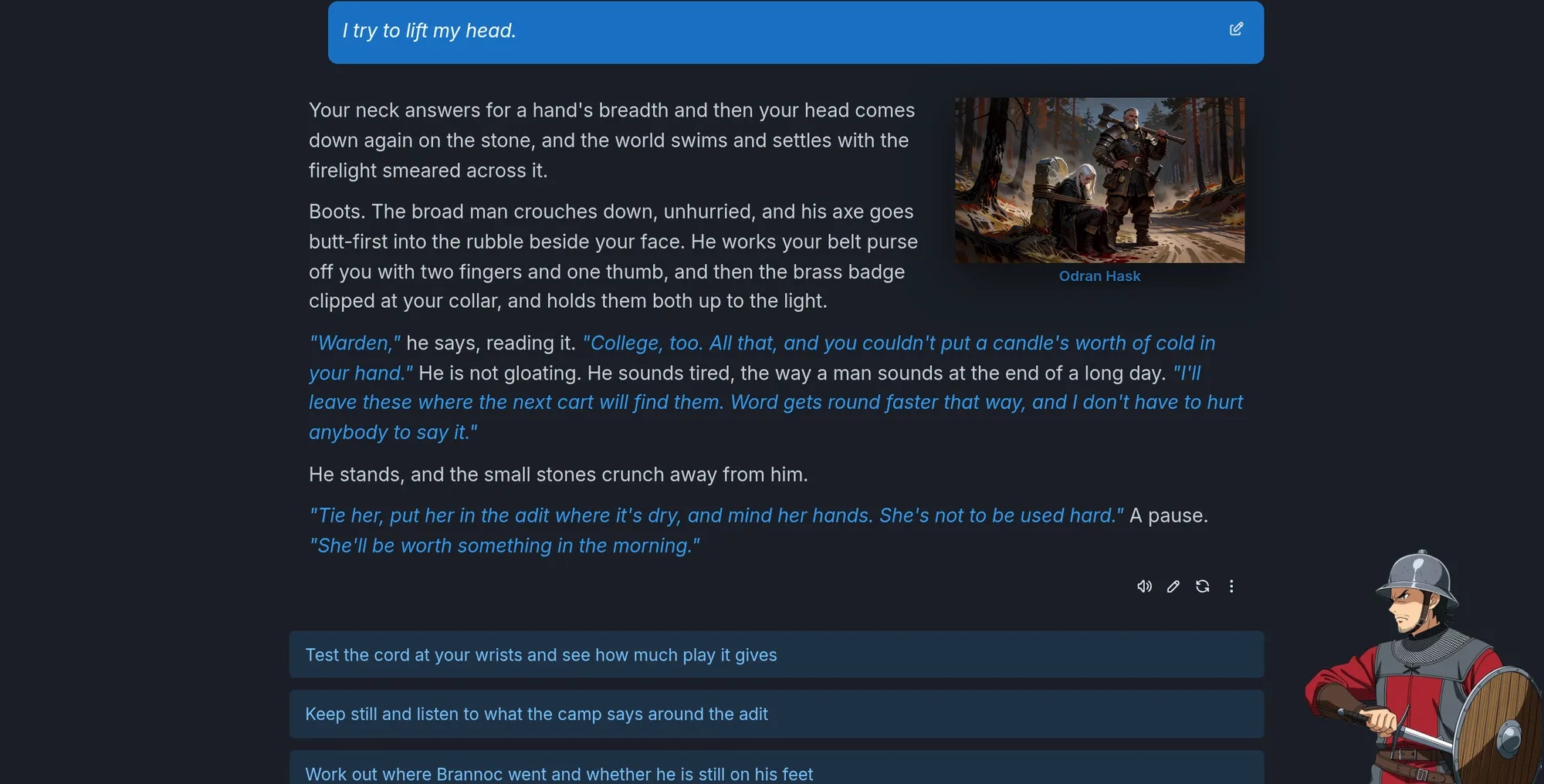
The turn after. wake fired before it was written. Mara's Health is full, the scene is at the Wayside Shrine and the fight is behind her. Enemy copies that won are removed from the scene. A named character such as Odran Hask stays in the story, no longer marked as fighting.
The wake comes two turns after the fall on purpose. defeated fires once the turn of the fall is written, so its moment is told on the next turn, and the one turn of wake is counted from there.
The scene waits for the next turn for the same reason. A beat that fires before a turn, on a bar that was already empty when the turn started, plays the scene on that same turn.
Ending a fight on a win
End the fight on Won beats everyone still standing against the party at once. In the Tollroad Wardens, the gang gives up when its leader falls.
The beat odran-falls has one condition, A character or enemy is defeated with Who on A character and Character on Odran Hask, and one effect, End the fight switched to Won. One-shot can stay on. Two fields appear on Won:
- Pay rewards: on by default. Each enemy copy the effect takes out pays its Experience and loot once, as after a blow. Turn it off for a win that pays nothing. A named character pays nothing either way.
- Shown as: the word they go out under, up to 24 characters. Left empty, each one goes out under the label of its own first out rule, or "Defeated" without a rule.
odran-fallshas "Routed" there, so the Bandits go out as "Routed" instead of their own "Runs off".
Switching between Won and Lost starts the effect over, and both fields are lost.
In play, Odran Hask's Health empties and his own rule takes him out as "Yields". The beat fires right after that turn, and the Bandits still standing go out with him. Under the turn, a Fight won card names who was beaten, as in "Bandit is beaten.", and shows what they paid. If the storyteller lets him go instead, he is not beaten and the beat does not fire.
Every fight ends with one end card, whatever ended it: this effect, the last blow or the storyteller. On that turn the Fight card carries no rewards line and no Spoils card shows, since the end card holds the totals of the whole fight. See The end card. For what follows any win, put a beat on The fight is won, or on The fight ends with How it ends on Won. Both also fire after an End the fight on Won.
The loop in a shared journey
The player character is the host's character. With Any player character, the first player down fires defeated, a guest included. With Every player character, it fires once, when everyone is down at the same time. Whether one fall loses the fight for all is therefore your choice of Whose bar.
The fight, the scene and the move are shared. Go to the respawn point takes the whole party, and an Adult version only plays in a shared journey that has adult content on.
A boss phase
Odran Hask is an ordinary NPC: a Boss in Strength, with 100 Health and an out rule that reads "Yields" when his Health is empty. At half Health he changes how he fights.
The beat odran-second-wind has One-shot on and holds:
- One condition, Character bar… from the purple group: Whose bar on A character, Odran Hask, Health, Is at or below a percent, 50.
- Appends to Dynamic Story Context (persistent): "Odran Hask fights in a rage since he fell to half Health: two-handed, reckless, no shield."
- Optionally, Bring in enemies, Bandit, 2, for reinforcements, and a Show story card.
- Describe to AI (one-shot): "Odran Hask is down to half his strength. He throws his shield aside and whistles for his men."
When the fight takes him to 50 Health or less, the beat fires right after that turn. The context line and the Bandits are there at once. The next turn opens with his change, after the line "Odran Hask's Health fell to 50% or less of its maximum." A one-shot phase fires once.
For a phase every copy of an enemy goes through, set Whose bar to Any copy of an enemy and pick the Bandit in Enemy. Each copy counts separately and fires the beat once when it drops. Keep that beat repeatable: a one-shot one fires for the first copy only.
The stage in a fight
A fight arranges the stage by itself: two sides facing each other and, with Bars on stage on, a plate of bars over each fighter and a reaction when a bar moves. No field in the editor places anyone. The stage reads the fight and the pictures you drew, so your part is the sprites and the switch.
The formation
The player's side stands on the left: the player's character when it is on stage, the party, allies and bystanders. Opponents stand on the right. None of them ever crosses to the left, even when nobody stands there.
- Seats. Up to eight opponents and four characters on the player's side are drawn. On a phone the opponents take the width and the player's side keeps three seats, two against three opponents and one against four or more. Anyone left over is counted in a "+n" chip. When seats run short, whoever acts or was hit is kept first, then everyone still in the fight, then those who just went out.
- Ranks. Only opponents form ranks. The party always stands in one row. With three or more opponents of mixed sizes, the tall ones stand at the back, drawn a little smaller and raised, with the biggest of them in the middle as the leader. The small ones go in front, the smallest in the middle so the leader's head stays clear. Up to four opponents of one size share a single row.
- Small enemies. Size is read from the picture itself. A sprite whose figure fills less than 70% of the picture's height counts as small. It floats whole in front, just above the text box, with a soft shadow under it. A taller figure stands on the bottom edge of the stage, partly behind the text box. Draw a beast filling its canvas if it should stand on the ground as tall as a person.
- A portrait and no sprite. An enemy with a portrait and no battle sprite still stands in the fight, as a framed card that floats like a small enemy.
- Who the fight is about. That is every fighter whose bar moved this turn. In visual novel mode it is the target of the blow the reader has reached. On a side of three or more, they come forward, a little larger and lit, and the rest of that side steps back.
- Out. A fighter who is out keeps their place, grayed, under their out label, until the game clears them. The others then close up with a short glide.
A crowd is drawn smaller and closer together, and nobody crosses the edge of the stage.
On the Tollroad, a Toll gang of four puts Bandit 1 to 4 on the right, facing Brannoc on the left, and Mara Vey beside him when her character is on stage. Brannoc's blow lands on Bandit 2: Bandit 2 comes forward and the other three step back. Once his Health is empty, Bandit 2 stays where he stood, grayed, under "Runs off".
The battle sprite
An NPC or player character's battle sprite is a gallery picture labelled sprite:battle. Each outfit can have one, like any mood sprite. Enemies keep their own Battle sprites.
With the world's game system on and your account's fights on stage beta, the sprite generator offers battle stance. Find it in the outfit's Poses step, under RPG Battle, the purple group with a gamepad mark after the usual mood groups. It is not ticked by default. The sprite planner offers the same choice for several outfits at once.
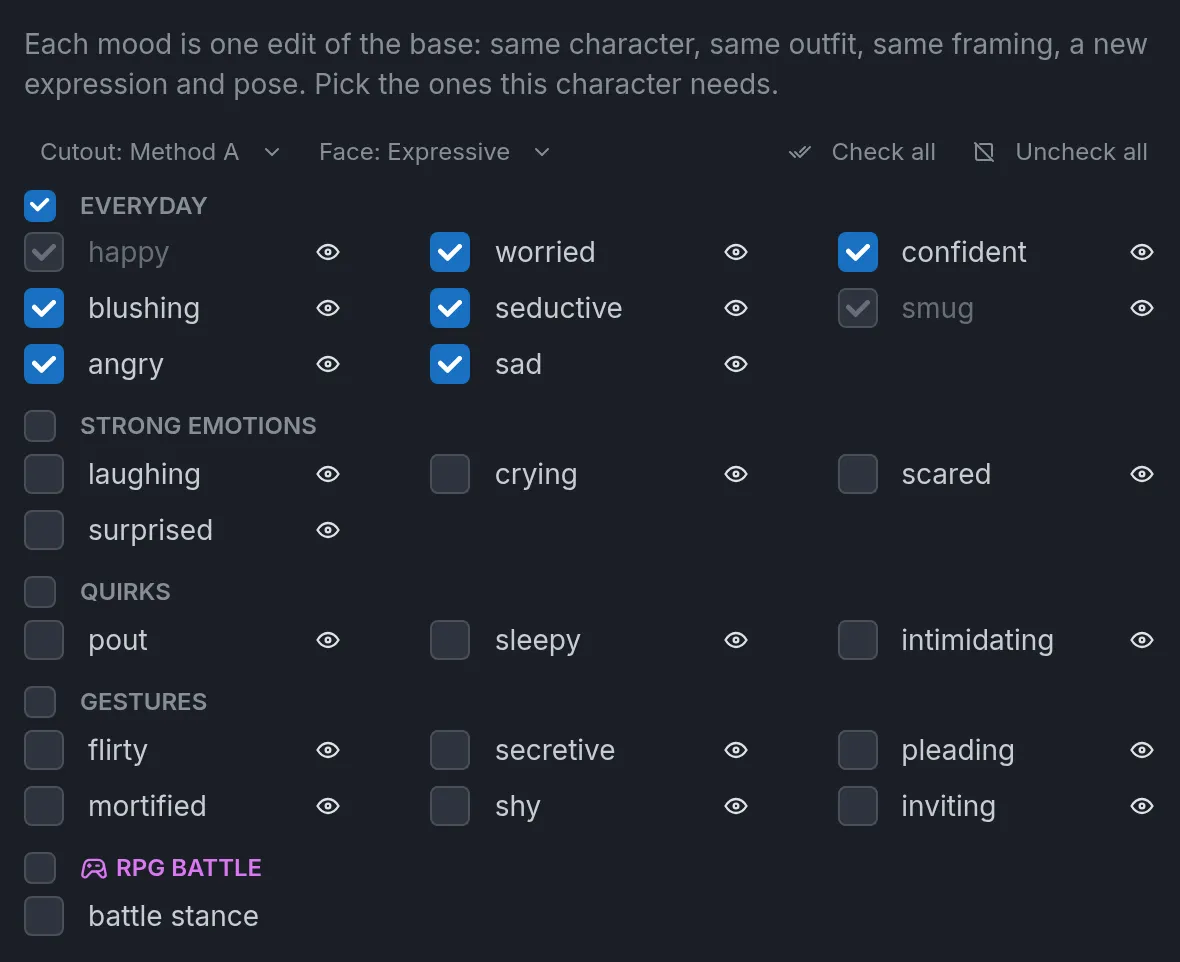
Drawing costs about 5 credits, like any mood sprite. It makes one edit of the outfit's base sprite, keeping the same character and clothes. The figure faces left in a ready fighting stance, empty-handed, from the thighs up. A beast is drawn whole, from the side. A take facing right is drawn again once.
You can also upload a transparent cutout facing left and label it sprite:battle. The gallery's label field suggests it where fights on stage are available. The picture carries a small purple gamepad mark. Pointing at it reads Used for RPG Battles.
In play:
- Stage only. The picture shows during fights in the classic, immersive and visual novel views. The cast list, party screen and character card keep the normal sprite. The storyteller never uses it as a mood, a reaction or a picture shown with the story.
- Who uses it. Everyone in the fight who has one: the player's character when on stage, party members, a guest's character in a shared journey and opponents who are not enemies. A bystander keeps their normal sprite.
- Which outfit. The fighter uses the battle sprite of the outfit they wear, or their default outfit's if that has none. Without either, they keep their normal sprite.
- Out. A fighter who is out returns to their normal sprite under their out label.
- Facing. On the player's side, the picture is mirrored to face the opponents. On the opponents' side, it stays as drawn.
With a battle sprite, Brannoc stands on the left of the Tollroad, mirrored to face the bandits.
The plates
Each fighter with bars carries a small glass plate over the head. It holds up to three bars with no numbers, the first one thicker. The bars an out rule reads come first, then the others in sheet order. Under the bars sit small chips: the out label and up to three status effects. The world's statuses show there with their icon, their name and the turns left.
In a fight, everyone on the player's side carries a plate, whether their bars moved or not: the player's character, party members and a guest's character in a shared journey. The player's character shows the player's meter trackers, such as Health and Mana, up to three, Health first when there are more. An enemy in a fight always shows its bars. Outside a fight, a plate appears while it matters: on the turn a bar moved and for three more turns, or while the out label shows. A dead character shows none.
- The name. In a fight, every plate on the player's side shows a name. An opponent is named only when the fight is about them. Only a fighter the fight is about takes a colored edge, red on the opponents' side and your world theme's accent color on the player's side, whatever the size of the side. When Bandit 3 answers and hits Mara, her plate takes the accent edge. On a desktop, pointing at a sprite also shows its name for a moment.
- A crowd. Past four fighters on a side, which in practice means the opponents, a fighter who is neither named nor hurt keeps a short bar and no plate. Hurt means their first bar is no longer full, or has started to rise for a bar that fills up.
- Out. In a fight, the plate of a fighter who is out is their out label alone.
- Colors. A bar takes its color from its name, whatever the case. A name containing hp, health or vit is red, mp, mana or essence blue, stam green, xp or exp gold. Other bars, such as Morale or Fear, are teal. Mara's Health is red and her Mana blue, and Brannoc's Stamina is green.
Outside a fight, and in the phone's view of one character at a time, the plate keeps the same glass and bars, with no name and no colored edge, and a character who is out keeps their bars, dimmed, with the label.
The reactions
- A blow. A character whose bar just went down shakes, with a short flash and a red rim. In visual novel mode this plays when the reader reaches the line the blow lands on.
- A filling bar. A bar that an out rule ends when full glows softly as it rises.
- A heal. Nothing plays on the sprite when Health goes back up.
For players who ask for reduced motion, nothing shakes or glides, and a fighter appears without an entrance animation.
Who counts as an opponent
An enemy always counts as an opponent. Another character counts when their sheet's Threat / disposition reads hostile (hostile, deadly, dangerous, elite, boss, wounded and similar words), they are not in the party and Bars on stage is on. An ally word such as friend or companion wins over a hostile one. A rival whose Threat is blank or neutral can still be fought, but stands on the player's side of the stage. A party member never stands opposite, and being out never moves anyone across.
When Bars on stage is on, or the world has an out rule or enemies, the cast list gathers opponents under Enemies, and a character who is out shows their label as a small tag.
What the player sees
A Fight card sits under the turn once it has landed, in the reading view and in visual novel mode. It is open on the latest turn and folded to one line on older ones, where the player can reopen it. The card has no buttons.
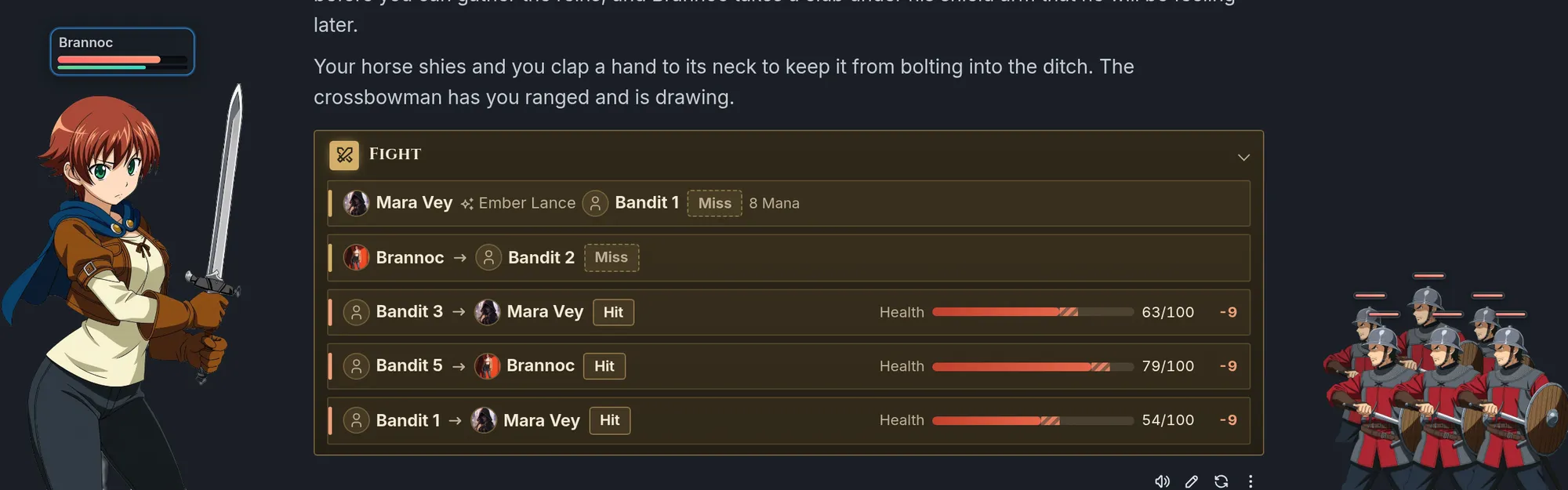
- The summary line counts the blows landed and missed, names who went out and gives the Experience earned: "2 blows landed · 1 missed · out: Bandit · +30".
- One row per blow: who struck, the target (with the ability's name for a spell), a result, the cost if there was one, and a small gauge of the bar it moved with what is left and the change, such as -18.
- The results are Critical hit, Hit, Graze, Miss, Fizzled, Guards for a defense, Got away for a flight that worked and Caught for one that failed.
- An out is flagged under the blow that caused it, with the name and the label.
- Statuses, on a world that has them: the card opens with each change a status made to a bar that turn, a skipped move reads such as "Stunned: cannot act", and a status given by a blow is marked on its row, such as "Poisoned, On Mara".
- The rewards line shows the player's Experience (with a "+N" and the track's name after it for each other progression track paid), each companion's ("Brannoc +30") and every item dropped, with its quantity when there are several. An enemy that paid nothing adds no line.
The numbers on the card are the ones the game applied.
When beaten enemies paid on a turn with no rolled blow (a told fight, or an enemy the storyteller took out), a Spoils card under the turn names them and shows only the rewards line.
Limits
- Out rules: 4 per character, bar name up to 40 characters, label up to 24.
- The player's out word, and the word of an Out of the fight effect: up to 24 characters.
- Other bars that defeat a player character: 3 per world, bar name up to 40 characters, word up to 24.
- Their blows go at and Hits: one bar each.
- A Character bar… condition: a percent from 0 to 100, or a value from 0 to 1,000,000.
- Experience on an enemy: 0 to 100,000.
- Loot: 6 lines per enemy, chance 1 to 100, quantity 1 to 99.
- Bars on stage: 3 per character, with up to 3 status tags.
- Defeat scene: Scene and Adult version up to 4,000 characters each.
- Shown as on an End the fight effect: up to 24 characters.
- Turns after its moment was told: 1 to 50.
Common mistakes
- Strength on a companion. The field shows on a party member's page and does nothing while they are in the party. Set it on opponents.
- Expecting Experience from an ordinary NPC. Only enemies from the Enemies section pay by themselves, and the Experience and Loot fields only exist on their pages.
- A rule on a bar the sheet does not have. Not on the stat block means the rule never fires. Pick one of the suggested bars.
- A character with no bars. Nobody can be fought through the game without a bar. Give opponents a sheet.
- A rival who stands with the player. Opponents face the party only when their Threat / disposition reads hostile and Bars on stage is on.
- Waiting for a critical hit on a dice world. With dice on, criticals need Critical margin (optional) and grazes need Near misses.
- Treating the player's out as an ending. Out of the fight is not a game over. Write what losing means in your instructions.
- A beat decides with no beat reacting. The storyteller stops at the fall and nothing refills Health, so the player stays at 0. When the card reads "No beat reacts yet.", use Add a beat for it.
- A beat on Health alone in a world with a losing bar. A condition set to Health runs out does not react when Dizziness fills. Set How to Any way.
- A blow aimed at a bar the target lacks. It lands on Health. The orange line under Their blows go at or Hits says when nobody carries the bar.
- A one-shot knockout beat. It fires at the first fall of the journey and never again. Leave One-shot off. A repeatable beat on a bar needs no cooldown.
- Expecting only the fallen player to move. The scene is shared, so Move scene to location in a knockout beat moves the whole party. Remove it if the party should stay put.
- The Out of the fight effect on the player. The effect skips the player's character. Their fall is set by When the player's Health is empty.
- The wake in the same beat as the fall. A refill and a move placed in the defeat beat land on the turn of the fall, before the scene. Put them in a second beat on After beats fired, one turn later.
- A defeat or wake beat left on One-shot. A new beat has One-shot on, so it would fire for the first fall and never again. Turn it off on both.
- No Lives condition on the defeat beat. A repeatable defeat beat keeps firing at 0 lives. Add Tracker value…, Lives, at least 1, to it and to the wake beat.
- Nobody has a Defeat scene. Play the defeat scene does nothing when the winner has no scene. Only the beat's own text is told.
- Only an Adult version. A journey without adult content gets no scene at all. Write a Scene as well.
- An adult Picture in a journey without adult content. No picture is shown, and nothing warns you.
- Out of the fight together with a defeat beat. The player's character is marked out and cannot act. Set When the player's Health is empty to A beat decides.
- The character whose bar crossed in the wake beat. The wake beat has no bar condition, so the editor warns that the effect has no character to act on. Pick The player character in Whose bar.
- Switching Won and Lost on a finished effect. The switch starts the effect over, and Pay rewards and Shown as are lost.
- Fight effects in a world without fights. End the fight, Play the defeat scene, A character or enemy is defeated, A fight starts, The fight ends and The fight is won are greyed out and do nothing there. Turn on Fights.
- A beast drawn small on its canvas. The stage reads size from the picture, so a figure that fills less than 70% of the picture's height floats in front as a small enemy. Draw it filling the canvas if it should stand on the ground as tall as a person.
- An enemy with only a portrait. It stands in the fight as a framed card, not as a figure. Give it battle sprites if it should stand among the others.
Frequently asked questions
Quests
Learn how to give your Imagina world a quest journal. Covers turning Quests on, the Quest rules card, writing a quest with steps, checks, availability and rewards, quests the storyteller makes up, time limits, quest beats, party play, and what players see when a quest is offered, taken and paid.
Statuses
Learn how to give your Imagina world statuses such as poison, stuns and blessings that the game keeps on characters and counts down. Covers turning Statuses on, writing a status with its duration in turns or story time, stacks and effects, the abilities, characters, enemies, items and beats that give and remove it, items that give a status while carried, cursed items, what players see, and party play.