Playing together
Learn how the RPG system behaves when several people play one journey of your Imagina world, covering whose account counts, each guest's sheet, Experience and points, abilities, money in shops and trainers, enemy levels, fights, statuses and the party screen.
Beta
The RPG system is in beta and only accounts with the RPG beta can set it up. It may still change.
When several people play one journey, each guest's character is a full party member under the RPG rules. It has a sheet of its own, earns Experience and level-up points (with Party system on), uses its own abilities, buys in shops and is compared with a place's enemy levels by its own level. The host keeps what the group shares: the one bag, the shared trackers and the companions.
The one card to check is Party system, on the Features page of the RPG game system group: without it, guests earn no Experience and no points of their own. This page describes how the pieces you set up behave with several players, so you can check that your world holds up in a group. The players' side of shared journeys is in the party play help article.
Host, guest and owner
Three accounts appear on this page:
- The owner is you, the author of the world.
- The host is the player who started the journey.
- A guest is a player who joined it. Each guest plays one of your world's player characters.
Whose account counts
Only the owner's account is read. The host's never is, and neither is a guest's. Nobody who plays needs the beta.
- The owner's account opens every piece, for every journey of the world: shops, abilities, encounters, trainers, enemies, quests, fights, statuses and the fight difficulty, as well as the party, a sheet for each character, sheet variants and the rows picked in Linked fields.
- The world's switches decide the rest. Guests earn Experience and level-up points of their own only with Party system on. The window where points are spent opens for the host and for each guest on a world that pays level-up points the game knows.
When the owner loses the beta, the world plays as if Party system, Per-character sheets, the roles, the built-in trackers and the per-level rates were off, in every journey.
A guest's character
A guest's character is in the party by definition. Nobody marks it, and nobody can take it out.
It keeps the variant picked on its player character. Say a friend joins Mara's journey as Tamsin Hale, a Knight. Mara, a Mage, has Mana. Tamsin has Stamina, with the caps of the Knight variant. See Character sheets.
Real values with caps need Per-character sheets, with or without the party system. Without it, a guest's character holds a loose block only.
Where a guest reads their own character (the Character tab, the Trackers window, the status sheet), the rows come in this order:
- Their own rows.
- The shared trackers of the world.
- Their own Experience and point pools. Experience shows when the world uses the built-in trackers and NPC sheets. With progression tracks, their list of levels and Experience shows instead. A pool shows only where the host's journey has a pool of that kind, under the same row names as the host's.
The host's personal trackers never show to a guest.
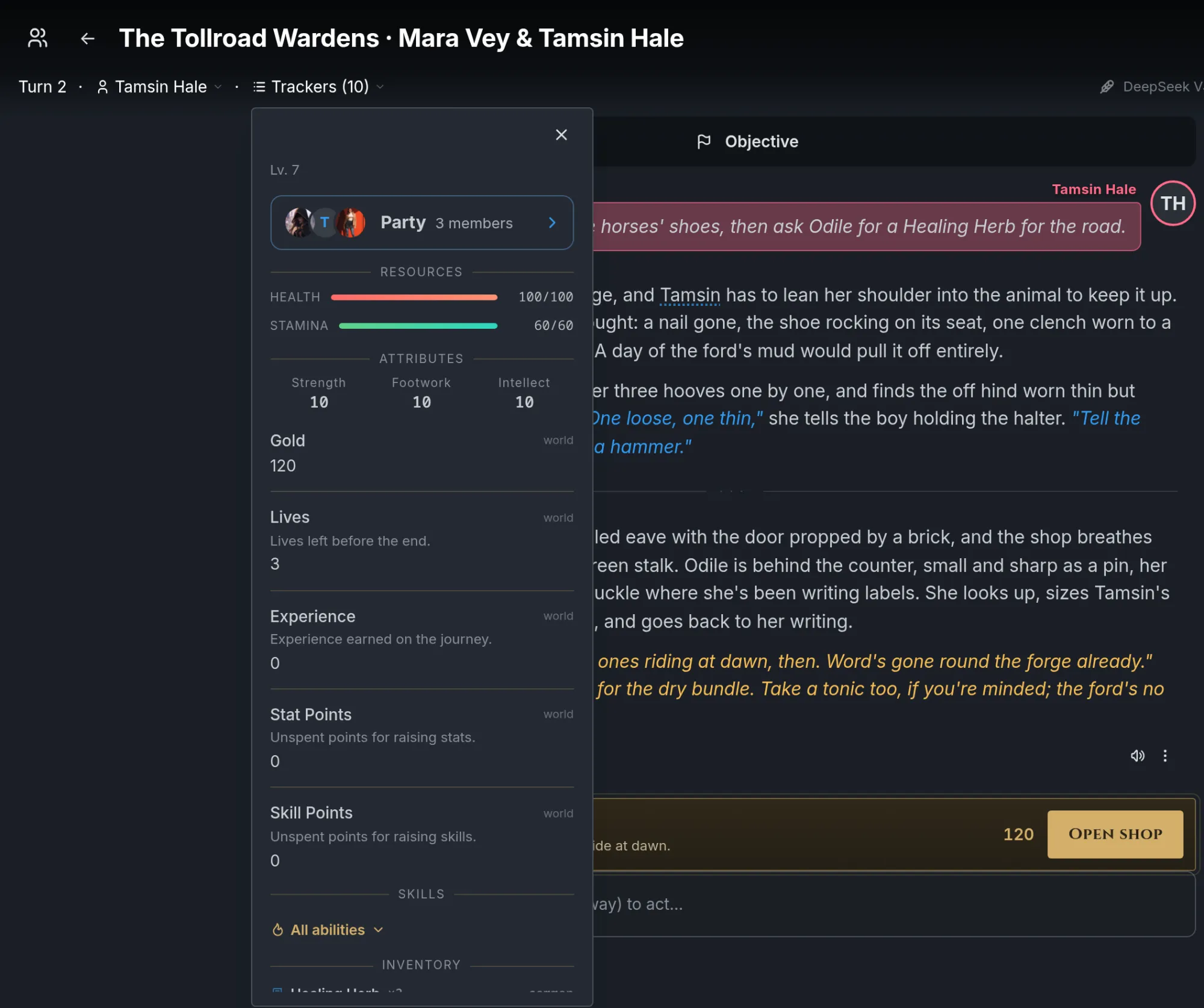
A guest's skills (with their own cooldowns), status, bonds and lists are their own. Inventory is not: the party has one bag, the host character's inventory, and everyone reads that one.
Guests can read the host's character on the Cast tab and on the party screen. They cannot change it.
Experience and points
With Party system on, a guest's character that has a sheet earns Experience and level-up points like a companion. Both are kept on that character, apart from the host's. See Levels and points.
- A won fight pays the full amount of each beaten enemy to every member who earns it, whoever landed the last blow. It is not split. This needs the built-in trackers, or progression tracks, which are each paid.
- The storyteller can give a guest's character Experience and change their level, as it does for a companion. Experience raises a level by itself only on a progression track set to At an amount of Experience.
- A level-up pays the world's points per level into the guest's own pools where the journey has such a pool, once per level. A level regained after a drop pays nothing a second time.
Each player spends for their own character:
- A guest spends only their own character's points.
- The host spends their own character's points and the companions'. The host cannot spend a guest's.
A guest gets the same call as the host, such as 2 points to spend with a Spend button. It is repeated under the latest turn with a level-up card, and a mark sits on the button that opens the sheet. The window is the same one, limited to their own character. On the party screen, a button such as Spend 2 points shows on their own card only.
On the next turn, the storyteller is told that the player spent their character's points.
Abilities
Nobody has a cast button. A player writes what their character does and the storyteller uses the ability. On a guest's turn, an ability used with no caster named is the guest's own character's. See Abilities.
- Energy and cooldowns are the guest's own. The cost comes out of the Energy row of their variant, and their cooldowns run apart from everyone else's.
- Reagents and items come out of the one bag. An ability that consumes an item takes it from the party's bag, whoever casts.
- Knowing an ability takes a skill with its name. A guest's character knows an ability when a skill on their sheet carries the name of an ability from your catalogue. That skill comes from the player character's starting skills or from a trainer.
All of this needs each character to have a sheet of their own. Without it, a guest's character cannot use an ability from the catalogue, and the storyteller is told to narrate the move without the game.
A guest's spellbook (All abilities) shows which abilities their character knows, can learn or lacks, with each cost in their own Energy. Their @ menu has no Abilities category: the host character's skills are listed as plain skills under that character's name, and their own under You. Its items are the party's bag first, where their purchases land, then the gear on their own character.
Shops and trainers
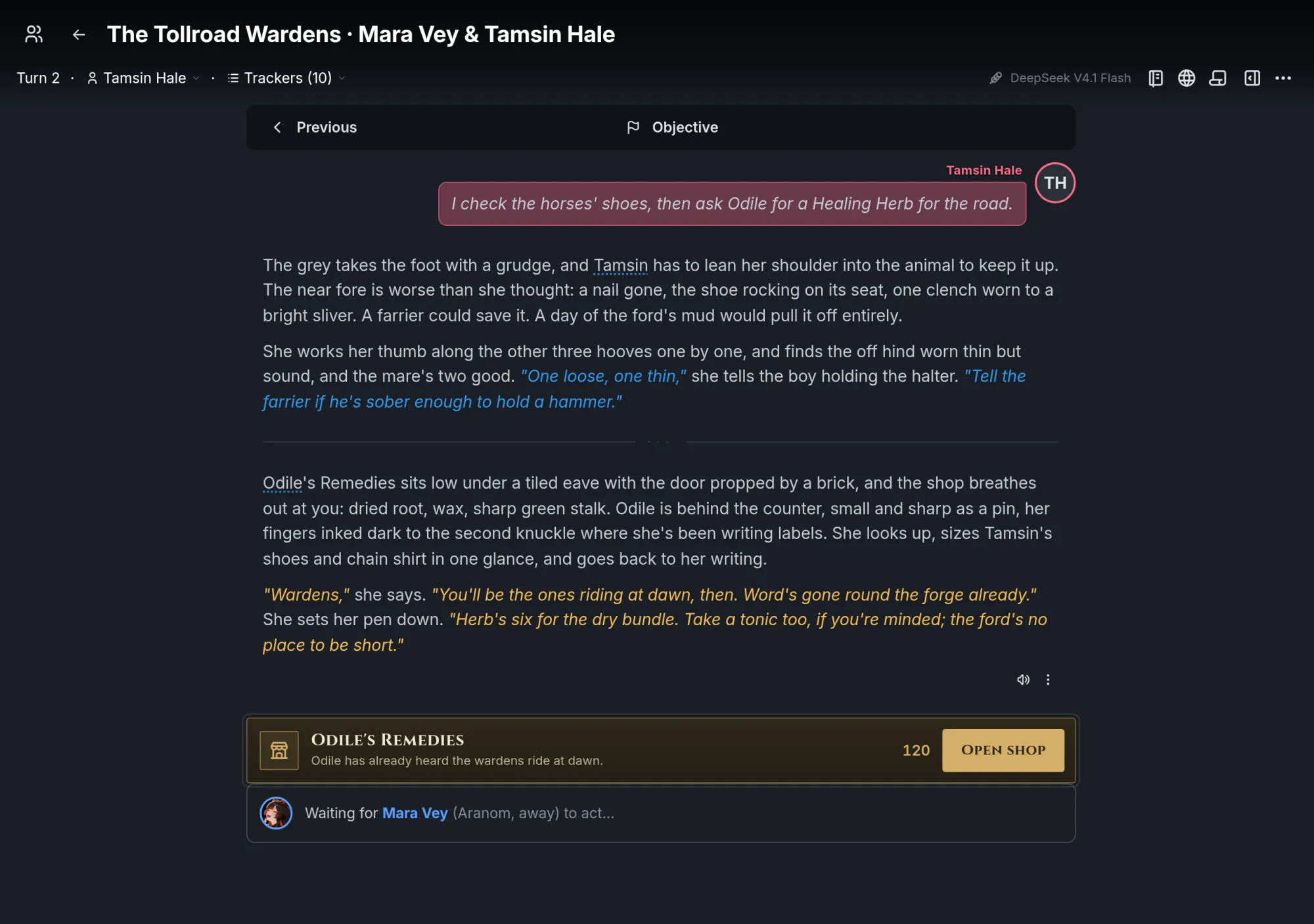
A guest buys for their own character. The shop card shows to them on the latest turn, and the shop button is also there while they wait for their turn. See Shops and Trainers.
Whose money
The game looks for a guest's money in this order:
- A row of their own. A row on the guest's character that holds a number and is named like your currency. That money is theirs alone. A Gold row from the sheet starts at its default value for a guest.
- The shared purse. When the currency is a shared tracker of the world, every member pays from it, and it drops for everyone.
- Nothing. When the money is a tracker of the host's character alone, a guest has none.
In the third case the card reads Only Mara carries money here. and the buy buttons stay off. A purchase that gets through anyway is refused with Your character carries no money here.
Money is the choice that matters most for shopping. If guests should shop in your world, put the currency on the sheet or make it a shared tracker. See Trackers.
Quest money follows the same rule. When guests' characters carry their own money, what a quest pays is split evenly between the characters who carry it. A shared purse takes the whole amount, and money on the host's character alone all goes to the host. See Party play on the Quests page.
Where a purchase lands
- Items go into the party's one bag.
- An upgrade raises the buyer's own row. Upgrades are counted per member, so the host can still buy the same one.
- An ability lands on the buyer's sheet.
- A lesson is owed to the buyer's character. The storyteller is told which lessons that character has paid for and not yet been taught.
- Requirements and level gates read the buyer's own level and skills. The host's purchases read the host's.
A guest's purchase carries their character's name. The Bought: line reads "Practice Staff for Tamsin Hale", and the receipt has a line such as For Tamsin Hale.
Enemy levels
Each player is compared with their own character. Map pins, the place and scene cards and the chip in visual novel mode read the viewer's own level, a guest's included. See Encounters.
The storyteller reads one level for the whole group: the strongest player character, among the host's and the living guests'. Companions are not counted.
Say Mara is level 5 and Tamsin is level 9, in a place with enemy levels 4 to 6. On Mara's screen the place reads as in range. Nothing marks it on Tamsin's screen. The storyteller is told that the strongest player character is level 9, well above the place.
Fights
The player's side is the host's character, the companions and the guests' characters. They never target one another. See Fights.
- Who acts. An act with no name is the acting player's character, so on a guest's turn it is the guest's. Each character acts once per exchange.
- Rewards. Experience goes to the host's character and to every member who earns it. Loot goes into the party's one bag. The fight card prints the host's line first, then one line per other member: when Tamsin finishes a Boar worth 70, it reads "Mara Vey +70 Experience", then "Brannoc +70" and "Tamsin Hale +70". Each player sees their own character's line lit.
- Out of the fight. A guest's character follows the player setting, not the out rules of NPCs. When that setting marks the player out, a guest whose Health empties is out under the word in Shown as, or Down when it is blank. On The story decides and A beat decides, the game does not mark them out, and with A beat decides a beat with A player character is defeated catches a guest's fall (see Defeat and respawn). When the storyteller takes a guest's character out without a word of its own, the same word applies. A heal brings them back. A guest who is out cannot act. See When the player's Health is empty.
The out needs the game to read the Health row.
The fight difficulty of a journey is the host's to change. For a guest the control is greyed out, with the line "Only the host can change this." See Difficulty.
Statuses
Each guest's character carries its own statuses. They count down on its own sheet, and a status that stops a move holds that character's own move. Everyone sees the same chips and cards, and each player reads their own character as "You". The line that says a character cannot act shows to the player whose character is held. A status that changes dice checks does not change a guest's checks yet.
The party screen and what stays with the host
On a guest's party screen, the first plate is the host's character, marked "Played by" with the host's username. The guest's own plate reads "You", other guests' plates read "Played by" with their usernames, and the host's companions follow.
A guest owns no companions. The following stay with the host:
- Companions. Only the host sees Remove from party and Bring back, and only the host spends a companion's points.
- Corrections. Edits in Memory and edits to the cast are the host's.
- The bag. The party's one bag is the host character's inventory.
A guest's character cannot be removed, by the host or by the storyteller.
What the storyteller decides and what the game settles
The storyteller decides:
- Whose action matters in a turn, and who acts in a round of a fight.
- Levels and Experience amounts.
- When a paid lesson is taught.
- Taking a character out of a fight by the story.
The game settles:
- Who may buy and who may spend points.
- Where a guest's money comes from.
- What each player sees of their own sheet.
- Where Experience, loot and points go.
- The sides of a fight and the out of each player's character.
- The level each player is compared with.
- The default caster and the default fighter on a guest's turn.
Common mistakes
- Money on the host's character alone. Guests then read Only Mara carries money here. and cannot buy. Put the currency on the sheet or in a shared tracker.
- Expecting one purse from a sheet row. A Gold row on the sheet gives each guest their own Gold, starting at the row's default. A shared tracker is the single purse.
- Counting on a guest's abilities without a sheet per character. Without Per-character sheets, a guest's character uses no ability from the catalogue.
- A starting skill that is not named like the ability. A guest's character knows an ability only through a skill that carries its name.
- Giving each character their own reagents. Whoever casts, the item comes out of the party's one bag.
- Expecting Defeated on a guest's character. A guest goes out under the player's out word, Down when it is blank. On The story decides or A beat decides, the game never marks them out by itself.
- Leaving Party system off. Guests then earn no Experience and no points of their own.
- Sizing a dangerous place for the host alone. The storyteller reads the strongest player character, guests included.
Frequently asked questions
Difficulty
Learn how a world setting option can change how fights play in an Imagina RPG world, covering the Add difficulty setting button, the Fight rules group on an option, narrative battles, damage percentages, stacking settings and how the host switches during a journey.
Upgrade with Ima
Move an older RPG world onto per-character sheets with the Upgrade with Ima button or the /rpg-upgrade command, with what Ima asks, what it changes and what to check afterwards.