Levels, experience and points
Learn how levels, experience and level-up points work in an Imagina RPG world. Covers the built-in trackers, points per level, spending from the character sheet, companions' points, and the editor warning about levels the game cannot read.
Beta
The RPG system is in beta and only accounts with the RPG beta can set it up. It may still change.
Levels and points let a world pay stat points and skill points each time a character levels up, keep an Experience counter and the two point pools as ready-made trackers, and let the player spend those points from a window on the character sheet. By default the storyteller decides when anyone levels and how much experience they earn, and a level can also rise by itself at an amount of Experience. The game pays the points, never pays the same level twice while the built-in trackers are on, and checks every spend.
Experience levels no one by default
Out of the box there is no experience curve. Experience is a number the storyteller raises, and a level is whatever the storyteller sets. A level can rise by itself at an amount of Experience when it sits on a progression track set to At an amount of Experience. See Progression tracks. Without one, if your world wants 100 experience per level, write that rule down for the storyteller. The game will not enforce it.
Turning it on
On the Features page of the RPG game system group, with Enable the RPG game system on, step 1 holds the card for this piece: Level-up points. It needs two other cards on, Character stats and Levels and identity. Without them its switch is disabled and it shows the chip "Needs Character stats and Levels and identity", with a Turn them all on button. All three are on in every set but Story with a sheet, which leaves Level-up points off.
With Levels and identity off, no character has a level, so nothing is ever paid.
Linked fields
The settings sit on the Linked fields page of the same group. Each row is one thing the game needs to find on a character, and four rows matter here:
- Level: where a character's level is read.
- Experience: the number a beaten enemy pays into. With several progression tracks, each track has its own, and a beaten enemy pays every one.
- Stat points: the pool a level-up fills for raising stats.
- Skill points: the pool a level-up fills for ranking up skills. The row shows only on a world that offers a Skills list.
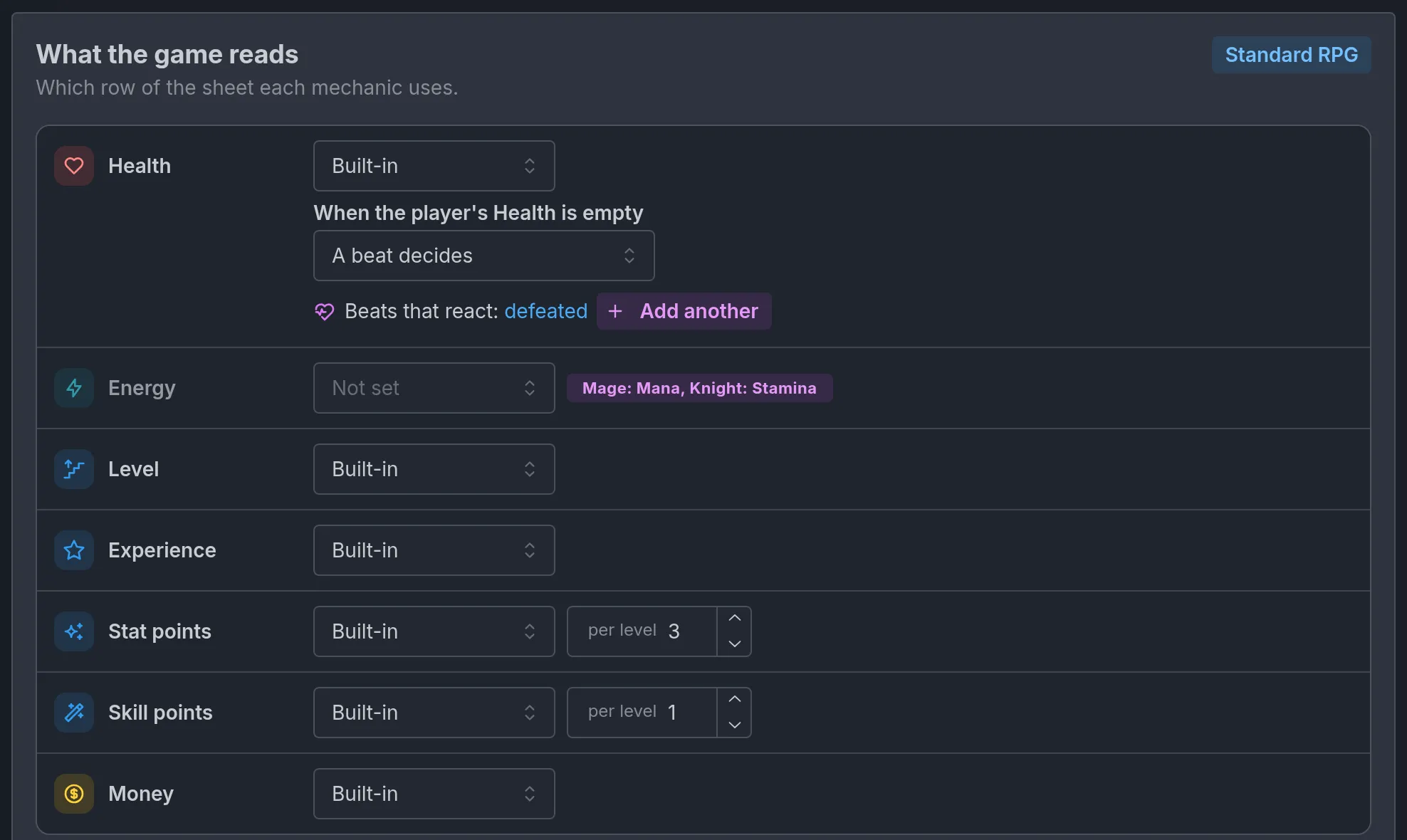
Each row has a picker that starts on Not set, with three choices:
- Built-in: the game supplies it. For Level, that is the level each character carries next to their class, race and title. For the other three, it is a ready-made tracker, described below.
- A tracker: one of your own trackers, chosen in a second picker (Pick a tracker). On a world that keeps a sheet per character, the choice reads A row of the sheet and the picker Pick a row. See Character sheets.
- None: the world does without it. On Level, the card notes "Nothing is granted or gated by level."
What you can pick depends on the row. Level, Stat points and Skill points take a counter or a stat tracker, or a number row of the sheet. Experience also takes a meter or a gauge, or a bar on the sheet. If the tracker or row is later renamed or deleted, the picker shows No such tracker or Not on the sheet until you choose again.
The Standard RPG button sets every row that has a built-in to Built-in in one click.
Points per level
Beside Stat points and Skill points, a per level field sets how many points one level pays. It takes a whole number from 0 to 20.
- Left empty on Built-in, the rate is 3 stat points and 1 skill point per level. The field shows that number greyed out.
- 0 means none.
- On a tracker or row of your own, type the rate yourself. Leave it empty only if another of the three rows is on Built-in, because then the default still applies.
A stat point is worth +1 on a stat. A skill point is worth one rank of a skill.
The built-in trackers
With the rows on Built-in, every new journey starts with up to three trackers on the host's character, all at 0:
| Tracker | What it holds | Added |
|---|---|---|
| Experience | Experience earned on the journey. | Always (unless a tracker of yours takes its place). |
| Stat Points | Unspent points for raising stats. | Always (unless a tracker of yours takes its place). |
| Skill Points | Unspent points for raising skills. | Only when the world has a Skills list whose Level column is in use. |
The names follow the journey's language. The host sees them in the Trackers window from the first turn, or on the character's sheet on a world that keeps one per character. The storyteller never prints these numbers in the prose. In a shared journey, a guest's character with a sheet has its own Experience count and the same kinds of point pools.
They are added when a journey starts. A journey already under way keeps the world it began with until its player updates it, and the ready-made trackers are never added to it afterward.
Using a tracker you already have
A starting tracker with the right name takes the place of the ready-made one. It keeps your name, kind, value, maximum and Update Instructions.
- Experience. The whole name must be XP, EXP, Exp, Experience or Experience Points (the equivalent word in several other languages works too). The tracker must hold a number. A meter such as 0/100 is fine. "Dungeon Experience" or "XP Points" do not match.
- The pools. Stat Points, Unspent Stat Points or Available Stat Points, and the same three with Skill, in English only. The tracker must be a counter or a stat, and not read-only.
When a tracker has another name ("Essence", "Renown"), set the row to A tracker and pick it. Experience from beaten enemies goes to your tracker. Set Stat points and Skill points to something other than Built-in as well, or the ready-made Experience still appears beside yours.
Do not author a tracker named exactly "Experience" or "Stat Points" beside a row you have bound to something else. A near-miss name has the same effect from the other side: a tracker called "XP Points" is not recognized, so a second Experience appears next to it.
How a level-up pays
The storyteller sets a level, or a track raises it at an amount of Experience. The game compares the new number with the highest level it has already paid on this journey, and pays the difference times your rates.
Take Mara Vey at the default rates. From level 2 to level 3 she receives 3 stat points and 1 skill point. From 2 straight to 5, she receives 9 and 3.
A few cases pay nothing:
- The first level. The first level a character is given is a starting point, not a level-up.
- A level-down. Nothing is paid and nothing is taken back.
- A level regained. If Mara drops from 5 to 3 and climbs back to 5, those levels were paid once already. Level 6 pays as normal.
- A level with no number in it. See the next section.
A level-up card the storyteller writes is decoration. The points are paid when the level changes, card or not. A level that rises at an amount of Experience gets its own card from the game.
With the Fights card on, a beaten enemy pays its experience once into the player's Experience and, with the built-in trackers on, into that of each party companion and, with Party system on, each guest's character that has a sheet. A Bandit worth 30 experience adds 30 to Mara's and 30 to Brannoc's. That moves Experience only, unless a track set to At an amount of Experience reaches its amount, and then its level rises after the fight. See Progression tracks and Enemies.
How a level is read
A level is free text: "Lv. 12", "Rank II" or "Tier 3 Adept" are all valid. To count levels gained, the game needs a number inside it.
| Written as | Read as |
|---|---|
| "Lv. 12", "Level 3", "Tier 3 Adept" | 12, 3, 3 |
| "Rank II", "Tier IV", "Rank XIV" | 2, 4, 14 |
| "3/10", "Level 3 (Rank II)" | 3, 3 |
| "Lv 1,000" | 1 |
| "Rank ii", "Rank XL" | Not a level |
| "S-rank", "Novice", "Master", "?" | Not a level |
The first run of digits wins. With no digits, the game looks for a Roman numeral: uppercase, standing on its own, made of I, V and X, from I to XXXIX. Anything else cannot be read.
A level the game cannot read pays no points. Ability, item and training requirements cannot read it either, and neither can encounters.
The editor warning
Under the Level row, the card lists each starting character whose level cannot be read, one line each. If Brannoc's sheet gave his level as "Master", the line would say:
Brannoc gets no points on a level-up: "Master" is not a number. Write it with one, like Lv. 3.
It means that character's level-ups pay nothing as things stand. Write the level with a number in it ("Lv. 3", "Rank II", "Tier 3 Adept"), or bind the Level row to a tracker or row that holds a number. For a companion, the level is the Level field of their sheet.
The warning covers player characters and the NPCs who start as companions with a sheet. It appears only while Level-up points is on and at least one rate is above 0. It leaves out:
- A blank level. The first level the story gives pays nothing anyway.
- NPCs who join the party later.
- Levels the storyteller writes during play. If it sets "Master" on turn 40, nothing is paid and nobody is told.
What the player sees
The call and the window described here show to each player for their own character, with Level-up points on, on a world that pays points the game knows. One of four things makes it so: the built-in trackers, a per level rate above 0, Per-character sheets, or a row picked in Linked fields. Money alone does not count. On any other world, such as one that keeps point trackers of its own and has none of these, points are spent in the story only, by the storyteller when a player asks.
The call to spend
When a character has points that can be placed, a row appears with a count and a Spend button: "4 points to spend", or "1 point to spend". On the sheet the count is the player's own, followed by the companions' when they have some, such as "1 point to spend (2 more in the party)". A player with none whose companions have some reads "2 points to spend in the party". Under a turn the count adds them all up. It shows:
- at the top of the Trackers window,
- under the character card in the header's character panel,
- under the turn that announces a level-up.
A small lit dot on the character in the header marks the same thing.
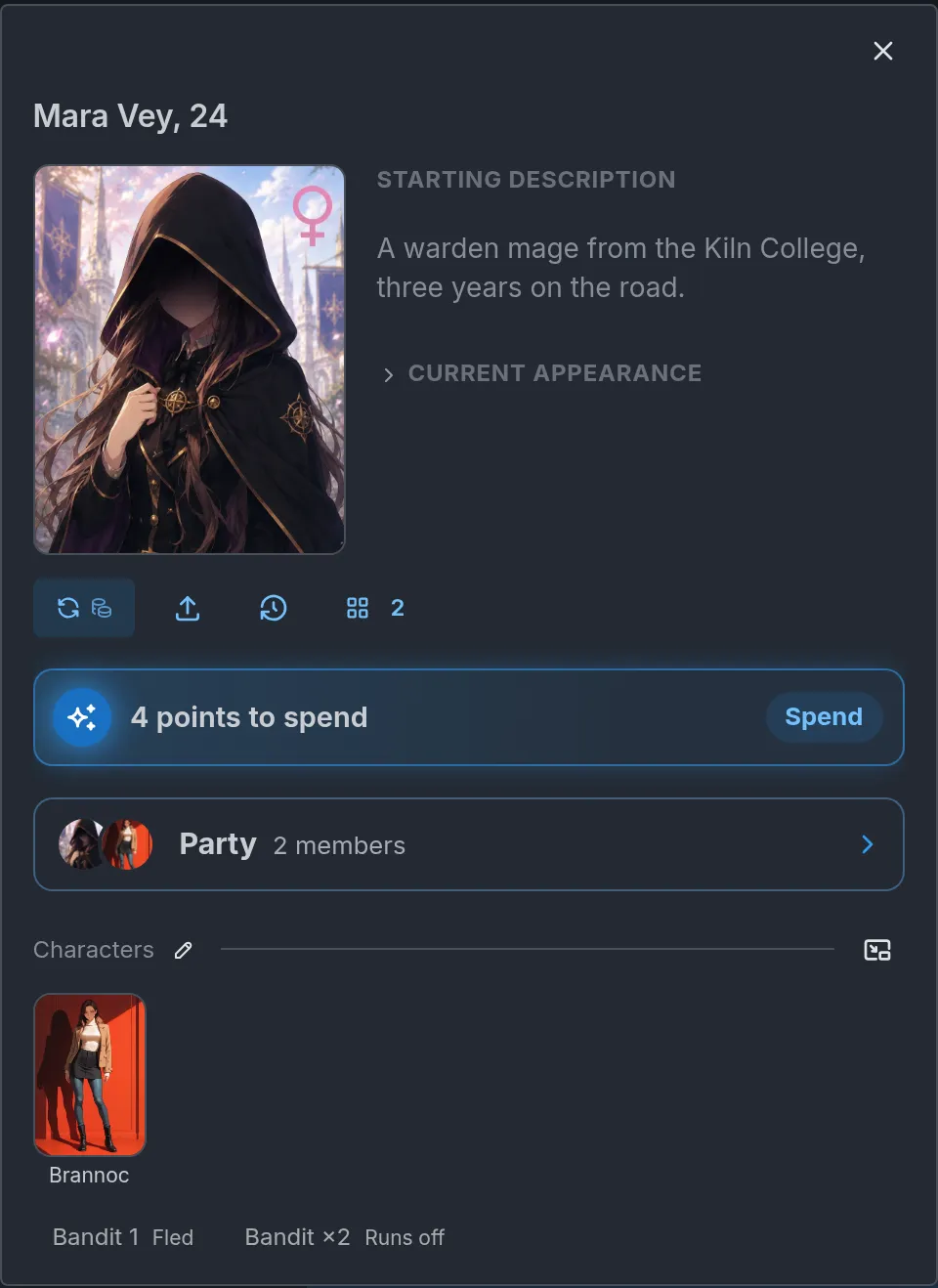
Only points with somewhere to go are counted. A stat pool with no stat to raise does not show a call.
The Spend points window
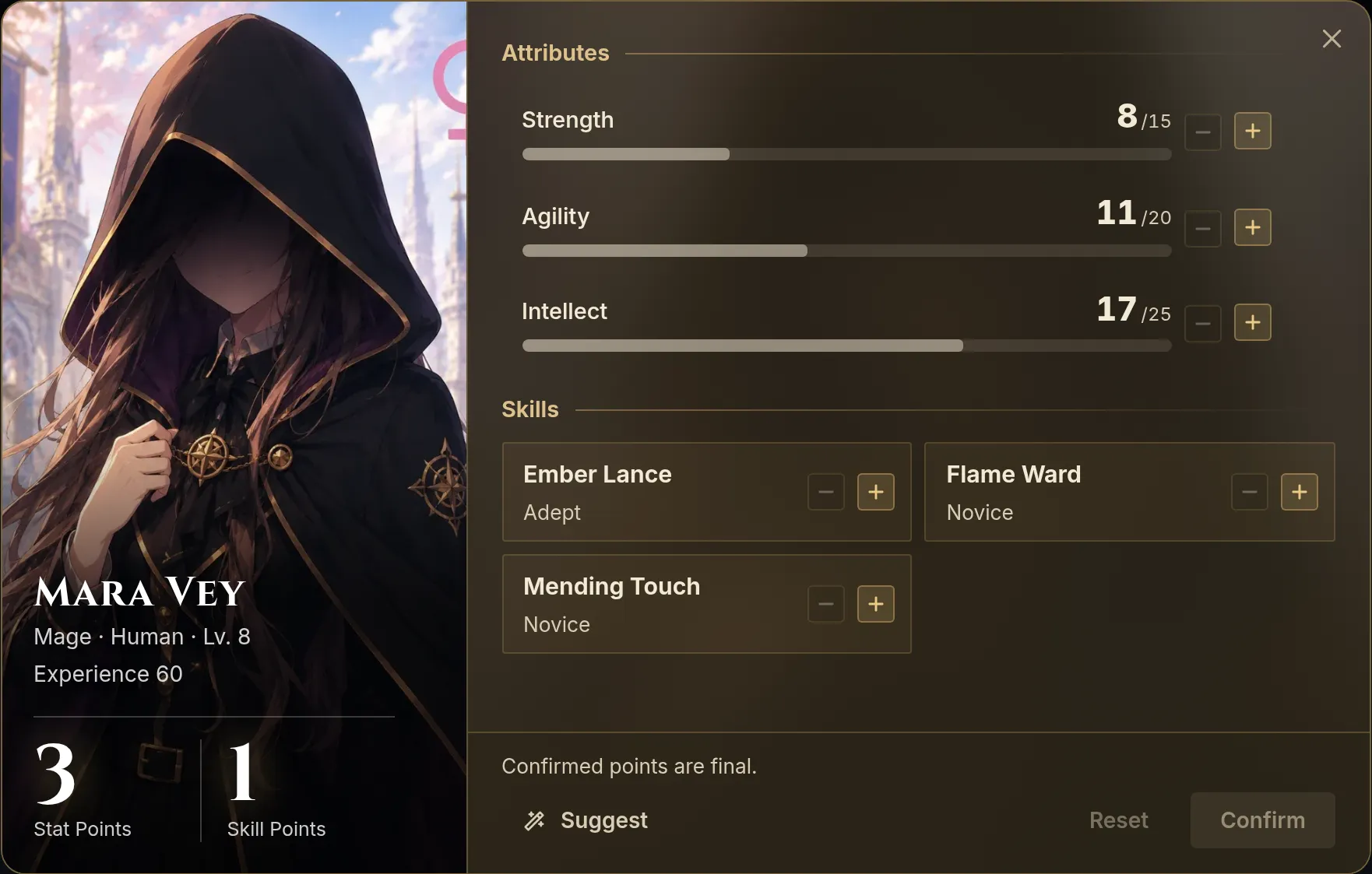
Spend opens the window on the first character with points to place. One side shows the portrait, the name, the class, race and level, the character's Experience, and the points left in each pool. The other side holds what can be raised:
- Stats (or your own table's title): a bar per stat with its value, its cap when it has one, a plus and a minus.
- Skills: a chip per skill with its rank and a plus and a minus. Pending points show as "Rank 2 › 3". A skill at the top of its ladder shows a crown and Highest rank.
At the bottom sit three buttons, Suggest, Reset and Confirm, under a note that reads "Confirmed points are final." When a spend is refused, the note gives the reason instead.
When several characters have points, a strip of portraits heads the window, the player first. Choices made on one character are kept while looking at another, and each character has their own Confirm.
What can be raised
Stats. Only a tracker of the stat kind that holds a number, and is not hidden, concealed, read-only or a variable. Counters, meters and gauges cannot be raised, which includes Experience and the pools themselves. On a world that keeps a sheet per character, the sheet's number rows count. The cap is the stat's own maximum, and a stat with no maximum has no cap. See Trackers.
Skills. Only skills already on the sheet and not hidden. The player learns new skills through the story. Each point is one rank:
- along the ladder, when the Skills table's Level column is a list of choices such as Novice, Adept, Expert,
- or one higher on a trailing number ("Rank 3" becomes "Rank 4"). A skill with no rank yet goes to "Rank 1".
A skill at the top of its ladder, or with a free-text rank that has no number, cannot be raised. On a world with no Skills list, or whose Skills table has no Level column, there is no skill pool and the window handles stat points only.
Suggest, Reset and Confirm
Suggest fills in a spread at no cost. Nothing counts until Confirm, and the spread can be edited or cleared with Reset. It leans on the stat that scores best for the character, counting how many of their skills read like it, whether their class reads like it, whether the world's dice checks roll on it, and how high it already is. Two thirds of the stat points go to that stat and the rest to the next one, never past a cap. The note above the buttons gives the reason, such as "Leans on Intellect, like your class".
Confirm is final. It takes no turn and no credits, and it is refused while a turn is being written. The one way back is to undo the turn the spend was made on, which returns the points.
On the next turn the storyteller is told once what was spent and is asked to show the change with one short beat in the prose, without numbers.
Companions' points
With Party system on, a companion in the player's party levels the same way. When the storyteller raises Brannoc from level 4 to level 5 at the default rates, he gets 3 stat points and 1 skill point of his own. His sheet in the cast shows a line such as "Experience 40 · 3 stat points unspent · 1 skill point unspent", which every player can read. With progression tracks, his Experience moves into a list of his levels and the line keeps the unspent points.
With the party system off, nobody is in a party. A companion is then an NPC with a stat block whose Threat / disposition reads friendly, such as "Allied" or "Friend", and a level-up still pays them points of their own. Experience from fights follows the same reading.
The host spends them in the same window, by picking the companion in the strip of portraits. A companion's stat cannot rise above the player's stat of the same name. With a sheet per character and the party system on, the points go on the companion's own rows, and the cap is that row's cap.
What it takes:
- The NPC has a sheet, is alive and is in the party. With the party system off, a friendly reading on their stat block stands in for the party. An enemy or a fallen NPC gets nothing. See Party.
- The player has a pool of that kind. With the rows on Built-in, that is always the case.
- Skill points are paid to companions only on a world where skills have ranks.
In a shared journey with Party system on, a guest's character earns Experience and level-up points like a companion, and the guest spends them from the same window, for their own character only. The host spends for their own character and their companions, never for a guest. See Playing together.
What the storyteller decides and what the game settles
The storyteller decides:
- when a character levels, up or down, by how much, with or without experience behind it, except on a track that rises by itself at an amount of Experience,
- how much experience is earned, and when, except what a beaten enemy pays,
- what to spend points on when the player asks it to, or when the story calls for it. Unlike the player, it can also teach a new skill with a point.
The game settles the rest by itself:
- It pays the points when a level rises, at your rates.
- It remembers the highest level paid on the journey, so a level lost and regained is not paid twice.
- With the built-in trackers on, it refuses once when the storyteller tries to add the same points by hand on the turn of a level-up. A real gift of points from the story still goes through, and so does a loss.
- It checks every spend against the pools, the caps and the rank ladder, for the player and the storyteller alike.
- It stops the storyteller from repeating a spend the player already made from the sheet.
Undoing a turn undoes its level-up: the points paid on that turn go back.
Limits
- Points per level: a whole number from 0 to 20, for each pool.
- A level the storyteller writes: up to 24 characters.
- Skills on a sheet: up to 24 for the player and 16 for a companion.
Common mistakes
- Expecting experience to level the character. Unless the level sits on a progression track set to At an amount of Experience, nothing turns experience into a level except the storyteller. Add a track (see Progression tracks), or put your thresholds in the Update Instructions of your own experience tracker or in your world's instructions.
- A level with no number in it. "Novice" or "S-rank" reads well and pays nothing. Write "Lv. 3", "Rank II" or "Tier 3 Adept".
- Stats built as counters. Points only go into trackers of the stat kind. With Strength as a counter, the pool fills and the call to spend never appears.
- A stat that is hidden or read-only. It cannot be raised from the window either.
- An experience tracker with a near-miss name. "XP Points" or "Renown" is not recognized by name. Bind it on the Experience row.
- Skill points with no ranks to buy. Without a Skills list and its Level column, no skill pool exists.
- Counting on a guest's character with no sheet. A guest's character earns points only with Party system on, a sheet of their own and a pool of that kind on the journey.
Frequently asked questions
Character sheets
Learn how each character of your Imagina world gets a sheet of their own, with sheet variants, the rows the game reads as Health, Energy or Level, and the RPG game system group on character pages.
Progression tracks
Learn how to give your Imagina world more than one level, each with its own Experience. Covers the main track, adding a track, levels that rise at an amount of Experience, what each level adds, Experience from beaten enemies and quests, and what players see.